A buyer comparing a 125mm, 160mm, and 200mm pad printer may assume that the larger number simply means a larger printable image. That is not how pad printing machine sizing works.
Pad printer stroke size generally describes the available front-to-back working travel of the printing mechanism, not the maximum logo size that the machine can print. A longer stroke provides more movement space for the pad, plate, fixture, or product configuration, but actual printing capability also depends on the printing plate, ink cup, silicone pad, product geometry, and machine design.
In practical terms:
- A 125mm pad printer is commonly suited to compact products and relatively small printing areas.
- A 160mm pad printer provides additional travel and more flexibility for medium-sized products or larger printing configurations.
- A 200mm pad printer is usually considered when the machine needs more working clearance, a longer plate configuration, a larger product, or a more complex multi-color setup.
Choosing the correct pad printer stroke size is therefore a machine-configuration decision rather than simply choosing the largest number available.
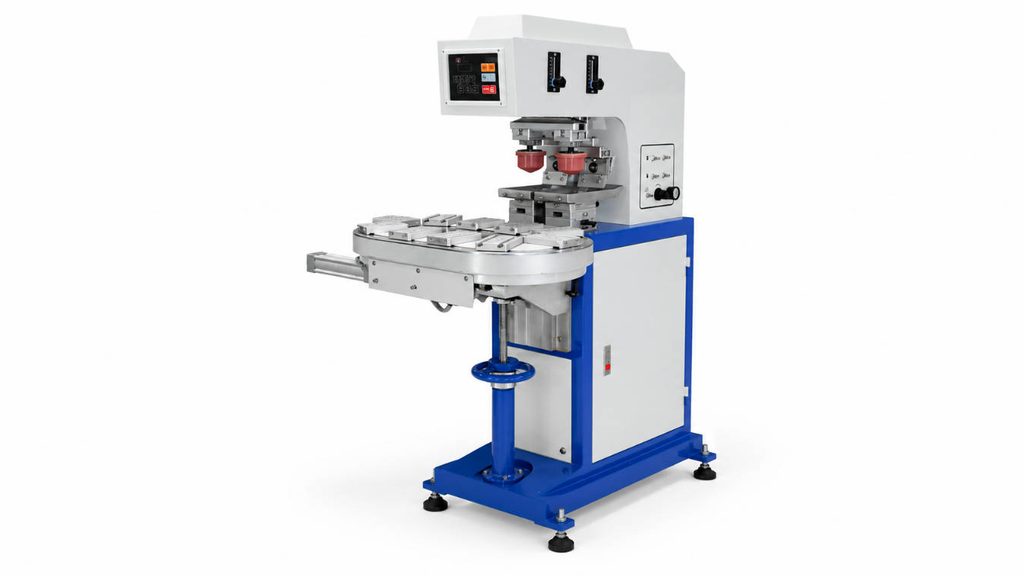
First: What Does “125mm, 160mm or 200mm Stroke” Actually Mean?
In a conventional pad printing cycle, the silicone pad must move between the cliché area and the product printing position.
The machine therefore requires enough travel to:
- move into the image pickup position;
- pick up the inked image from the cliché;
- travel toward the product;
- descend onto the correct printing location;
- return for the next cycle.
The specified working stroke describes part of this movement envelope.
This is different from maximum print area.
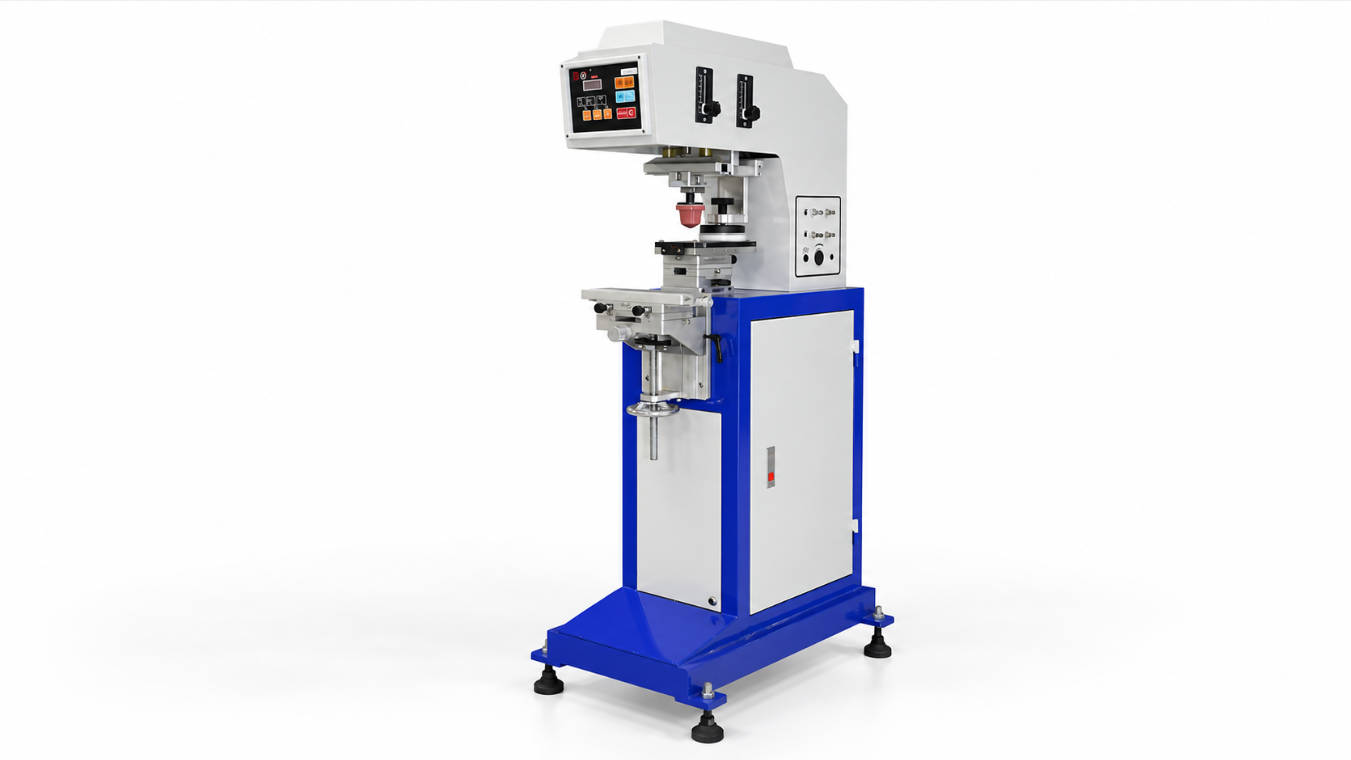
For example, ENGY’s current EN-C125/1 one-color closed ink cup pad printer uses a 125mm front-and-back working stroke while its published plate size is 200 × 100mm and its stated maximum printing size is Ø70mm. The EN-C160/1 pad printing machine uses a 160mm working stroke with a 250 × 100mm plate and a published maximum printing area of 100 × 75mm. These examples show why stroke and printable image size should not be treated as the same specification.
A 160mm stroke does not mean you can automatically print a 160mm-long logo, and a 200mm stroke does not automatically provide a 200mm print area.
That distinction should be understood before comparing machine models.
125mm vs 160mm vs 200mm Pad Printer at a Glance
| Selection Factor | 125mm Stroke | 160mm Stroke | 200mm Stroke |
| General machine positioning | Compact | Medium | Larger working envelope |
| Typical product requirement | Small parts | Small to medium products | Medium to larger or more complex products |
| Movement clearance | Lower | Moderate | Higher |
| Plate configuration | Usually more compact | Allows longer configurations | Can support larger/longer configurations depending on model |
| Fixture flexibility | Standard fixtures | Greater flexibility | More space for larger fixtures or layouts |
| Multi-color applications | Possible depending on model | Commonly adaptable | Useful where more travel is required |
| Machine footprint | Usually smaller | Moderate | Usually larger |
| Purchase consideration | Compact, straightforward jobs | Flexible general industrial use | Larger or special applications |
| Is stroke equal to print size? | No | No | No |
This table should be treated as a selection framework rather than a universal dimensional standard. Actual specifications depend on the individual machine.
When a 125mm Pad Printer Makes Sense
A 125mm machine is often a logical starting point when the products are compact and the printing location is easy to reach.
Think about applications such as:
- pens;
- small bottle caps;
- small plastic components;
- tags;
- buttons;
- electronic parts;
- compact promotional items;
- relatively small logos and markings.
The advantage of selecting an appropriately sized machine is not simply lower machine size.
A compact stroke can also make sense when the process does not require unnecessary movement. Excess machine capacity may provide no meaningful production benefit if the pad only needs to travel a short distance between a compact cliché and a small product.
A 125mm machine is particularly suitable when:
The logo is relatively small.
The product fits easily beneath the printing head.
The silicone pad does not require a large horizontal movement envelope.
The fixture is compact.
Production does not require an unusually long plate or large product clearance.
For small-part printing, choosing a correctly sized 125mm machine can be more practical than automatically moving to a larger machine specification.
However, buyers should still provide the product and artwork before assuming that 125mm is sufficient.
A small logo on a large product can sometimes require more stroke than expected because the machine must physically reach the required position on the product.
That leads to one of the most important machine-selection principles in this guide.
Product Size Can Matter More Than Logo Size
Imagine two printing jobs.
Product A is a small plastic cap with a 40mm logo.
Product B is a long plastic housing with exactly the same 40mm logo positioned far from the edge.
The artwork size is identical.
But the second product may require:
- more fixture space;
- more pad travel;
- different plate positioning;
- additional clearance around the product.
Therefore, selecting a machine only from artwork dimensions can lead to the wrong conclusion.
Pad printer stroke must be evaluated against both the print area and the physical distance the pad must travel to reach that print area.
This becomes particularly important for:
- long housings;
- tubes;
- handles;
- power-tool components;
- appliance parts;
- products with logos near one end;
- recessed printing locations.
Before choosing a machine, evaluate the complete product geometry instead of sending only an artwork file to the equipment supplier.
Why 160mm Is Often a Flexible Middle Option
A 160mm pad printer occupies an important position between compact equipment and larger-stroke systems.
For buyers whose products vary in size, the additional movement range can provide more flexibility without immediately moving into a substantially larger machine.
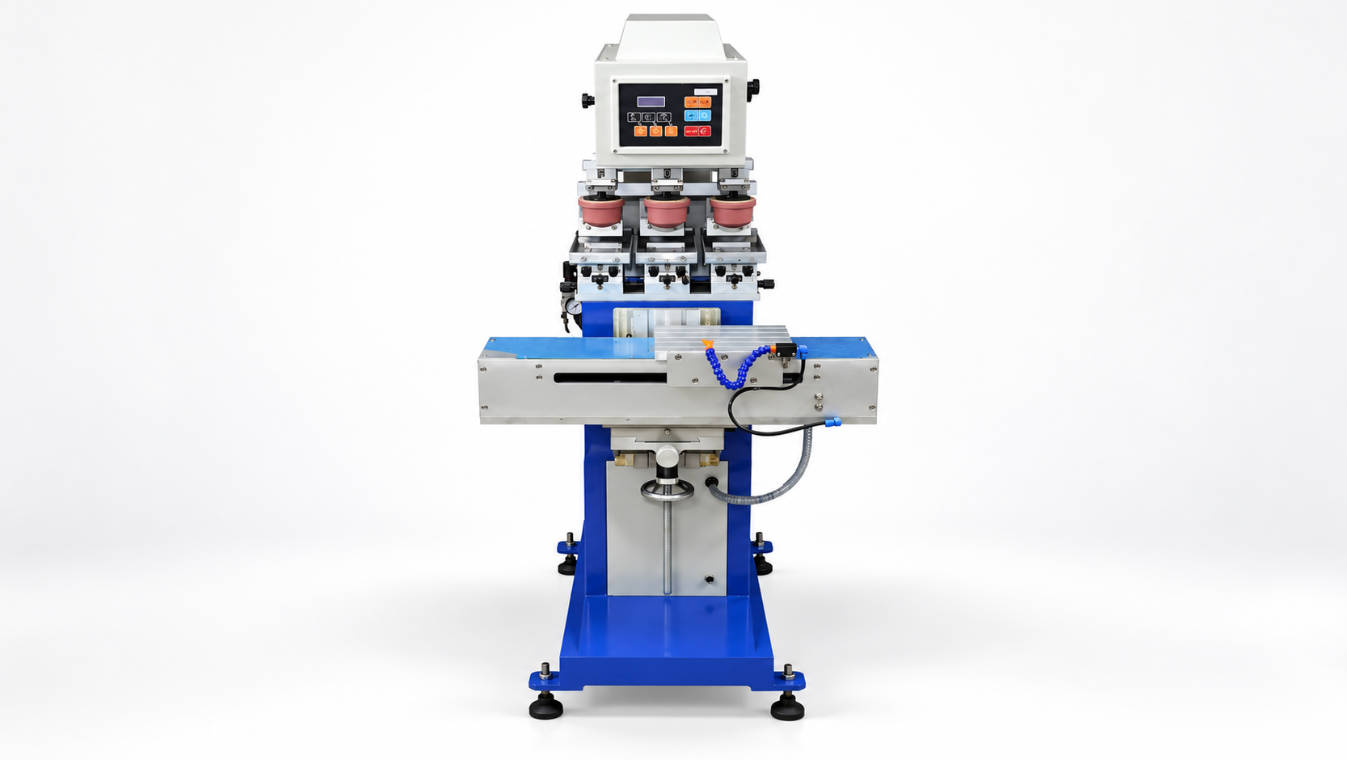
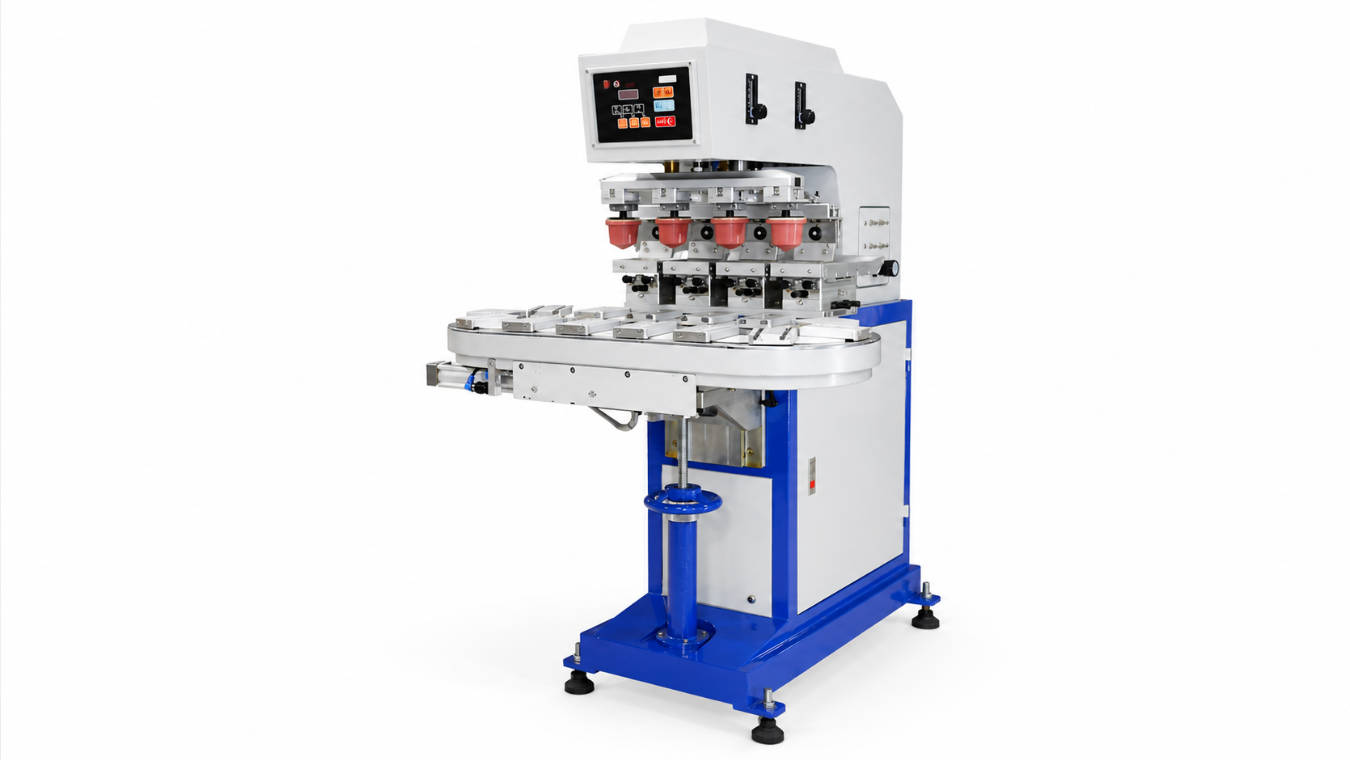
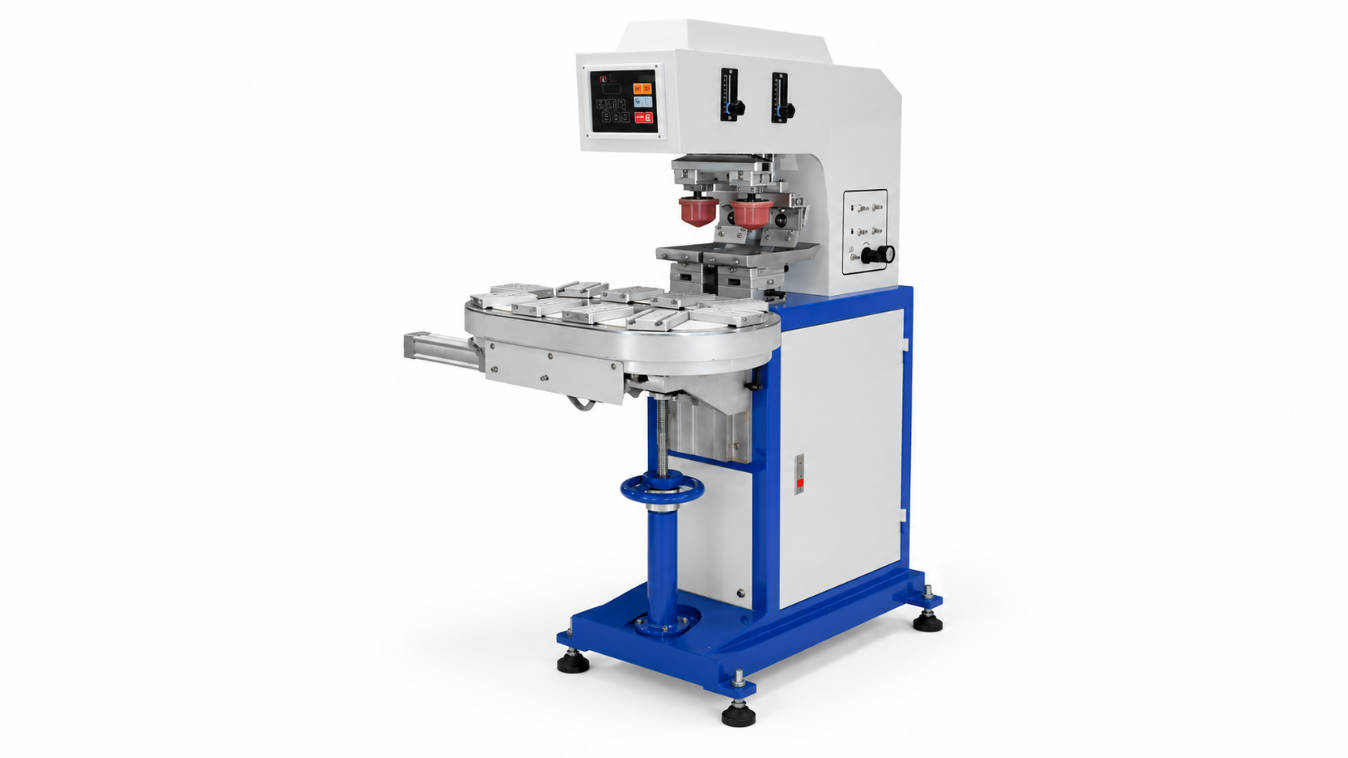
ENGY currently uses 160mm working-stroke configurations across several machine designs, including single-color and multi-color equipment. Its product range also shows 160mm machines used with conveyors and rotary fixtures, demonstrating that stroke size is only one part of the overall architecture.
A 160mm pad printer may be worth considering when:
Your product is larger than a typical small-part application.
Your print position needs additional horizontal reach.
You expect to process different product sizes on the same machine.
Your required plate configuration is longer.
A larger silicone pad needs more clearance.
You want additional flexibility for future jobs.
For many general industrial applications, this makes the 160mm class useful as a versatile machine configuration.
But buyers should not interpret this as meaning that 160mm is automatically the correct default.
A 125mm system may still be sufficient for a small application, while some products clearly require a 200mm or customized system.
When Should You Move to a 200mm Pad Printer?
The reason to move from 160mm to 200mm should normally be an engineering requirement, not simply the assumption that “larger is better.”
A larger working stroke becomes useful when more horizontal travel is needed between the cliché and printing position.
That requirement can come from several sources.
Larger Products
The machine may need additional space to clear the product or reach the print location.
Longer Printing Plate Arrangement
Some applications require a larger or longer cliché configuration. A longer machine stroke may be necessary to accommodate the movement.
Larger Pads
A larger silicone pad needs sufficient movement and surrounding clearance without contacting fixtures or machine components.
Multi-Color Printing
Depending on the machine architecture, additional colors, plate arrangements, conveyors, or product movement systems may increase the required travel.
Special Product Positioning
If the product has an unusual shape or the print location is difficult to reach, a larger movement envelope can create more configuration options.
ENGY’s customized pad printing machine options specifically describe 125, 160, 200 and even 250 machine-stroke options, reflecting the fact that different product geometries require different machine layouts.
Do You Need a Larger Stroke for a Larger Logo?
Sometimes—but not always.
This is one of the most important questions to answer before ordering.
A larger image may require:
- a larger cliché;
- a larger silicone pad;
- a larger ink cup or different ink system;
- more machine clearance;
- more rigid support.
These requirements can indirectly lead to the need for a larger machine stroke.
But stroke alone does not define whether the machine can transfer the image.
Check These Specifications Together
| Specification | Why It Matters |
| Front/back working stroke | Determines available travel |
| Maximum print area | Indicates the machine’s usable printing capability |
| Plate size | Must accommodate the etched artwork and ink system |
| Ink cup diameter | Limits usable image width in many closed-cup configurations |
| Silicone pad size | Must cover and transfer the complete image |
| Product dimensions | Affect clearance and positioning |
| Fixture size | Determines how the product can be held |
| Print location | Determines how far the machine must reach |
| Number of colors | Influences machine structure and movement |
| Production volume | May change the preferred automation configuration |
Stroke size should always be evaluated as part of the complete printing system rather than as an isolated specification.
A Better Way to Select Pad Printer Stroke Size
Instead of starting with “Should I buy 125mm or 160mm?”, start with the printing job.
ENGY’s existing pad printing machine selection guide similarly recommends evaluating the product shape, printing size, number of colors, production capacity and fixture design before choosing the machine.
Step 1: Measure the Product
Provide:
- overall length;
- width;
- height;
- curvature;
- any protruding or recessed areas.
A dimensional drawing is more useful than a general product description.
Step 2: Define the Exact Printing Location
Specify where the logo sits on the product.
A photo with the printing position marked is often useful.
Two products with the same dimensions may need different machine travel if their print positions differ.
Step 3: Provide the Artwork Size
State the actual length and width of the printed image.
Do not provide only the product dimensions.
Step 4: Confirm the Number of Colors
A one-color logo and a four-color graphic may require completely different machine layouts even on the same product.
Step 5: Define Production Capacity
State the expected output:
- per hour;
- per shift;
- or per day.
Stroke selection should not be separated from production planning. A machine may physically print the product but still be unsuitable for the required production rate.
Step 6: Consider Loading and Automation
Determine whether products will be:
- manually loaded;
- moved by shuttle;
- transported by conveyor;
- indexed on a rotary table;
- automatically fed.
These systems change the required space and machine architecture.
Step 7: Test the Real Product
For complex applications, sample testing can resolve uncertainties that cannot be answered reliably from dimensions alone.
ENGY’s custom pad printer service outlines a process based on receiving customer requirements, designing the machine solution, confirming the configuration and performing sample printing before delivery.
125mm vs 160mm vs 200mm: Practical Selection Scenarios
| Printing Requirement | Likely Starting Point | Why |
| Small logo on compact product | 125mm | Compact movement requirement |
| Pen, cap, small electronic part | 125mm | Often fits smaller machine envelope |
| Medium plastic housing | 160mm | Additional movement and fixture space |
| Several product sizes on one machine | 160mm | More configuration flexibility |
| Logo located farther inside a long product | 160mm or 200mm | More reach may be needed |
| Larger fixture or pad | 200mm | Additional movement clearance |
| Long plate configuration | 200mm or custom | Larger travel may be required |
| Complex multi-color application | 160mm / 200mm / custom | Depends on station layout |
| Very large or unusual product | Customized | Standard stroke may not be sufficient |
The phrase “likely starting point” is deliberate.
Machine selection should still be verified with the exact product and printing requirement.
Three Common Stroke-Selection Mistakes
Mistake 1: Treating Stroke as Maximum Print Length
This can result in purchasing a machine that cannot accommodate the real artwork, plate, or pad configuration.
Always check the published maximum printing area separately.
Mistake 2: Sending Only the Logo Size to the Supplier
A 30mm logo does not tell an engineer whether the product is 40mm or 400mm long.
Provide both the product dimensions and the exact printing location.
Mistake 3: Buying Extra Stroke “Just in Case”
A larger machine may offer more working space, but additional capacity should have a purpose.
Machine footprint, investment, plate configuration, cycle movement and production workflow should all be considered.
Selecting equipment close to the actual process requirement is generally more useful than treating the largest specification as automatically preferable.
What Information Should You Send Before Requesting a Quote?
A useful pad printer quotation should begin with real printing information.
Send the supplier:
| Information | Example |
| Product dimensions | L × W × H |
| Product material | ABS, PP, metal, glass, etc. |
| Artwork dimensions | Length × width |
| Number of colors | 1, 2, 4, etc. |
| Printing location | Top, side, curved area, recessed area |
| Product photo | With printing position marked |
| Required output | Pieces/hour or pieces/day |
| Loading method | Manual or automatic |
| Current printing problem | If replacing an existing machine |
| Future product range | If one machine must handle multiple parts |
This information allows the supplier to evaluate whether the application requires a 125mm, 160mm, 200mm or customized machine.
FAQ
What does 125mm stroke mean on a pad printing machine?
A 125mm stroke normally refers to the machine’s front-to-back working travel specification. It does not mean the machine can print a 125mm-wide image.
Is a 160mm pad printer able to print a 160mm logo?
Not necessarily. Maximum print area depends on plate size, ink cup configuration, pad size, machine design and other factors. Check the machine’s stated maximum printing area separately from stroke.
Should I choose a 200mm pad printer for a large product?
Possibly. Large products often require more working clearance, but the correct stroke also depends on the location and size of the artwork, fixture layout and silicone pad movement.
What is the difference between a 125mm and 160mm pad printer?
The 160mm machine provides additional working travel. Depending on the model, it may also use a larger plate or offer more space for different product configurations. Exact specifications should be compared model by model.
Does pad printing machine size affect printing quality?
Machine size alone does not determine print quality. Fixture stability, pad selection, cliché quality, ink condition, machine rigidity and correct setup all affect the final result.
How do I calculate the pad printer stroke size I need?
There is no reliable calculation based only on logo width. Evaluate product dimensions, print location, pad dimensions, plate arrangement, fixture space and machine movement together.
Is a larger pad printer always better for future products?
No. Additional stroke can provide flexibility, but a larger machine is useful only if future products genuinely require the extra working space or configuration.
Final Selection: Do Not Choose the Machine by One Number
The comparison between a 125mm, 160mm and 200mm pad printer looks simple on a specification sheet, but the correct choice depends on the geometry of the entire printing process.
For a compact product and small logo, a 125mm machine may provide all the working travel required.
For manufacturers handling a broader range of products, 160mm can provide additional configuration flexibility.
When products, pads, fixtures or plate arrangements need substantially more clearance, a 200mm or customized machine may be more appropriate.
The correct pad printer stroke is the one that provides sufficient travel for the actual product, pad, cliché and fixture configuration—not simply the largest stroke available.
Before ordering a machine, provide the product dimensions, artwork, print position, colors and target production capacity so the complete pad printing configuration can be evaluated.