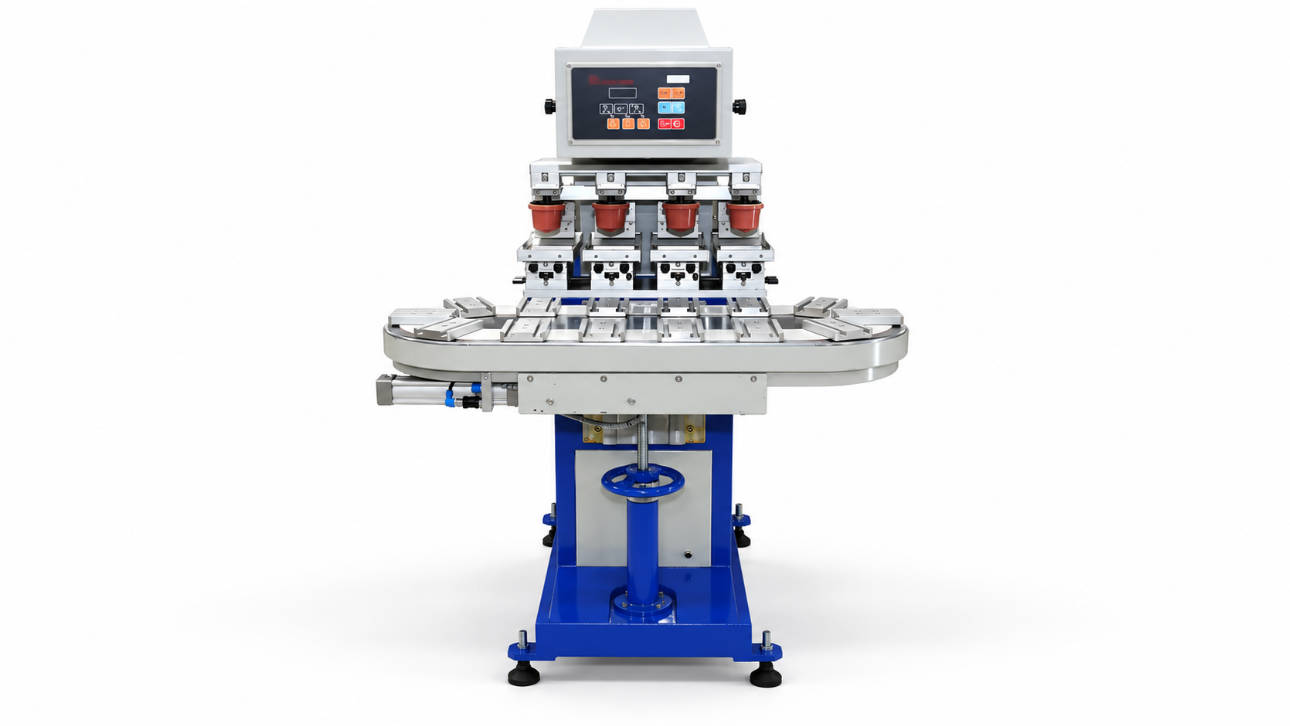
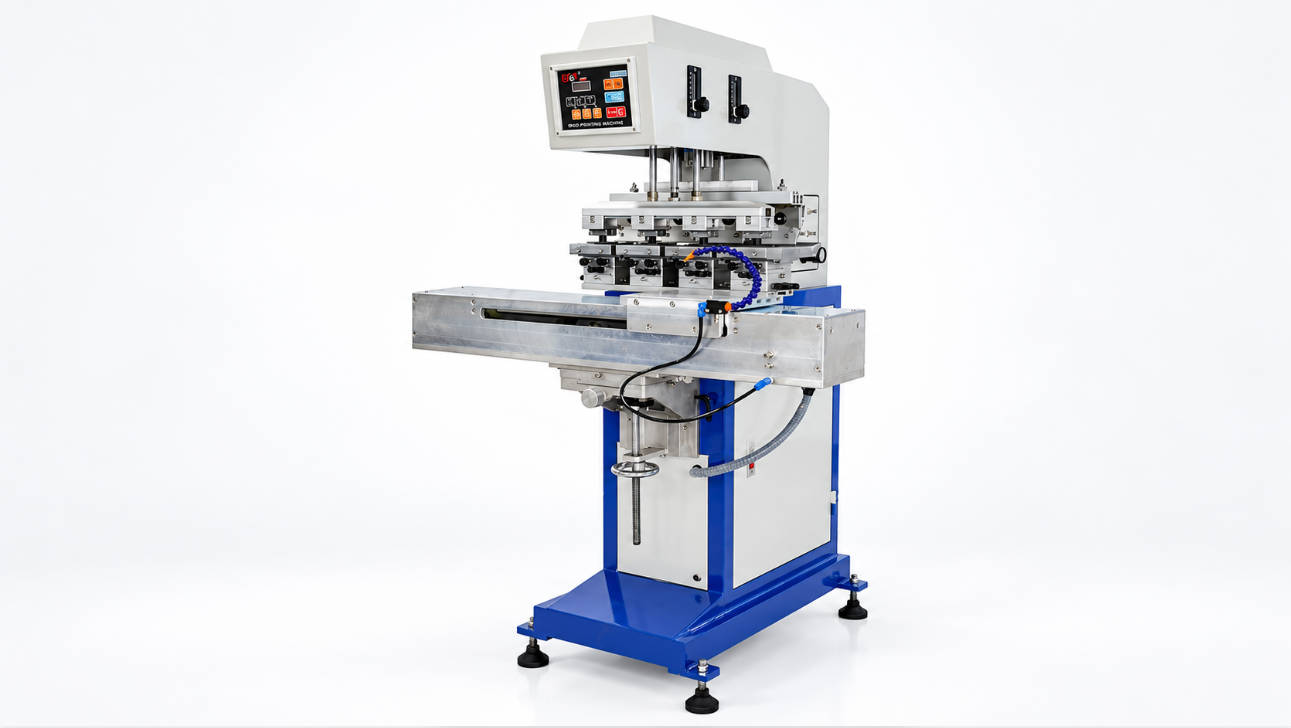
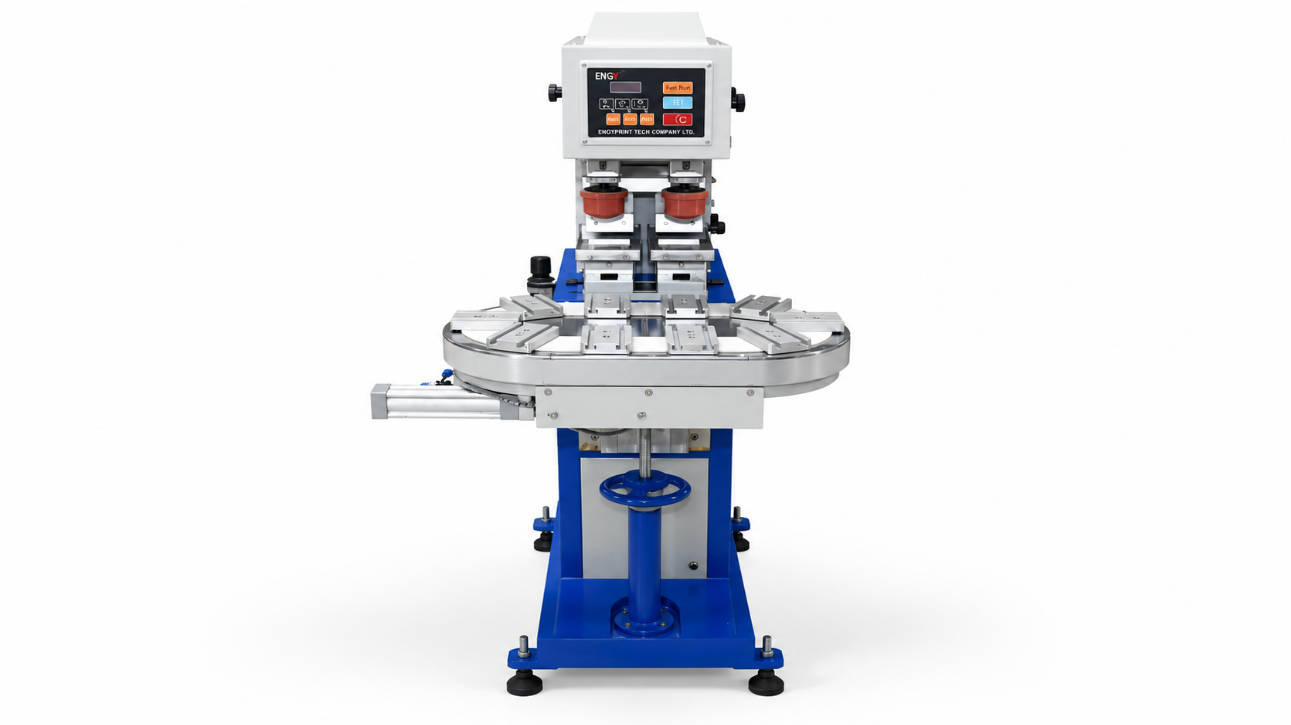
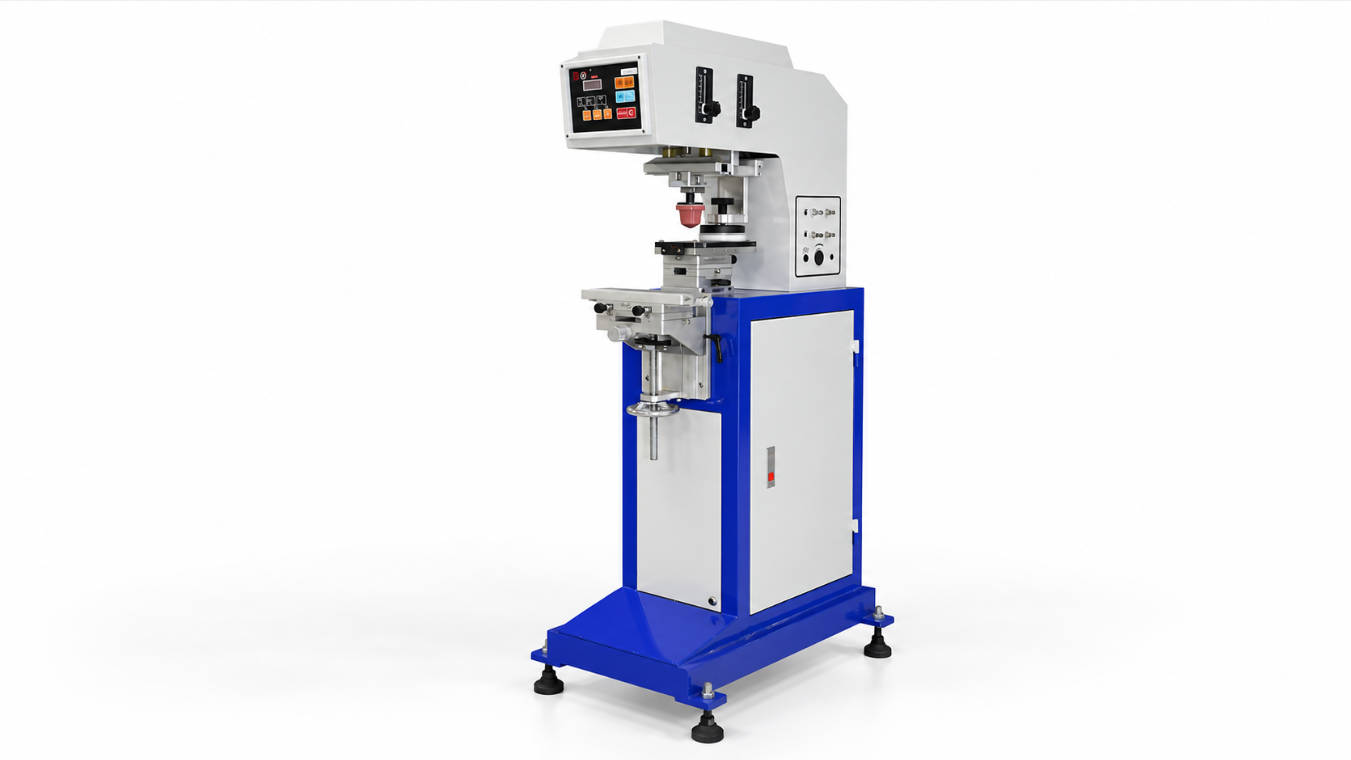
When manufacturers need to increase pad printing output, choosing the right machine structure becomes an important production decision. A rotary pad printing machine and a shuttle pad printer can both achieve reliable industrial printing results, but they are designed for different production requirements.
A rotary pad printing machine is generally designed for continuous, high-volume production with faster cycling and multi-station operation, while a shuttle pad printer is often preferred for flexible production where product loading, positioning, and process adjustments are more important than maximum output speed.
The right choice depends on several factors, including product shape, printing quantity, automation requirements, number of colors, and production workflow.
For manufacturers upgrading from manual or semi-automatic printing, understanding the differences between rotary and shuttle pad printers helps avoid investing in equipment that does not match actual production needs.
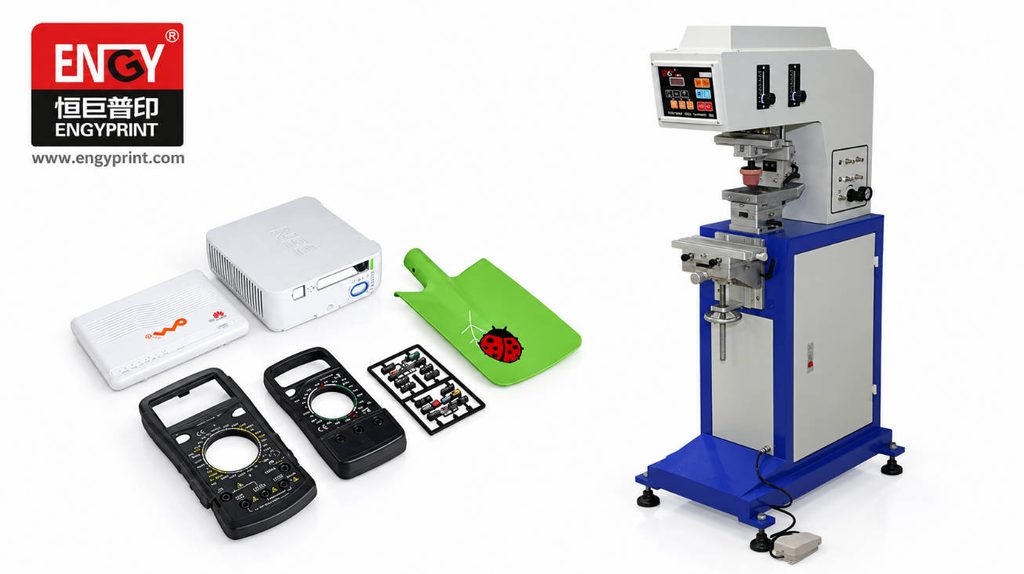
What Is a Rotary Pad Printing Machine?
A rotary pad printing machine uses a rotating mechanism to move products, printing pads, or workstations through different stages of the printing process.
Instead of completing each printing cycle in a single linear movement, the rotary structure allows multiple operations to happen continuously around a rotating table.
A typical rotary pad printing system may include:
- Product loading station
- Printing station
- Ink transfer station
- Unloading station
- Multiple printing positions
This design reduces idle time between cycles and allows products to move smoothly through the production process.
Rotary pad printers are commonly considered for applications where:
- Production volume is high
- Printing speed is important
- Products require repeated and consistent printing
- Automation integration is needed
For manufacturers producing thousands of similar components, the rotary structure can provide better production flow.
What Is a Shuttle Pad Printer?
A shuttle pad printer uses a reciprocating movement system where the product fixture or printing components move back and forth during the printing cycle.
The shuttle mechanism usually works by moving the product into the printing position, completing the print transfer, and then returning the product to the loading area.
This structure is widely used because it provides:
- Simple operation
- Easy product changeover
- Flexible fixture design
- Convenient maintenance
Shuttle pad printers are suitable for many industrial applications where product variety is high and production requirements change frequently.
Typical applications include:
- Plastic components
- Consumer products
- Electronic housings
- Promotional products
- Small and medium batch production
Rotary Pad Printing Machine vs Shuttle Pad Printer: Main Differences
The biggest difference between these two systems is the way products move during printing.
| Comparison Factor | Rotary Pad Printing Machine | Shuttle Pad Printer |
| Movement Structure | Rotating table or rotary station system | Back-and-forth shuttle movement |
| Production Style | Continuous production | Batch production |
| Output Efficiency | Suitable for higher output requirements | Suitable for flexible production |
| Product Changeover | Usually more involved | Easier adjustment |
| Automation Integration | Suitable for automated lines | Suitable for semi-automatic solutions |
| Fixture Quantity | Multiple fixtures/stations | Usually fewer fixtures |
| Space Utilization | Efficient for continuous production | More flexible layout |
| Maintenance Complexity | Higher system complexity | Simpler structure |
Production Efficiency: Which Machine Provides Higher Output?
Production efficiency is one of the main reasons manufacturers compare rotary and shuttle pad printers.
A rotary pad printing machine can improve efficiency because the printing process is distributed across different stations.
While one product is being printed, another product may be loaded or unloaded at another position.
This reduces waiting time and improves machine utilization.
For high-volume production with standardized products, rotary pad printing machines can provide advantages because they are designed for continuous operation and reduced cycle interruption.
However, output is not determined only by machine structure.
Actual production capacity also depends on:
- Number of printing colors
- Product loading method
- Fixture design
- Ink drying time
- Operator efficiency
- Automation level
A shuttle pad printer may achieve excellent efficiency when products require frequent adjustment or when operators need easier access during production.
Rotary Pad Printer for High Volume Manufacturing
Rotary systems are often considered when manufacturers have:
- Stable product designs
- Large order quantities
- Long-term production programs
- Requirements for consistent printing quality
Examples include:
- Bottle caps
- Cosmetic packaging components
- Electronic parts
- Automotive plastic components
- Consumer product housings
In these applications, reducing seconds from each cycle can create significant production improvements over long operating periods.
For manufacturers planning automated production lines, rotary equipment can also be integrated with:
- Automatic feeding systems
- Conveyor systems
- Robotic loading solutions
- Vision inspection systems
Shuttle Pad Printer for Flexible Production
Although rotary systems offer advantages in continuous production, shuttle pad printers remain widely used because flexibility is important in many factories.
A shuttle pad printer may be more suitable when:
Multiple Products Share One Machine
Factories producing different products may need frequent fixture changes and parameter adjustments.
A simpler shuttle structure can make product switching easier.
Production Volume Is Medium
Not every manufacturer requires maximum output.
For medium-volume production, a shuttle system may provide sufficient efficiency without unnecessary investment.
Product Shapes Are Complex
Some irregular products require manual positioning or special fixtures.
A shuttle design may provide easier access for operators during setup.
Automation Capability Comparison
Automation is becoming increasingly important in industrial printing.
Both rotary and shuttle pad printers can be integrated into automated production systems, but their advantages are different.
Rotary System Automation Advantages
Rotary machines naturally support continuous workflows because products move between stations.
They are suitable for:
- Automatic feeding
- Multiple printing stages
- Inline inspection
- Continuous production
Shuttle System Automation Advantages
Shuttle systems provide flexibility for customized automation.
They can be combined with:
- Robot loading
- Automatic fixture systems
- Product positioning devices
The better choice depends on whether the factory prioritizes production speed or process flexibility.
How Product Design Affects Machine Selection
The product itself is one of the most important factors when selecting between rotary and shuttle pad printers.
Consider:
Product Size
Large products may require more space for fixture movement and printing stroke.
Product Shape
Curved surfaces, irregular components, and complex positioning requirements may influence fixture design.
Printing Requirements
Products requiring:
- Multiple colors
- Multiple printing locations
- High registration accuracy
may need a more advanced machine configuration.
ENGY provides industrial pad printing machine solutions designed for different production requirements, including customized configurations based on product and process needs.
You can view available equipment solutions here:
industrial pad printing machine solutions
Key Factors to Consider Before Choosing a Rotary or Shuttle Pad Printer
Choosing between a rotary pad printing machine and a shuttle pad printer should not only focus on speed. A suitable printing solution needs to match the entire production process.
Before making a decision, manufacturers should evaluate the following factors.
1. Production Volume and Future Growth
Production quantity is usually the first consideration.
If your factory produces the same product continuously with large quantities, a rotary pad printer may provide better long-term efficiency.
For example, automotive suppliers or packaging manufacturers often require stable output over extended production periods. Reducing cycle interruptions can improve overall productivity.
However, if production volume changes frequently or product orders are diversified, a shuttle pad printer may provide better flexibility.
A common mistake is selecting equipment based only on current output requirements while ignoring future production expansion.
Manufacturers should consider:
- Current daily production demand
- Expected order growth
- Product replacement frequency
- Possibility of adding automation later
2. Number of Printing Colors
The number of printing colors can also influence machine selection.
Single-color printing applications may work well with both rotary and shuttle systems.
However, multi-color printing requires more attention to:
- Registration accuracy
- Printing sequence
- Product positioning
- Cycle coordination
For products requiring multiple colors, a rotary pad printing machine can provide advantages by arranging different printing stations in a continuous process.
Examples include:
- Product logos with multiple colors
- Decorative patterns
- Detailed graphics
3. Product Loading Method
Loading efficiency directly affects the real production output.
Even a high-speed machine cannot achieve expected capacity if product feeding is slow.
Manufacturers should evaluate:
- Manual loading requirements
- Automatic feeding possibility
- Robot integration requirements
- Fixture replacement time
For automated production lines, equipment selection should consider the complete workflow rather than only the printing unit.
4. Maintenance and Operation Requirements
Maintenance is another important factor affecting long-term production.
A rotary pad printing machine usually has a more complex structure because it includes:
- Multiple stations
- Rotary mechanisms
- More synchronization requirements
This means operators need proper training and maintenance procedures.
A shuttle pad printer generally has a simpler mechanical structure, which can make daily operation and troubleshooting easier.
For factories with limited technical support resources, simplicity may be an important advantage.
Rotary Pad Printer vs Shuttle Pad Printer: Advantages and Limitations
Rotary Pad Printing Machine Advantages
1. Higher Production Efficiency
The continuous rotary movement reduces unnecessary waiting time between printing cycles.
2. Better for Automated Production
Rotary systems are suitable for integration with automatic loading, inspection, and production lines.
3. Stable Output for Large Orders
For standardized products, rotary machines can maintain consistent production performance.
Rotary Pad Printing Machine Limitations
1. Higher Initial Investment
More complex mechanical structures and automation capabilities may increase equipment investment.
2. Less Flexible for Frequent Product Changes
Changing products may require more fixture adjustments and setup time.
Shuttle Pad Printer Advantages
1. Flexible Product Changeover
Operators can adjust fixtures and settings more easily for different products.
2. Suitable for Small and Medium Batch Production
Shuttle systems can provide a practical solution without excessive automation investment.
3. Easier Operation and Maintenance
The mechanical structure is generally simpler.
Shuttle Pad Printer Limitations
1. Lower Efficiency in Continuous Mass Production
The back-and-forth movement may create more downtime between cycles.
2. Limited Expansion for High-Speed Production Lines
For very high-volume production, additional automation may be required.
Which Pad Printing Machine Is Better for Your Production?
There is no universal answer to whether a rotary pad printer or shuttle pad printer is better.
The correct choice depends on your production environment.
Choose a Rotary Pad Printing Machine If:
- You have large production quantities
- Products are standardized
- Printing demand is continuous
- Production efficiency is a priority
- You plan to build an automated production line
Choose a Shuttle Pad Printer If:
- You produce multiple product models
- Product changeover happens frequently
- Production volume is moderate
- Flexibility is more important than maximum speed
- You need a simpler operation process
Common Mistakes When Selecting a Pad Printing Machine
Mistake 1: Comparing Only Machine Speed
Many buyers focus only on advertised cycle speed.
However, actual production output depends on the complete process.
A machine with higher theoretical speed may not perform better if:
- Loading is slow
- Fixtures are inefficient
- Operators require frequent adjustments
Mistake 2: Ignoring Product Positioning Requirements
Product positioning directly affects printing accuracy.
Complex products may require:
- Custom fixtures
- Automatic positioning systems
- Special pad designs
The printing machine should be selected together with the complete printing solution.
Mistake 3: Choosing Too Much Automation
Automation can improve efficiency, but unnecessary automation may increase investment and maintenance requirements.
The right solution should balance:
- Production demand
- Labor cost
- Product stability
- Future expansion plans
How to Select the Right Pad Printing Machine Supplier
Selecting the right machine manufacturer is as important as selecting the machine type.
A professional supplier should understand:
Printing Process Experience
A supplier should be able to analyze:
- Product structure
- Printing position
- Ink compatibility
- Fixture requirements
Machine Customization Capability
Different products often require customized solutions.
A capable supplier should provide support for:
- Printing configuration
- Fixture design
- Automation integration
- Production optimization
Long-Term Technical Support
Industrial equipment requires ongoing support after installation.
Important factors include:
- Spare parts availability
- Technical communication
- Machine adjustment guidance
- Maintenance support
ENGY focuses on providing pad printing equipment solutions for industrial applications, helping manufacturers select suitable machines according to production requirements.
Learn more about ENGY:
pad printing machine manufacturer
FAQ
What is the difference between a rotary pad printing machine and a shuttle pad printer?
A rotary pad printing machine uses a rotating production structure designed for continuous operation, while a shuttle pad printer uses back-and-forth movement. Rotary systems are generally more suitable for high-volume production, while shuttle systems provide more flexibility.
Is a rotary pad printer faster than a shuttle pad printer?
A rotary pad printer can provide higher production efficiency in continuous manufacturing environments because multiple stations can operate within one cycle. Actual output depends on product loading, printing requirements, and automation level.
Which pad printing machine is better for mass production?
For standardized products with large quantities, a rotary pad printing machine is often considered because it supports continuous production and automation integration.
Is a shuttle pad printer suitable for industrial production?
Yes. Shuttle pad printers are widely used in industrial applications where flexibility, easier setup, and product variety are important.
How do I choose between a rotary pad printer and a shuttle pad printer?
Consider production volume, product design, printing colors, automation requirements, and future production plans before selecting a machine.
Can a rotary pad printing machine be customized?
Yes. Industrial pad printing machines can be customized with different fixtures, printing configurations, and automation options based on product requirements.
Conclusion
Both rotary pad printing machines and shuttle pad printers have important roles in industrial printing applications.
A rotary pad printer is generally suitable for manufacturers that need continuous production, higher efficiency, and automation capability.
A shuttle pad printer is often a practical choice for manufacturers that require flexibility, easier product changeover, and adaptable production.
Before investing in equipment, manufacturers should evaluate their products, production volume, and long-term goals. Choosing the right machine structure can help improve printing stability and production efficiency.