U.S. buyers comparing pad printing machine suppliers can consider Inkcups, ITW Trans Tech, Engineered Printing Solutions, Teca-Print USA, Printex USA, and ENGYPRINT. Their equipment ranges cover standard printers, application-specific tooling, and automated systems. The right shortlist depends on your part, print requirements, production volume, and the support you need after delivery.
A machine that prints a clean sample may still be awkward to run through a full shift. Loading the part, keeping it in position, changing artwork, and replacing consumables all affect production. These details deserve as much attention as the printer itself.
Pad Printing Machine Suppliers at a Glance
Use the table below to decide which suppliers warrant a closer look. The final choice should follow a discussion of your application and, where practical, a print trial using your actual parts.
| Supplier | Published Equipment Offering | Useful Starting Point for Discussion | What to Confirm |
|---|---|---|---|
| Inkcups | Industrial pad printers with one to six colors, plus supplies and supporting services | Standard machine selection and ongoing consumable requirements | Image size, part clearance, tooling, and support arrangements |
| ITW Trans Tech | Single- and multi-color printers, standalone equipment, and automated configurations | Projects requiring printing, part handling, and inspection options | Included automation, fixtures, and acceptance criteria |
| Engineered Printing Solutions | Entry-level equipment, electro-pneumatic and servo-electric platforms, and custom automated cells | Integrating pad printing into a broader production process | Loading, pretreatment, curing, inspection, and line interfaces |
| Teca-Print USA | Multiple pad printer series, consumables, and automation offerings | Comparing equipment configurations against an application | Current model availability, tooling, and service scope |
| Printex USA | Standard machines, integrated systems, and specialized tooling | Parts requiring rotation, multiple print positions, or custom fixtures | Tooling configuration, changeovers, and expansion options |
| ENGYPRINT | Standard and custom pad printing machines, open-tray and closed-cup equipment, and consumables | Evaluating equipment and matching supplies from a China-based manufacturer | Project-specific electrical configuration, shipping, training, and spare parts |
Six Pad Printing Machine Suppliers to Consider
Inkcups
Inkcups offers industrial pad printing machines ranging from one to six colors. Its product selection tools organize equipment by factors such as maximum image size, part height, and color count—useful information when narrowing down a standard machine.
The B100 provides a straightforward example of why specifications need careful reading. It is a single-color tabletop printer with a 90 mm ink cup and a stated maximum image size of 80 mm. Cup diameter and usable print area are different measurements.
Inkcups also supplies plates, pads, inks, cups, rings, and spare parts, alongside training and technical support.
When requesting a recommendation, provide the complete part dimensions, including the space needed for its fixture. Ask which accessories are included and which must be quoted separately. A machine may accommodate the artwork while still needing a different setup to hold the part.
ITW Trans Tech
ITW Trans Tech offers single- and multi-color pad printing equipment in manual, semi-automatic, and fully automated configurations. Its published range includes electromechanical, pneumatic, and rotary systems.
The company also describes automation incorporating material handling and camera-based quality control. That makes the surrounding production process an important part of the conversation, particularly when printing is only one step in a larger manufacturing operation.
A useful inquiry should explain what happens before and after the print station. Does an operator orient each part? Must the part be treated before printing? Is inspection performed manually?
Ask Trans Tech to identify exactly which operations its proposal covers. The distinction between a printer, a printer with a fixture, and an integrated production system has a substantial effect on both the quotation and the work remaining at your factory.
Engineered Printing Solutions
Engineered Printing Solutions, commonly called EPS, publishes several pad printing platforms, including its Eazy series, KP electro-pneumatic equipment, and KE/KV/PE servo-electric systems. It also engineers custom automated cells.
Those cells can include pick-and-place loading, surface pretreatment, printing, curing, inspection, and reject handling. For a buyer considering automation, this provides a basis for discussing the complete process rather than selecting a print station in isolation.
Prepare a simple process description before requesting a proposal. Include how parts arrive, how they must be oriented, the required markings, and where finished parts go.
Ask EPS to explain the proposed cycle and the assumptions behind its output estimate. A production target is more useful when it accounts for handling and inspection, not just the movement of the printing head.
Teca-Print USA
Teca-Print USA offers pad printing machines and consumables, with equipment listed across several series, including TPE and TPX models. Its published information covers pneumatic, servo-driven, and automated equipment options.
The TPE 151 illustrates the importance of checking configurations within a model family. Its technical literature lists up to two colors and several round and oval ink cup options. Buyers therefore need more than a model name to establish whether a particular setup matches their artwork and parts.
Send the proposed image, substrate information, and production requirements when making an inquiry. Ask which machine configuration is being recommended and why.
For repeat orders or multiple product lines, also discuss the tooling and consumables needed for each job. That helps establish how much of the setup can remain in place when production changes.
Printex USA
Printex USA offers standard pad printing machines, integrated systems, and specialized tooling. Its published examples include rotating fixtures, tilting fixtures, multiple printing positions, and automatic unloading.
These examples are relevant when the challenge is presenting the surface to the pad. A part may need to rotate between impressions, or two print locations may sit at different angles.
Printex also describes equipment and tooling qualification before shipment, personnel training, and on-site technical support.
For this type of project, send a drawing or physical sample that shows every print location. Ask how the part will be located, how it moves between positions, and what changes when a second product is introduced. Confirm the scope and cost of training and on-site support within the quotation.
ENGYPRINT
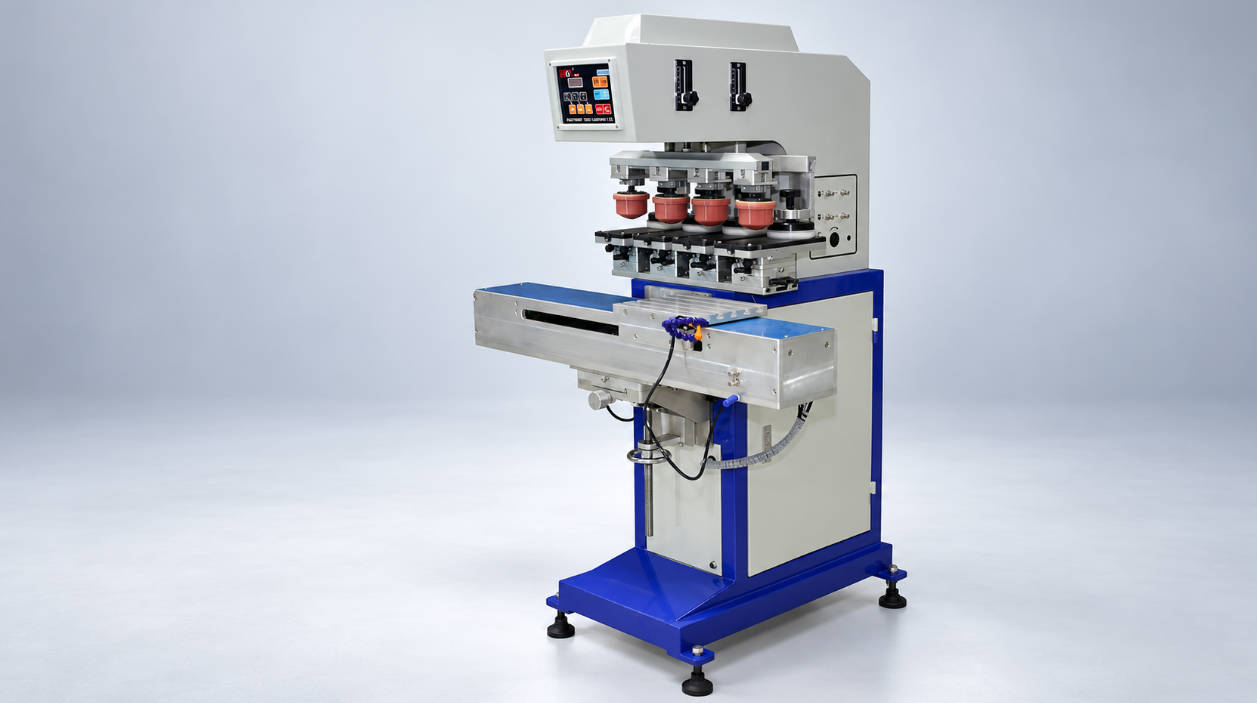
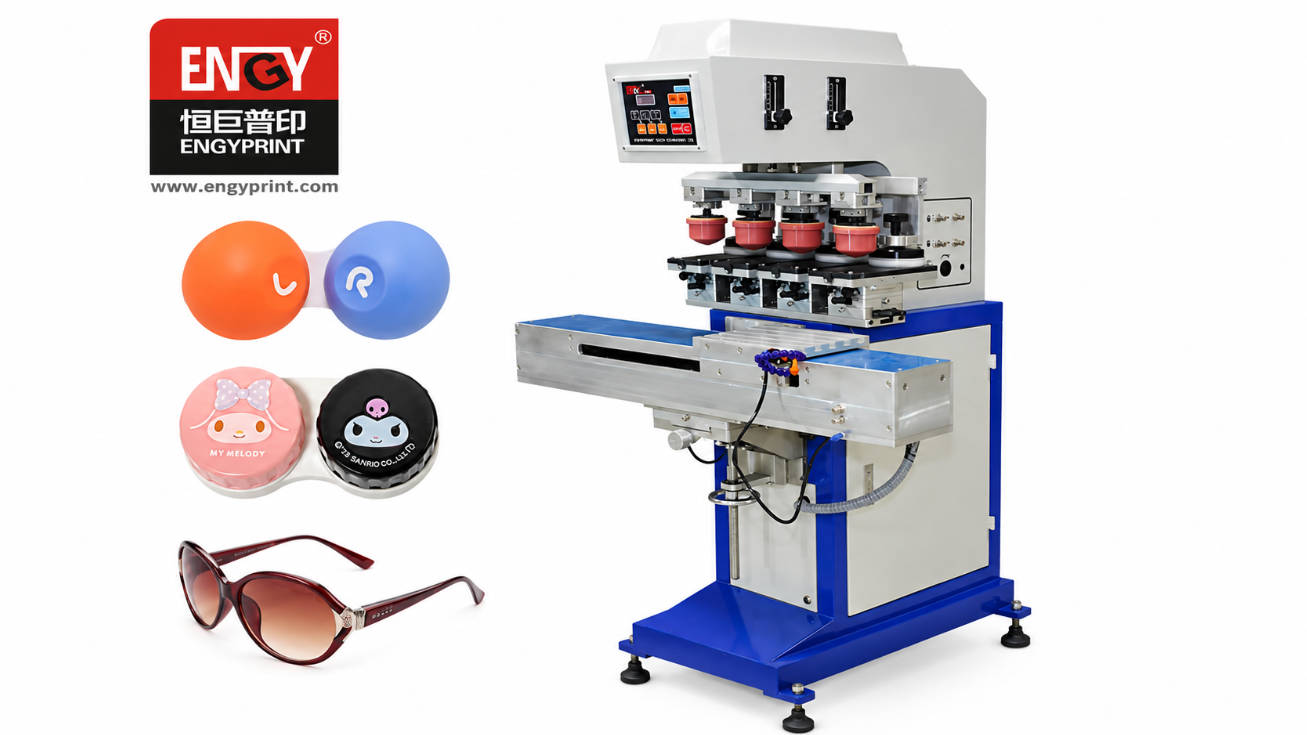
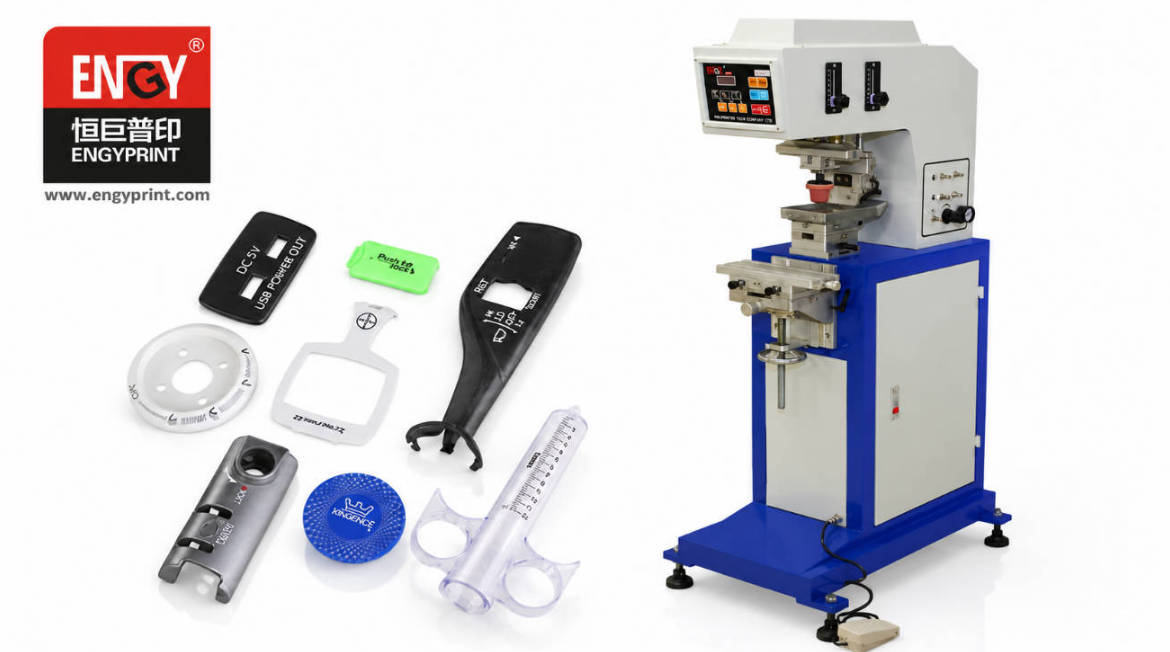
ENGYPRINT is a China-based manufacturer offering standard and custom pad printing machines, together with matching consumables. Its range includes open-tray and closed-ink-cup equipment, single- and multi-color printers, and semi-automatic and automatic configurations.
Published applications include plastic components, power tools, bottle caps, and promotional products. One example is the EN-C160/2A, a two-color closed-cup printer with a rotary table and six fixture positions.
ENGYPRINT’s service process includes discussing the application, developing a machine proposal, and conducting a printing trial with customer samples before shipment. Its published support information also describes operating videos, manuals, and remote communication.
For U.S. buyers considering overseas sourcing, the next step is to confirm the configuration and delivery arrangements for the specific project. Electrical requirements, sample approval, training, replacement parts, and shipping responsibilities should all be agreed before ordering.
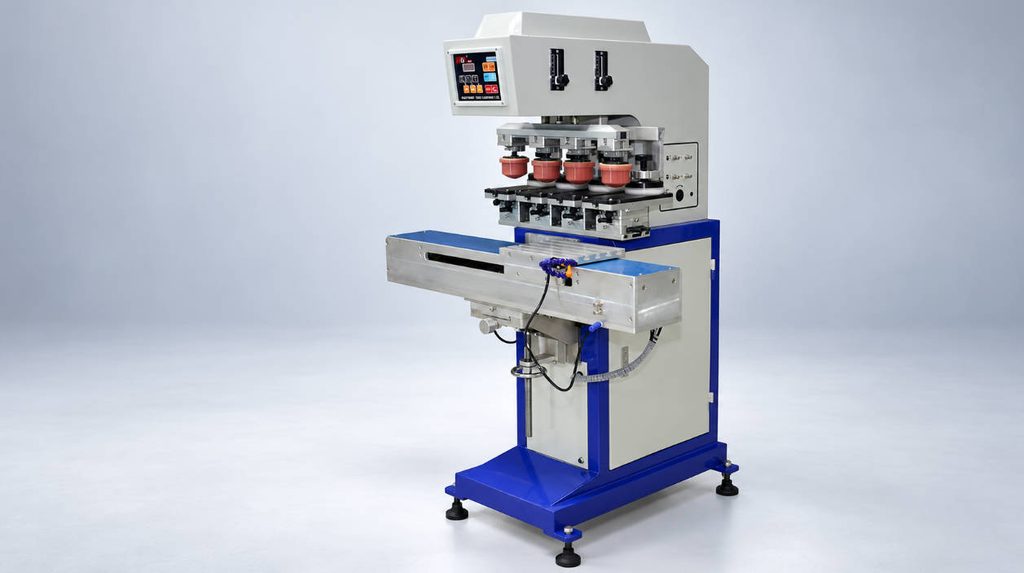
What Matters More Than a Supplier’s Position on a List?
A supplier comparison becomes useful when every company is answering the same questions. Sending different requirements to different suppliers makes the quotations difficult to evaluate.
Start with the following details.
Part Geometry and Usable Print Area
Specify the artwork dimensions and the exact location on the part. Include recesses, raised edges, curves, and any features that may obstruct the pad.
The fixture also occupies space. Ask the supplier to assess the part and fixture together, rather than approving the machine solely from the artwork size.
For curved or textured surfaces, request a trial on representative production parts. A photograph of a similar product is helpful, but it cannot establish the result on your material and geometry.
Production Output Under Defined Conditions
Ask what the quoted speed measures: machine cycles, impressions, or completed parts.
A multi-color part may require several printing operations. Loading, drying, inspection, and unloading can also affect the number of acceptable parts produced during a shift.
Request an output estimate tied to your application, including:
- The number of colors and print positions.
- Manual or automatic loading.
- Any pretreatment or drying stages.
- Inspection requirements.
- The assumptions used for continuous operation.
Keep maximum machine speed separate from expected production output.
Tooling, Changeovers, and Repeat Jobs
For businesses running several products, changeover procedures deserve close attention.
Ask what must be changed when moving to another part: the fixture, pad, plate, ink cup, settings, or all of these. Find out how the operator returns to the correct position when a previous job comes back.
A demonstration of a changeover can reveal practical details that a specifications sheet leaves out. It also helps identify which spare fixtures or consumables should be ordered with the machine.
Consumables and Replacement Parts
Evaluate the supply arrangements for pads, plates, cups, and doctor rings before placing the equipment order.
Useful questions include:
- Which items are supplied with the machine?
- What specifications are needed for repeat orders?
- Which parts are standard, and which are custom?
- What should be kept on hand for routine operation?
When considering alternative pad printing consumables, check dimensions, mounting arrangements, and material compatibility. A similar appearance does not establish that a replacement will fit.
Comparing U.S.-Based and Overseas Suppliers
A U.S. address identifies where a supplier operates; it does not, by itself, establish where every machine is manufactured. If manufacturing origin matters to your purchasing policy, ask about the specific equipment being quoted.
For both domestic and overseas purchases, make the support arrangement explicit. Find out who handles installation questions, whether training is remote or on-site, and how replacement parts are dispatched.
The quotation should also separate the machine from the costs and services around it.
| Item to Compare | Questions to Resolve |
|---|---|
| Equipment configuration | Which printer, controls, fixtures, and accessories are included? |
| Factory requirements | What voltage, frequency, phase, air supply, and working space are required? |
| Sample approval | Which parts and artwork will be tested, and what counts as an acceptable result? |
| Shipping and delivery | Who arranges transport, and which delivery costs are included? |
| Installation and training | What assistance is provided, in what format, and at what cost? |
| Warranty and service | What is covered, what is excluded, and how is a claim handled? |
| Spare parts | Which parts should be ordered initially, and how are later orders fulfilled? |
Electrical configuration requires particular care. Do not assume that every model from a supplier uses the same power supply. Ask for written confirmation against the utilities available at your facility.
Compare quotations only after these details are clear. A lower machine price may cover a different configuration or leave more work for the buyer.
What to Include in Your Pad Printing RFQ
A useful request for quotation gives the supplier enough information to recommend equipment without guessing.
| Information | What to Provide |
|---|---|
| Part | Photos, drawings, dimensions, and physical samples where available |
| Material | Substrate and any coating or surface treatment |
| Artwork | Vector file, image dimensions, colors, and print locations |
| Output | Required parts per hour or shift, plus typical batch sizes |
| Product mix | Number of different parts and expected changeover frequency |
| Quality requirements | Registration, appearance, adhesion, and any specified tests |
| Factory conditions | Available electricity, compressed air, and installation space |
| Project scope | Required loading, pretreatment, drying, inspection, and unloading |
If some details are undecided, identify them as open questions. It is better to discuss an uncertain production target than to receive a quotation built around an incorrect assumption.
For an ENGYPRINT inquiry, you can start with the available pad printing machines and send your part information for review. The sample testing and customization process explains how a proposed setup can be checked against customer samples before shipment.
Frequently Asked Questions
How do I choose a pad printing machine supplier?
Shortlist suppliers whose published equipment fits your application, then compare their proposals using the same parts, artwork, and output requirements. Check the printing result, tooling, operator tasks, consumables, training, and service arrangements before deciding.
Does a U.S.-based supplier always sell U.S.-made machines?
No. Supplier location and equipment manufacturing origin are separate questions. If your purchasing requirements specify an origin, request confirmation for the particular machine and configuration being offered.
Can U.S. buyers consider overseas pad printing machine suppliers?
Yes. Include overseas suppliers in the comparison when their equipment and delivery arrangements suit the project. Confirm electrical specifications, sample acceptance, shipping responsibilities, training, warranty terms, and spare parts support before placing the order.
Should I choose a standard or custom pad printing machine?
A standard machine is worth evaluating when its print area, working space, and available tooling accommodate the part. Discuss a custom solution when the project requires unusual positioning, several print locations, dedicated handling, or integration with other production equipment.
How many colors should my pad printer support?
Base the decision on the artwork you expect to produce, including reasonably foreseeable jobs. Ask suppliers to explain how additional colors affect tooling, registration, cycle time, and changeovers. More colors do not automatically make a machine more suitable.
Can I buy replacement consumables from another supplier?
Possibly, but compatibility needs to be checked. Provide the machine model, dimensions, mounting details, and relevant material information. For custom pads, cups, or rings, a drawing or sample may be needed before a replacement can be confirmed.