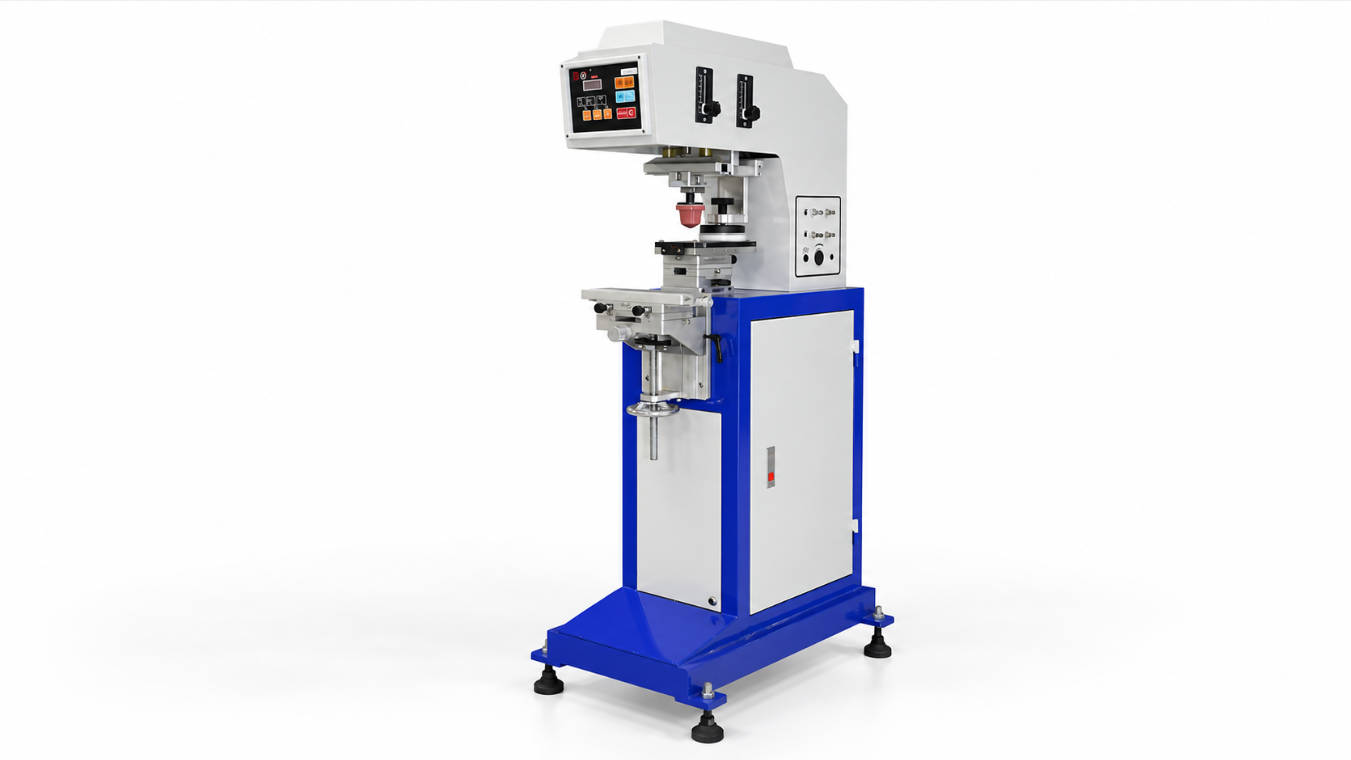
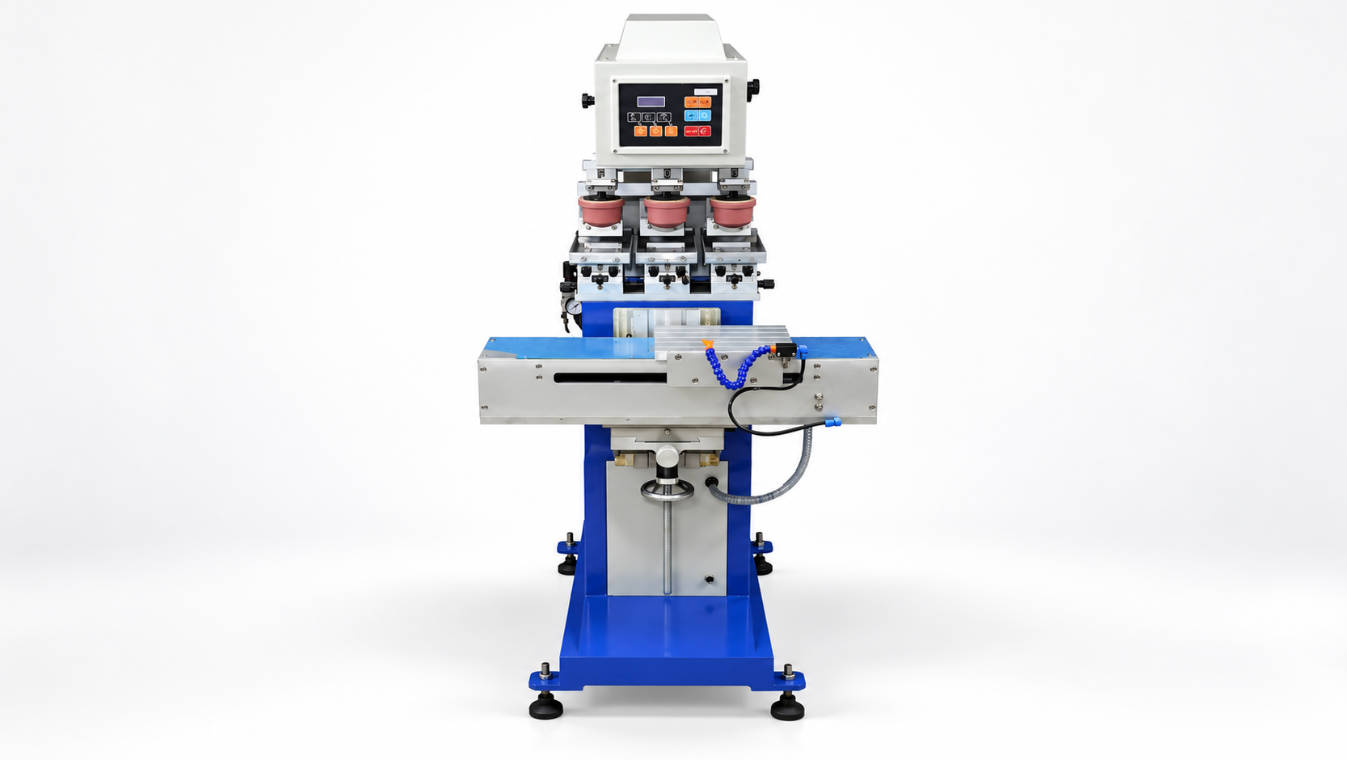
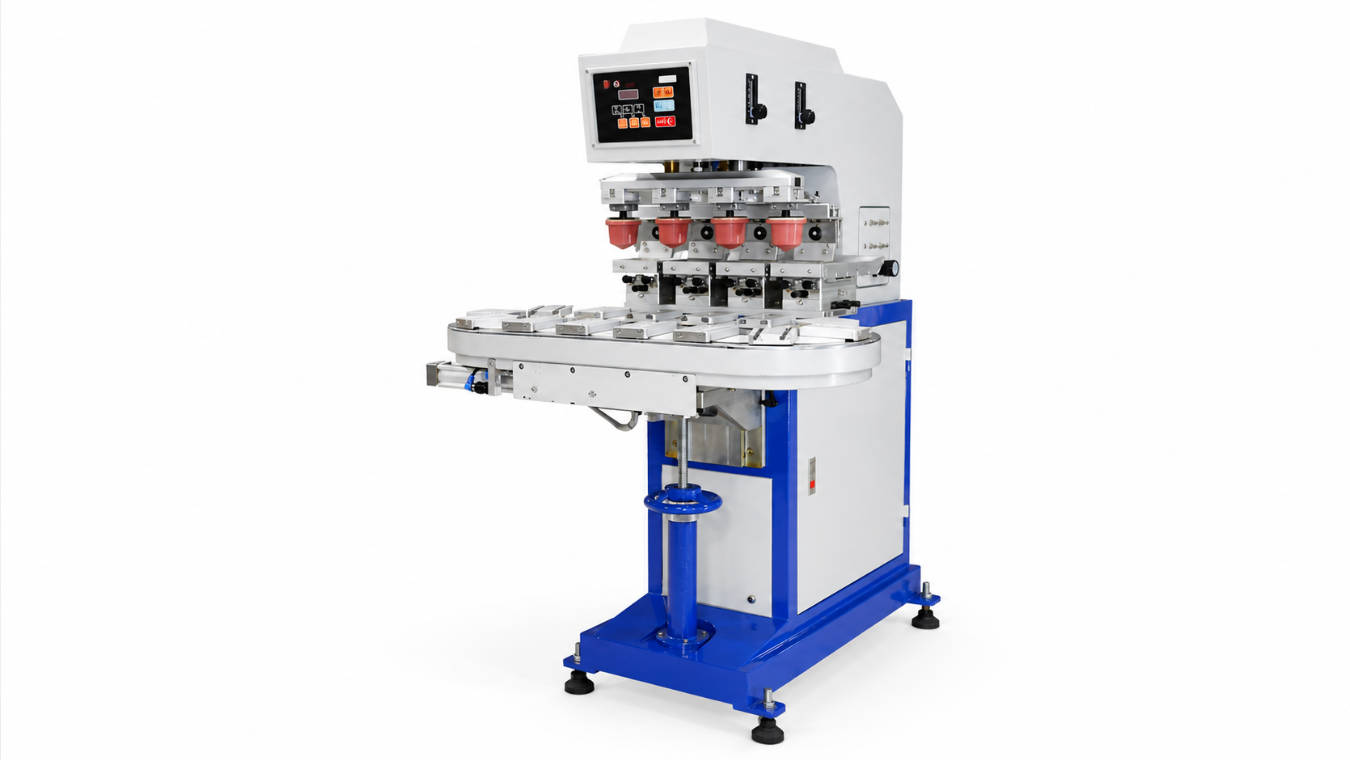
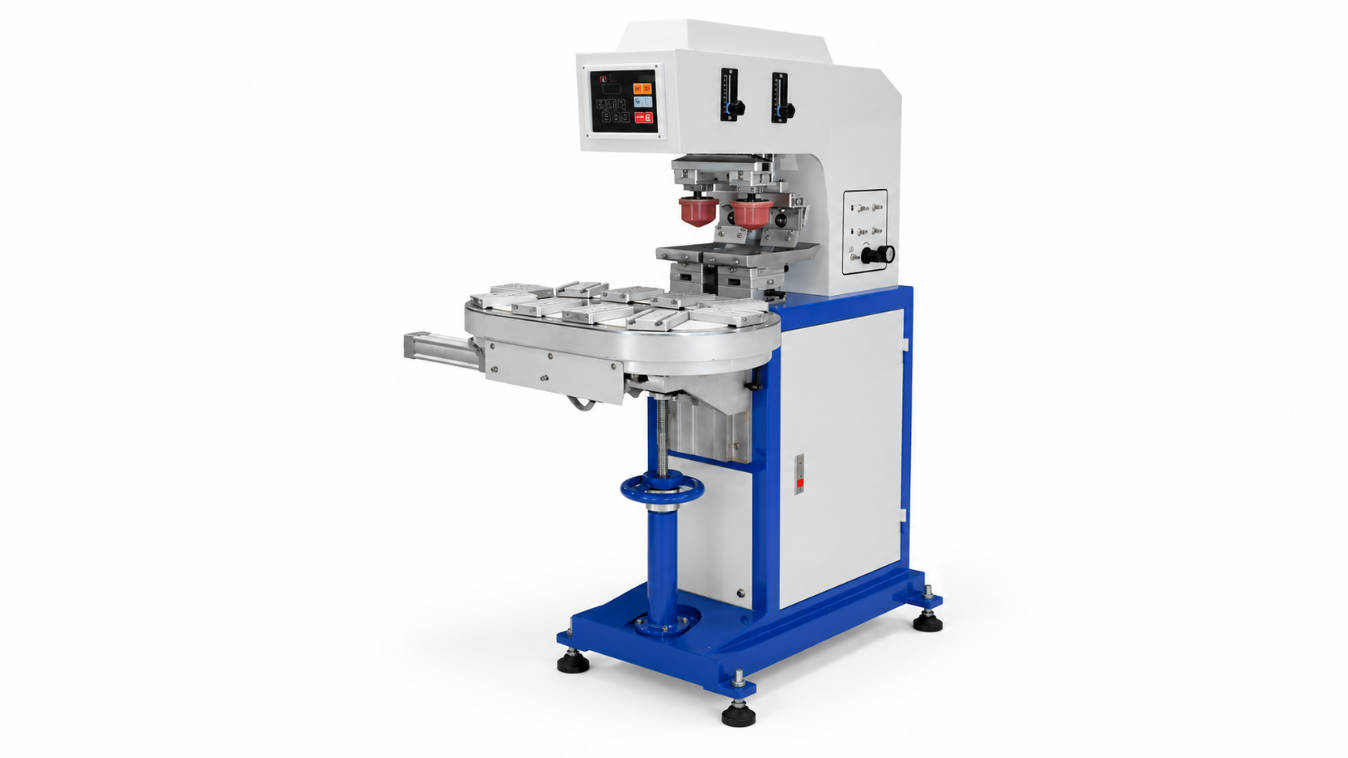
A pneumatic pad printing machine is usually a practical choice for cost-sensitive, standard, and air-supply-ready production environments, while an electric pad printer is often preferred when buyers need finer motion control, lower air dependency, programmable movement, and potentially quieter operation. The right choice depends on production volume, available utilities, control accuracy, maintenance capability, machine configuration, and total operating cost.
Many buyers compare pad printers by color count, ink cup type, print area, or machine size. However, the drive system is also important. A pad printer drive system affects motion stability, cycle control, compressed air demand, maintenance workload, noise, energy use, and how easily the machine can be integrated into a production line.
This guide compares pneumatic pad printing machines and electric pad printers from a buyer’s perspective. Instead of treating one system as automatically better, it explains when each drive type is more suitable and what information buyers should prepare before requesting a recommendation from ENGY.
For standard and customized pad printer options, buyers can review ENGY’s pad printing machine category.
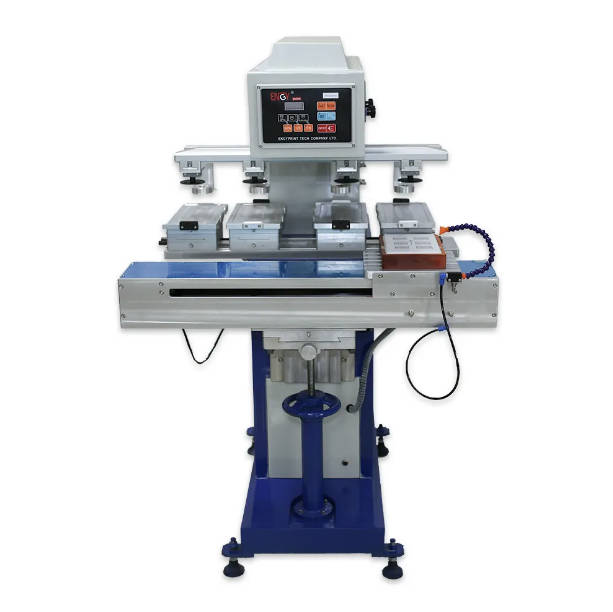
The Short Decision Map: Which Drive System Fits Your Factory?
Before going into technical detail, use this quick decision map.
| Your Situation | More Likely Fit |
| You already have stable compressed air in the workshop | Pneumatic pad printing machine |
| You want simple, cost-effective equipment for standard logo printing | Pneumatic pad printer |
| You need programmable movement and precise control | Electric pad printer |
| You want to reduce dependence on compressed air | Electric pad printing machine |
| You run mixed products with frequent motion adjustments | Electric or servo-assisted system |
| You print simple one-color marks in small or medium batches | Pneumatic system may be enough |
| You want easier integration with advanced automation | Electric or hybrid system may be considered |
| You prioritize lower initial machine cost | Pneumatic machine is often practical |
| You are concerned about compressor noise and air consumption | Electric system deserves review |
The best pad printer drive system is not decided by machine type alone; it is decided by the factory’s utilities, product requirements, operator skill, and long-term production plan.
What Is a Pneumatic Pad Printing Machine?
A pneumatic pad printing machine uses compressed air to drive key machine movements. Depending on the machine design, air cylinders may control pad movement, plate movement, shuttle movement, printing stroke, or other mechanical actions.
In many factories, pneumatic pad printers are common because they are relatively simple, familiar to maintenance teams, and practical for many standard pad printing applications. They are often used for one-color logo printing, closed ink cup pad printing, open tray pad printing, semi-automatic product decoration, and small to medium production runs.
A pneumatic pad printer usually depends on:
- Air compressor
- Air filter and regulator
- Pneumatic valves
- Air cylinders
- Tubing and fittings
- Mechanical stops or stroke adjustment
- Operator settings for speed and pressure
A pneumatic pad printing machine is often suitable when the buyer wants a simple, proven, and cost-effective pad printing solution and already has stable compressed air available.
What Is an Electric Pad Printer?
An electric pad printer uses electric motors, servo systems, stepper motors, or other electrically driven mechanisms to control movement. The exact design depends on the manufacturer and machine configuration.
Electric pad printers are often considered when buyers need more controlled motion, digital adjustment, repeatable stroke settings, programmable movement, or lower dependence on compressed air. Some machines may still use air for certain auxiliary actions, but the main drive system is electrically controlled.
Electric pad printers may be useful for:
- Precise motion control
- Repeated parameter storage
- Automation integration
- Lower air utility dependence
- Quieter production environments
- Applications requiring controlled pad speed
- Advanced multi-color or customized printing processes
However, electric systems can also be more complex. They may require more advanced troubleshooting knowledge, control components, and different maintenance skills compared with pneumatic machines.
Drive System Comparison: Pneumatic vs Electric Pad Printer
| Comparison Point | Pneumatic Pad Printing Machine | Electric Pad Printer |
| Main drive source | Compressed air | Electric motor, servo, or stepper system |
| Utility requirement | Stable compressed air supply | Stable electrical power |
| Initial cost | Often lower for standard models | Often higher depending on control system |
| Motion control | Mechanical and air pressure adjustment | Digital or programmable control possible |
| Maintenance style | Air cylinders, valves, seals, tubing | Motors, drivers, sensors, controllers |
| Noise source | Machine movement plus compressor system | Mainly motor and mechanical movement |
| Operating cost | Includes compressed air generation | Includes electrical consumption |
| Best fit | Standard printing, cost-sensitive setups | Precise, programmable, or automated setups |
| Operator adjustment | Usually manual knobs and air settings | May support parameter-based adjustment |
| Integration potential | Good for simple automation | Better for advanced control integration |
Difference 1: Air Supply and Factory Utilities
The first difference is the utility requirement. A pneumatic pad printing machine needs compressed air. If your factory already has a stable compressed air system, pneumatic equipment can be straightforward to install and operate. If not, you may need to buy an air compressor, air dryer, filter, regulator, and proper piping.
Compressed air quality matters. Moisture, oil, unstable pressure, or insufficient air flow can affect machine movement and long-term pneumatic component life.
Buyers should check:
| Air Supply Item | Why It Matters |
| Air pressure stability | Affects movement consistency |
| Air flow capacity | Prevents slow or weak motion |
| Moisture control | Reduces valve and cylinder problems |
| Filtration | Protects pneumatic components |
| Compressor noise | Affects workshop comfort |
| Compressor maintenance | Adds operating responsibility |
An electric pad printer reduces dependence on compressed air for main movement, but it does not remove all utility concerns. Buyers still need stable power, electrical safety, and suitable control environment.
If compressed air is already stable and inexpensive in your workshop, a pneumatic pad printer can be a practical choice. If compressed air is limited, noisy, or costly to maintain, an electric pad printer may be worth considering.
Difference 2: Motion Control and Printing Accuracy
Pad printing quality depends on more than the drive system. Ink, plate, pad, fixture, surface material, and operator setup all matter. However, the drive system can affect motion repeatability and adjustment convenience.
Pneumatic machines usually control movement through air pressure, flow control valves, stroke settings, and mechanical adjustment. This can be enough for many standard applications, especially one-color and simple product decoration.
Electric systems may offer more programmable control over:
- Stroke position
- Pad speed
- Dwell time
- Movement sequence
- Acceleration and deceleration
- Repeated settings for different products
- Integration with sensors or automation
For high-precision applications, the machine structure and control system must be evaluated together. An electric drive alone does not automatically solve poor fixture design or wrong pad selection.
| Application Requirement | Drive System Consideration |
| Simple one-color logo | Pneumatic may be sufficient |
| Small text with tight position control | Electric or high-quality pneumatic system may be reviewed |
| Multi-color registration | Machine structure and fixture accuracy are critical |
| Frequent parameter changes | Electric control may be easier |
| Automated product handling | Electric or hybrid systems may offer more control options |
Difference 3: Maintenance and Troubleshooting
Pneumatic and electric pad printers require different maintenance thinking.
A pneumatic pad printing machine is often easier for factories that already maintain air-driven equipment. Common maintenance points include checking air leaks, replacing seals, cleaning filters, adjusting regulators, and maintaining valves or cylinders.
An electric pad printer may require knowledge of motors, controllers, sensors, wiring, drivers, and software parameters. It may reduce some air-related maintenance but increase the importance of electrical diagnostics.
| Maintenance Area | Pneumatic Machine | Electric Machine |
| Common issues | Air leaks, cylinder wear, valve sticking, pressure instability | Motor alarms, sensor faults, driver issues, parameter errors |
| Required skill | Pneumatic and mechanical maintenance | Electrical and control-system maintenance |
| Spare parts | Cylinders, valves, tubing, fittings, seals | Motors, drivers, sensors, controller parts |
| Daily checks | Air pressure, moisture, oil, tubing | Power, sensor status, program settings |
| Troubleshooting style | Mechanical and air-flow based | Electrical and control-logic based |
A pneumatic machine may be easier to maintain in factories familiar with air systems, while an electric pad printer may be better for teams comfortable with electrical control and automation.
Difference 4: Noise and Working Environment
Noise is not only produced by the pad printer itself. For pneumatic machines, the compressed air system may be a major source of noise. Air exhaust, valves, cylinder movement, and compressor operation can all contribute.
Electric pad printers may reduce some air-related noise, especially if the workshop does not need a compressor running near the machine. However, electric systems still create mechanical and motor noise, and the final noise level depends on machine design, speed, enclosure, and production environment.
Buyers should consider:
- Is the compressor located near operators?
- Does the workshop already use compressed air for other machines?
- Are there noise restrictions?
- Does the machine need to run for long shifts?
- Is operator comfort a priority?
- Will the machine be used in a clean or controlled environment?
If noise is a concern, buyers should discuss the full system, not only the machine body.
Difference 5: Total Operating Cost
Many buyers compare only machine price. That is not enough. Total operating cost includes utilities, maintenance, spare parts, downtime, operator time, setup time, energy use, and process stability.
| Cost Item | Pneumatic Pad Printer | Electric Pad Printer |
| Machine purchase cost | Often lower for standard models | Often higher depending on control level |
| Utility cost | Compressed air generation | Electricity |
| Additional equipment | Compressor and air treatment may be needed | Electrical control components included |
| Maintenance cost | Pneumatic parts and air system care | Electrical components and diagnostics |
| Downtime risk | Air supply issues can stop production | Controller or sensor faults can stop production |
| Operator setup | Manual adjustment may take time | Digital settings may reduce repeat adjustment |
| Long-term value | Good for stable standard applications | Good for controlled and flexible applications |
For a factory that already has compressed air, pneumatic equipment may be economical. For a factory without compressed air or with high compressor maintenance costs, electric equipment may become more attractive.
When a Pneumatic Pad Printing Machine Is the Better Choice
A pneumatic pad printing machine is often a better fit when the application is standard, the budget is controlled, and the factory already has reliable compressed air.
Choose pneumatic when:
- The printing job is simple and stable.
- The logo is one-color or basic multi-color.
- The factory already uses compressed air.
- Operators are familiar with pneumatic machines.
- Lower initial investment is important.
- Maintenance staff can handle cylinders, valves, and air systems.
- Advanced programmable motion is not required.
- The buyer wants a practical machine for general product decoration.
Pneumatic systems remain widely used because they are practical for many pad printing applications. For buyers printing plastic parts, caps, toys, electronics, promotional products, hardware, and industrial components, a pneumatic machine may provide the right balance between cost and performance.
When an Electric Pad Printer Is the Better Choice
An electric pad printer may be more suitable when the buyer needs programmable movement, better parameter control, less reliance on compressed air, or easier integration with advanced automation.
Choose electric when:
- Compressed air is not available or not preferred.
- The factory wants digital movement control.
- The application requires frequent setting changes.
- The machine needs to integrate with sensors or automation.
- Operators need repeatable parameter storage.
- Noise from air systems is a concern.
- The production process requires finer motion adjustment.
- The buyer is prepared for electrical maintenance and control troubleshooting.
Electric pad printers may be more attractive for factories moving toward automation or controlled production environments. However, buyers should confirm whether the benefits justify the higher machine complexity and possible cost.
Do You Need a Pure Pneumatic, Pure Electric, or Hybrid System?
In practice, some pad printers are not purely pneumatic or purely electric. Many machines use a combination of drive technologies. For example, a machine may use electric controls for timing and sequencing while using pneumatic cylinders for certain motions. Other machines may use servo drive for key movements and air for clamping, loading, or auxiliary functions.
Instead of asking only “pneumatic or electric,” buyers should ask:
| Question | Why It Matters |
| Which movements are pneumatic? | Shows air dependency |
| Which movements are electric or servo-driven? | Shows control capability |
| Can settings be stored? | Useful for repeated products |
| What utilities are required? | Affects installation cost |
| What maintenance skills are needed? | Affects long-term operation |
| What is the expected production volume? | Affects automation value |
| What print accuracy is required? | Affects drive system selection |
This approach gives a more accurate machine recommendation than choosing by label alone.
Buyer Checklist Before Requesting a Quote
Before requesting a machine recommendation, prepare the following information:
| Information to Provide | Why It Helps |
| Product photos or samples | Helps evaluate shape and fixture design |
| Product material | Helps select ink and pretreatment |
| Logo size | Determines print area and plate requirements |
| Number of colors | Affects machine configuration |
| Production volume | Helps choose manual, semi-automatic, or automatic setup |
| Available utilities | Confirms air supply or electrical requirements |
| Required accuracy | Affects machine structure and drive system |
| Operator skill level | Helps choose control complexity |
| Maintenance capability | Helps decide pneumatic or electric suitability |
| Future product plans | Prevents buying a machine with limited flexibility |
For application review, buyers can compare ENGY’s pad printing machine options and prepare product details before asking for a recommendation.
Common Buying Mistakes
Mistake 1: Choosing Pneumatic Only Because It Is Cheaper
A pneumatic machine may be cost-effective, but it still needs stable compressed air. If air supply is poor, machine performance and maintenance may suffer.
Mistake 2: Choosing Electric Only Because It Sounds More Advanced
An electric pad printer can offer more control, but it may not be necessary for simple logo printing. If the application is basic, the extra cost and control complexity may not bring enough value.
Mistake 3: Ignoring Air Compressor Cost
When comparing costs, include compressor purchase, air treatment, electricity consumption, maintenance, noise, and space. A pneumatic machine is not only the printer itself.
Mistake 4: Forgetting Fixture and Ink Factors
Drive system does not solve all printing problems. Poor ink adhesion, wrong pad shape, unstable fixture, or unsuitable plate depth can still cause printing defects.
Mistake 5: Not Checking Maintenance Skills
The right machine should match the factory’s maintenance capability. A simple machine that can be maintained locally may be better than an advanced machine that the team cannot troubleshoot.
How to Choose the Right Supplier
A good supplier should not simply say pneumatic is better or electric is better. The supplier should ask about your production environment, product shape, logo size, material, color count, output, air supply, accuracy requirement, and automation plan.
When comparing suppliers, check whether they can support:
- Pneumatic and electric drive system explanation
- Product sample review
- Fixture design advice
- Pad and plate selection
- Closed ink cup or open tray recommendation
- One-color or multi-color machine configuration
- Semi-automatic or automatic production planning
- Operation training
- Troubleshooting support
- Spare parts availability
ENGY offers standard and customized pad printing machines for different product decoration requirements. Buyers can also visit the ENGY website to learn more about available printing equipment and company background.
FAQ
1. What is a pneumatic pad printing machine?
A pneumatic pad printing machine uses compressed air to drive machine movements such as pad motion, shuttle movement, or printing stroke. It is commonly used for standard logo printing and product decoration applications.
2. What is the difference between a pneumatic pad printer and an electric pad printer?
The main difference is the drive system. A pneumatic pad printer uses compressed air, while an electric pad printer uses motors, servo systems, or other electrically controlled movement. This affects utilities, control accuracy, maintenance, and operating cost.
3. Is an electric pad printer more accurate than a pneumatic pad printer?
An electric pad printer may offer better programmable motion control, but final printing accuracy also depends on fixture design, pad selection, plate quality, ink behavior, and product loading consistency.
4. Does a pneumatic pad printing machine need an air compressor?
Yes, a pneumatic pad printing machine normally requires a stable compressed air supply. If the factory does not have compressed air, buyers may need an air compressor and air treatment system.
5. Which pad printer drive system is better for small factories?
For small factories with stable compressed air and standard printing needs, a pneumatic pad printer can be practical and cost-effective. If compressed air is not available or the buyer needs digital control, an electric pad printer may be considered.
6. Is an electric pad printer quieter than a pneumatic pad printer?
An electric pad printer may reduce air exhaust and compressor-related noise, but total noise depends on machine design, production speed, motor movement, and the surrounding workshop environment.
7. How should I choose between pneumatic and electric pad printing machines?
Start with your product, logo size, material, color count, output, available utilities, accuracy requirement, maintenance capability, and automation plan. Then ask the supplier to recommend the most suitable drive system.
Conclusion
A pneumatic pad printing machine and an electric pad printer can both be suitable for industrial product decoration, but they solve different buyer problems.
A pneumatic pad printer is often practical for standard printing jobs, controlled investment, and factories with reliable compressed air. An electric pad printer is worth considering when the buyer needs programmable motion, reduced air dependency, quieter operation, or better integration with automation.
The best choice depends on your real production conditions. Before ordering, prepare product samples, logo size, material information, number of colors, output requirement, utility conditions, and accuracy expectations. ENGY can help evaluate the application and recommend a suitable pneumatic pad printing machine or electric pad printer solution.