I. Introduction: The Power Source Dilemma
In the industrial marking and decoration industry, the “heart” of your operation is the drive system of your pad printing machine. For the better part of five decades, the choice was simple: pneumatic. Compressed air was the undisputed king of the factory floor. However, with the rise of Industry 4.0 and the demand for extreme precision in the medical and electronics sectors, electric (servo-driven) machines have emerged as a formidable challenger.
If you are currently evaluating a new equipment purchase, you are likely at a crossroads. You might be wondering, “Is the traditional pneumatic machine still relevant, or am I falling behind by not choosing electric?” The truth is that “better” is subjective. The choice between a pneumatic and an electric pad printing machine depends primarily on your specific production environment, required precision, and budget; while pneumatic machines offer a lower initial investment and rugged durability, electric machines provide unparalleled digital control, cleanliness, and long-term energy savings.
In this guide, we will move past the marketing brochures and look at the “boots-on-the-ground” reality of running these machines, helping you make a sincere investment in your company’s future.
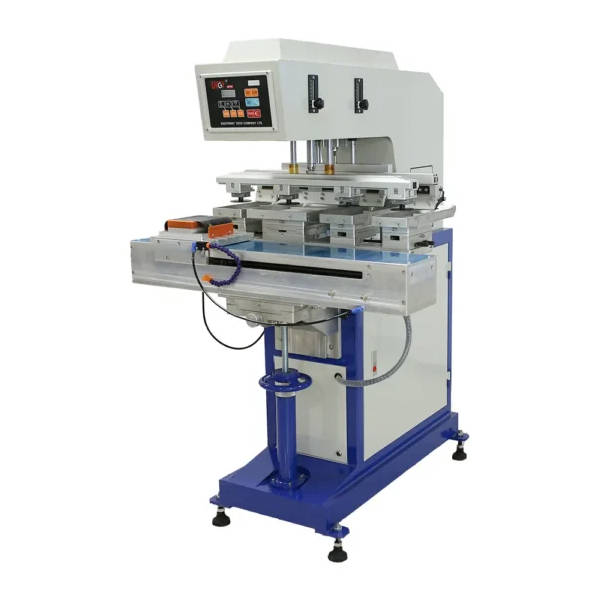
II. Pneumatic Pad Printing: The Reliable Standard
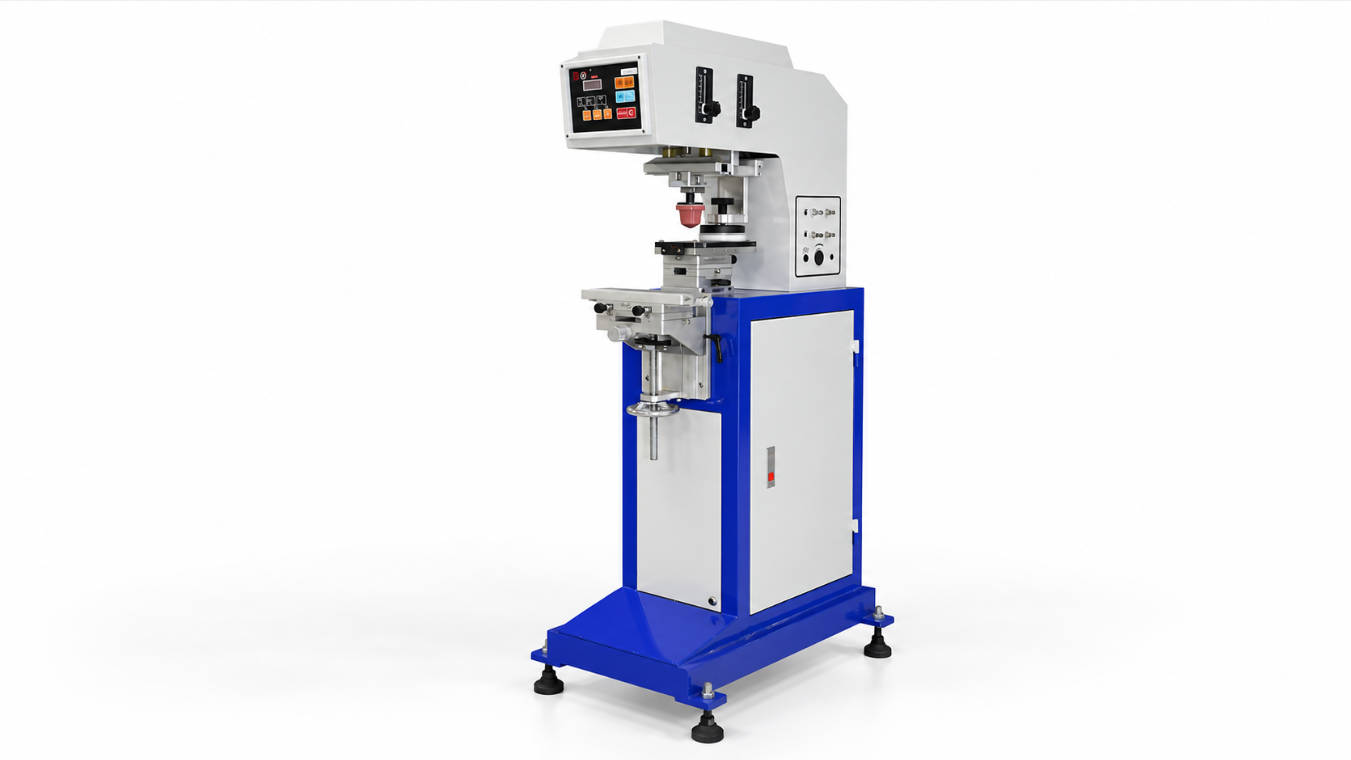
Pneumatic pad printing machines are the “iron men” of the industry. They utilize compressed air to drive the motion of the printing pad and the ink cup. For many high-volume, cost-sensitive manufacturers, this remains the gold standard.
1. The Mechanism of Simplicity
At its core, a pneumatic pad printing machine relies on air cylinders, solenoid valves, and flow controls. When the cycle is triggered, air pressure pushes the cylinders to move the pad forward to pick up ink from the cliché (plate) and then downward to transfer it to the product. It is a linear, mechanical process that has been refined over half a century.
2. The Benefits of “Analog” Reliability
One of the most sincere advantages of a pneumatic system is its ruggedness. Pneumatic machines are highly resistant to harsh industrial environments, such as dust, humidity, and temperature fluctuations, because they lack the sensitive electronic motor components found in servo-driven systems. If a pneumatic machine stops working, the fix is usually as simple as replacing a $20 O-ring or adjusting an air valve—tasks that any standard maintenance technician can perform without specialized software knowledge.
3. Lower Entry Costs (CAPEX)
For many growing businesses, the initial price tag is a major hurdle. Pneumatic machines generally have a much lower capital expenditure (CAPEX). Because they utilize standard industrial components (cylinders and valves) rather than expensive high-torque servo motors and complex PLC controllers, they are significantly more affordable to purchase and install.
III. Electric (Servo-Driven) Pad Printing: The Precision Specialist
As products become smaller and designs more intricate, the limitations of “air” become more apparent. This is where the electric pad printing machine (often called a servo-driven machine) enters the picture.
1. Total Motion Control
Unlike a pneumatic cylinder, which is either “open” or “closed,” a servo motor can be programmed to move to an exact coordinate with sub-micron accuracy. In an electric pad printing machine, the operator can digitally control the stroke length, descent speed, and pad pressure via a touchscreen interface, allowing for “recipe” storage that ensures every job setup is identical to the last.
2. Cleanroom and Medical Suitability
If you are printing on medical catheters, syringes, or aerospace components, cleanliness is non-negotiable.
- The “Air” Problem: Pneumatic machines exhaust a small amount of “oily” air with every stroke. This can introduce contaminants into a cleanroom environment.
- The Electric Solution: Electric machines are completely “dry.” They do not exhaust air, they do not require lubricants in the drive path, and they operate in near-silence. For sterile environments, the electric machine is the undisputed king.
3. Energy Efficiency: The “Silent” Saving
While air compressors are standard in most factories, they are incredibly energy-inefficient. A pneumatic machine requires a compressor to run constantly. An electric machine, however, only uses significant power when the motor is in motion. Over a three-to-five-year period, the reduction in electricity costs can go a long way toward paying off the higher initial price of an electric unit.
IV. Performance Head-to-Head: Precision and Setup
To help your team visualize the technical differences, we’ve organized the key performance data into a comparative table.
Technical Performance Comparison
| Feature | Pneumatic Pad Printing | Electric (Servo) Pad Printing |
| Positioning Accuracy | +/- 0.03 mm | +/- 0.01 mm |
| Setup Time | 15–30 Minutes (Manual) | 2–5 Minutes (Digital Recall) |
| Motion Profiles | Constant (Mechanical) | Programmable (Variable) |
| Noise Level | 70–80 dB (Hiss/Exhaust) | 40–50 dB (Whisper quiet) |
| Multi-Color Registration | Moderate (Standard) | Exceptional (Independent Servos) |
| Environmental Impact | High (Compressed Air waste) | Low (Direct Drive) |
Accuracy and Repeatability
The most significant “pain point” with pneumatic machines is “Drift.” As the day progresses and your factory’s air demand fluctuates (perhaps because a large machine elsewhere on the line just turned on), the air pressure feeding your printer may drop. This changes the force with which the pad hits the product.
Electric pad printing machines eliminate “pressure drift” because the torque and position of the servo motor are monitored thousands of times per second, ensuring the pad hits the exact same depth regardless of how many other machines are running in your building.
V. The Infrastructure Factor: Utilities and Hidden Costs
When you are looking at the price of a pad printing machine, you must look at the “hidden” infrastructure required to run it.
The “Compressed Air Tax”
A pneumatic machine is not a standalone unit. To run it successfully, you need:
- An Industrial Air Compressor: This is a separate, often expensive investment.
- Air Dryers and Filters: If moisture from your air lines gets into your printer, it will corrode the valves and ruin your cylinders.
- Piping: Running air lines across a factory floor is a labor-intensive process.
An electric machine, by contrast, is “Plug and Play.” You simply plug it into a standard electrical outlet, and you are ready to print. For startups or facilities that do not already have a centralized air system, the electric machine often ends up being the more “cost-effective” choice once you factor in the plumbing and compressor costs.
VI. Maintenance and Long-Term Reliability: A Tale of Two Systems
In a 24/7 manufacturing environment, reliability equals profit. If your machine is down, your revenue stops. When comparing a pneumatic pad printing machine to an electric one, the maintenance profiles are fundamentally different.
1. The Pneumatic Maintenance Cycle: “Low Complexity, High Frequency”
Pneumatic machines are mechanical workhorses. Because they rely on air pressure, they have many “wear parts” that interact with friction.
- The Seals and O-Rings: These are the most common failure points. Over millions of cycles, the rubber seals inside the air cylinders will dry out or tear. Replacing them is inexpensive (often just a few dollars), but it requires the machine to be stopped.
- Air Quality Management: This is the most critical maintenance task. To prevent premature failure of a pneumatic pad printing machine, you must ensure your air lines are equipped with a high-efficiency dryer and lubricator; moisture and oil-free air is the only way to protect the delicate internal solenoid valves from sticking.
2. The Electric Maintenance Cycle: “High Reliability, Low Frequency”
Electric servo machines are “solid-state” in their drive philosophy. There are no air seals to leak and no valves to clog.
- Electronic Longevity: The primary components are the PLC (Programmable Logic Controller) and the servo motors. These are designed for millions of maintenance-free hours.
- The “Black Box” Risk: While they rarely break, if a motherboard or a motor controller fails, it usually requires a specialized part from the manufacturer. You cannot “fix” a circuit board with a wrench. While electric pad printing machines require 60% less daily maintenance than pneumatic systems, the rare repairs they do need are typically more expensive and require higher technical expertise.
VII. Operational Comparison: Speed vs. Flexibility
There is a common industry myth that electric machines are “faster” because they are newer. This isn’t always the case.
1. Why Pneumatic Still Wins the “Sprint”
For simple, high-volume, single-color jobs—such as printing a logo on a bottle cap—a pneumatic machine is incredibly fast. The physical “snap” of an air cylinder moving between two fixed points is often faster than a servo motor, which must follow a programmed “acceleration and deceleration” curve to protect the motor’s lifespan. For mass production of basic parts where the artwork doesn’t change, a high-speed pneumatic pad printer is often the most cost-effective path to high throughput.
2. Why Electric Wins the “Marathon”
Where electric machines dominate is in Job Changeover and Complexity.
- The Setup Advantage: In a pneumatic machine, every time you change the product height, you must manually adjust mechanical stops and sensors. This can take 20 minutes. In an electric machine, you simply select a different “Job Recipe” on the touchscreen, and the machine adjusts its own stroke height in seconds.
- Independent Motion: Electric machines often allow the “Inking” speed to be different from the “Printing” speed. This flexibility allows you to pick up ink slowly (to avoid bubbles) but print quickly (to save time), which is a level of optimization that air cylinders simply cannot match.
VIII. The Final Decision Matrix: Which One Should You Buy?
To help you make the right choice, we have developed this expert framework based on different manufacturing scenarios.
| If your situation is… | Your Best Choice is… | Why? |
| A Startup on a tight budget | Pneumatic | Lowest entry price and easiest for a non-specialist to maintain. |
| Medical Device Manufacturing | Electric (Servo) | No oily air exhaust, silent operation, and perfect for cleanrooms. |
| High-Precision Electronics | Electric (Servo) | +/- 0.01mm repeatability is required for tiny, detailed components. |
| Massive Volume (Same design) | Pneumatic | Raw cycle speed and lower energy cost per part for simple motions. |
| Frequent Custom Jobs | Electric (Servo) | Digital job recall saves hours of setup time every week. |
IX. Expert Insight: Addressing Your Common Doubts
As a consultant in this industry, I often hear the same concerns from factory owners. Here is the sincere truth:
- “Is electric too complicated for my staff?” If your staff can use a smartphone, they can use an electric pad printer. The interface is actually easier than mechanical knobs once the “recipes” are set up.
- “Can I achieve ‘Electric Quality’ with a pneumatic machine?” Yes, but it requires a very stable air supply. If your building has fluctuating air pressure, you will struggle to maintain the same quality that an electric machine provides effortlessly.
- “What about the noise?” If your factory is already loud, the hiss of a pneumatic machine won’t matter. But in a quiet, modern assembly room, the constant “pssh-clunk” of air exhaust can lead to operator fatigue and errors.
X. Conclusion: Investing in Your Future Production
There is no “loser” in the battle between pneumatic and electric. Both have a vital place in modern manufacturing.
If you need a rugged, affordable workhorse for high-volume industrial parts, a pneumatic pad printing machine remains a smart, profitable investment. It is the “Land Rover” of the printing world—it works everywhere, and anyone can fix it.
However, if you are moving toward high-end precision, medical standards, or a “smart factory” where you need to change jobs five times a day, the electric servo-driven machine is the superior choice. It offers a level of cleanliness, quietness, and digital precision that justifies its higher upfront cost through significantly lower setup times and a near-zero reject rate.
Sincerely, the best way to choose is to audit your facility. Do you have clean, dry air? If not, the “cheap” pneumatic machine will become very expensive very quickly. If you want a machine that is “Plug and Play,” go electric.
FAQ: Quick Review for Decision Makers
1. Which machine is better for 4-color process printing?
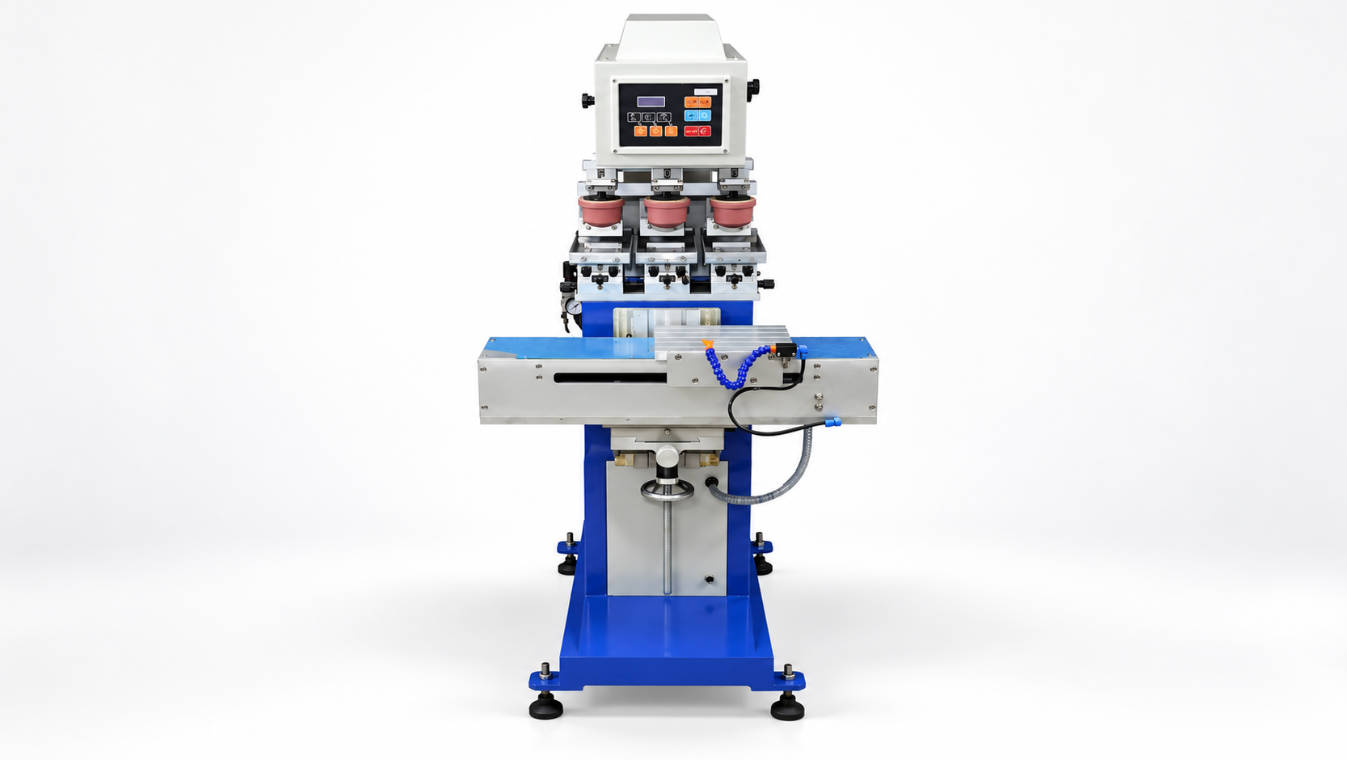
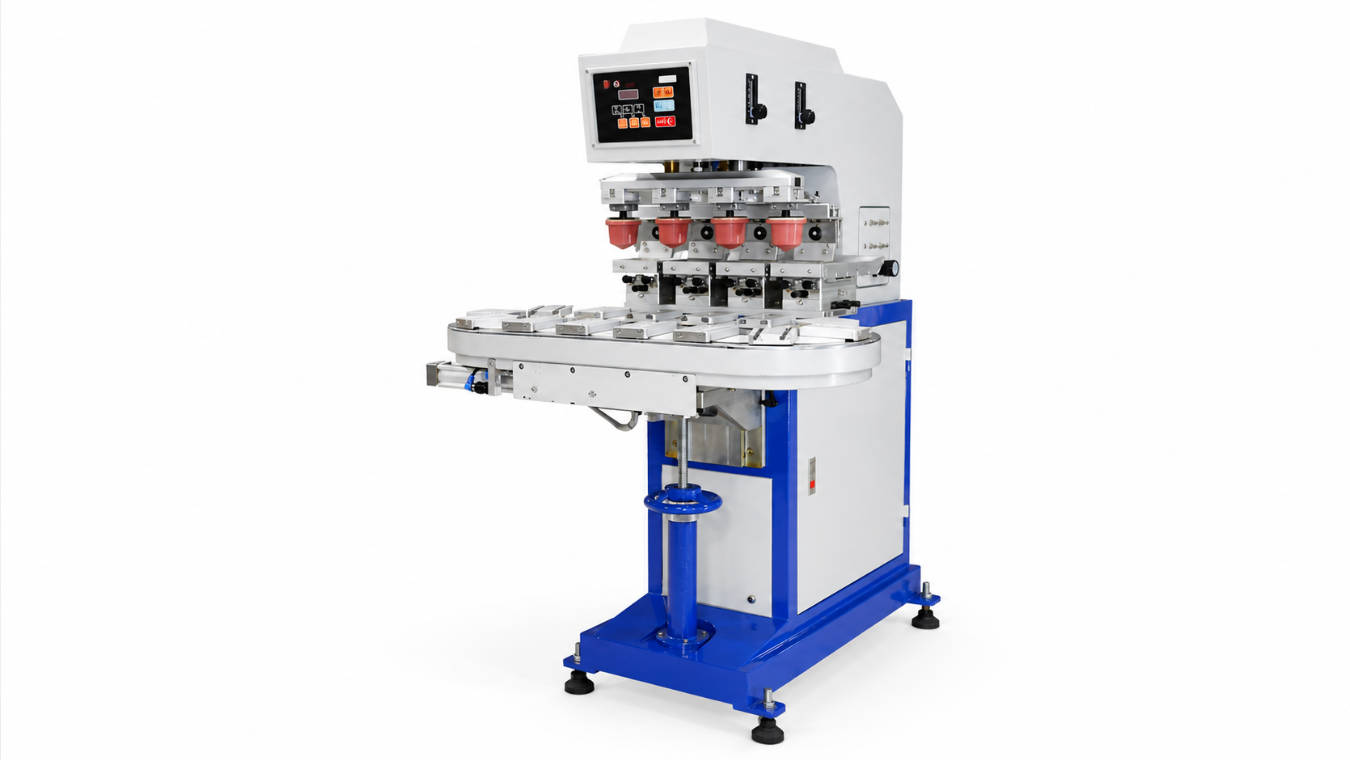
Electric machines are significantly better for multi-color registration because the servo motors ensure the pad hits the exact same coordinate every time, whereas pneumatic cylinders can “drift” slightly due to air pressure changes.
2. Does an electric pad printer require an air compressor?
No. This is one of the primary reasons to buy one. Electric pad printing machines are completely independent of air infrastructure, making them ideal for small shops, laboratories, or high-rise offices where installing a large compressor is impossible.
3. Is the energy saving of an electric machine significant?
Yes. While a pneumatic machine is idle, your air compressor is still running and consuming power. An electric machine only pulls significant amperage when it is actually moving. For large-scale operations, this can save thousands of dollars per year.
4. Can a pneumatic machine be used in a medical cleanroom?
It is possible, but difficult. You must install high-end exhaust filters and ensure the air is oil-free. For most medical manufacturers, switching to an electric machine is a more reliable way to meet FDA or ISO standards.
5. Which has a higher resale value?
Currently, electric servo-driven machines hold their value better on the secondary market because they are perceived as more “future-proof” and integrated with modern digital workflows.