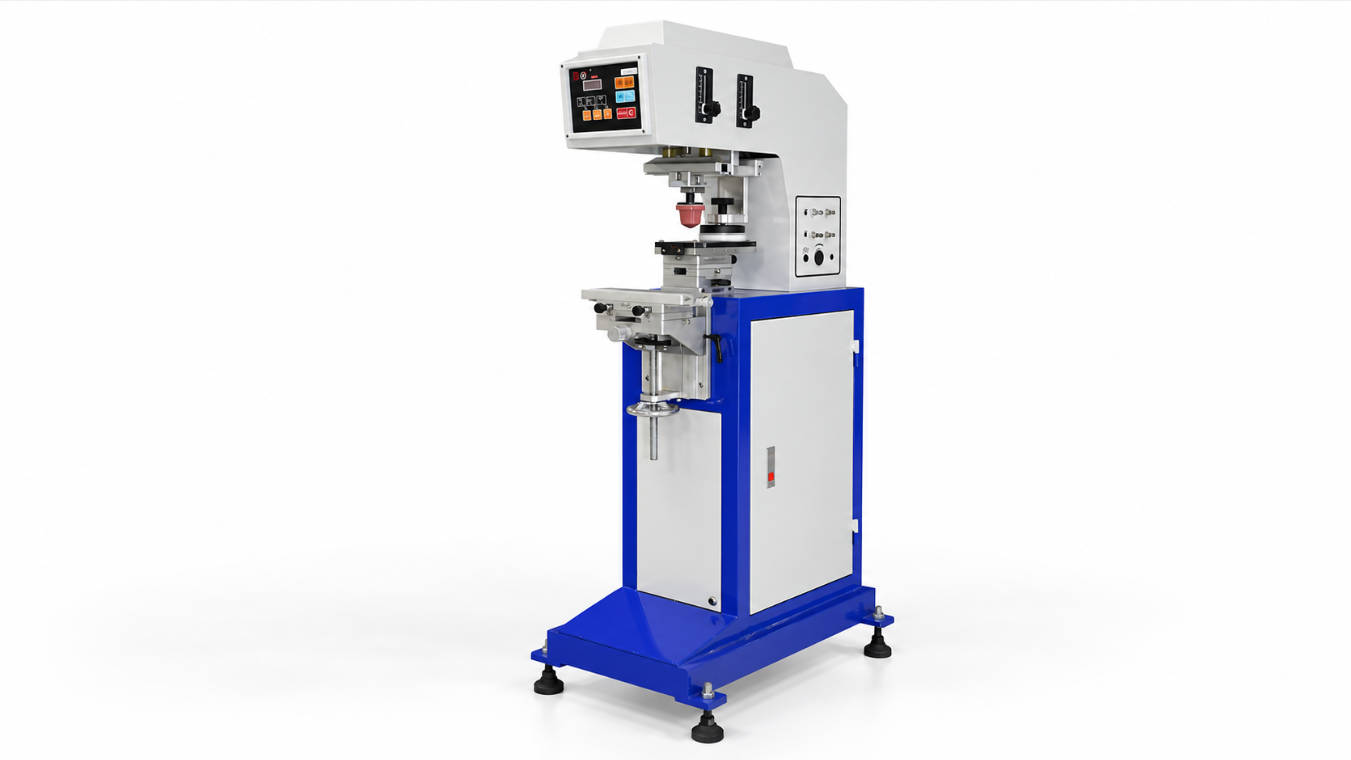
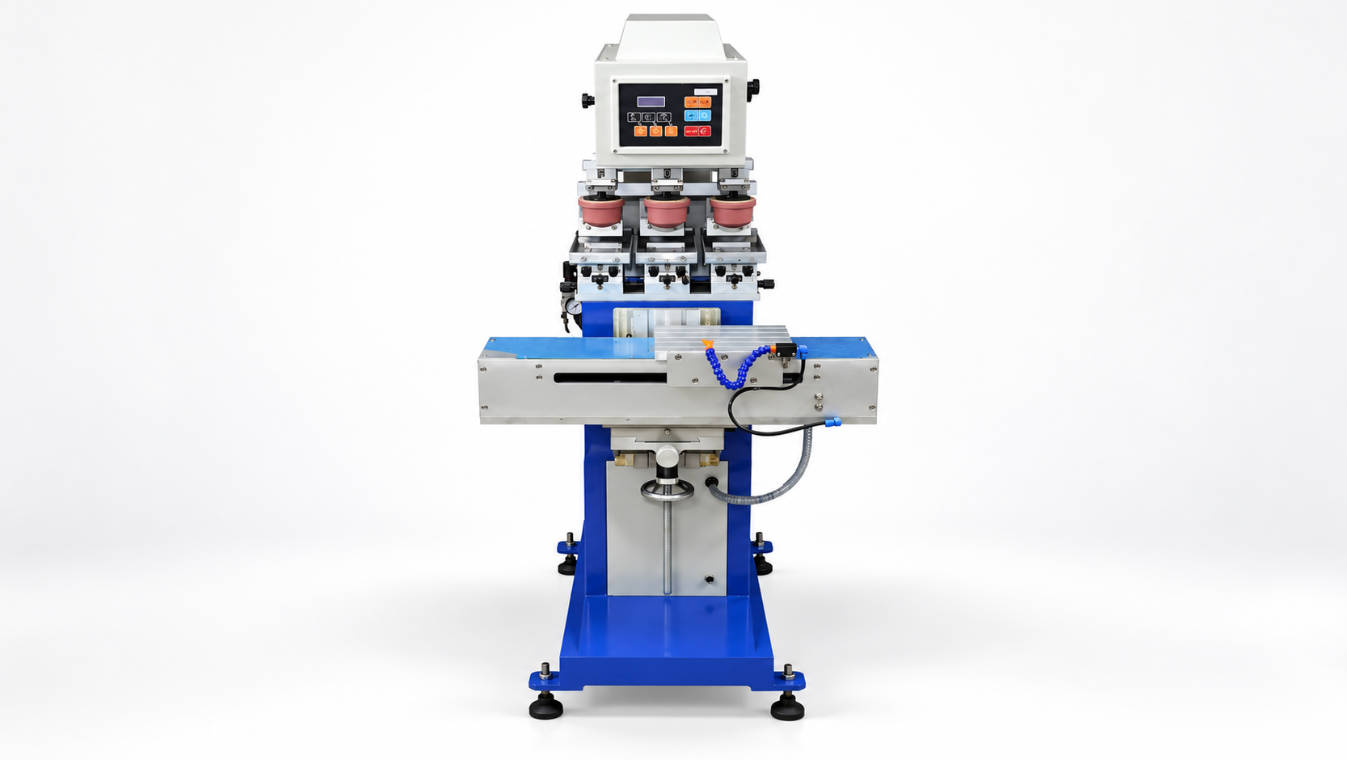
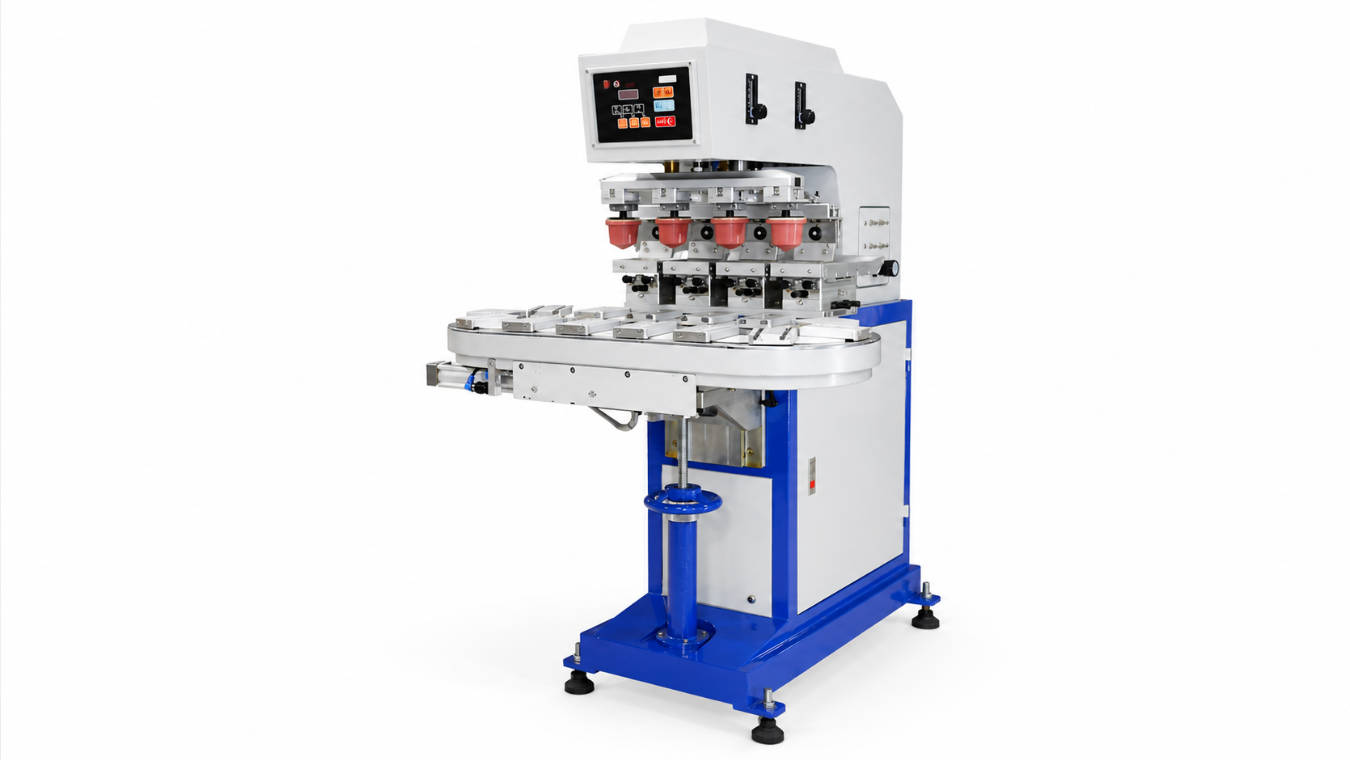
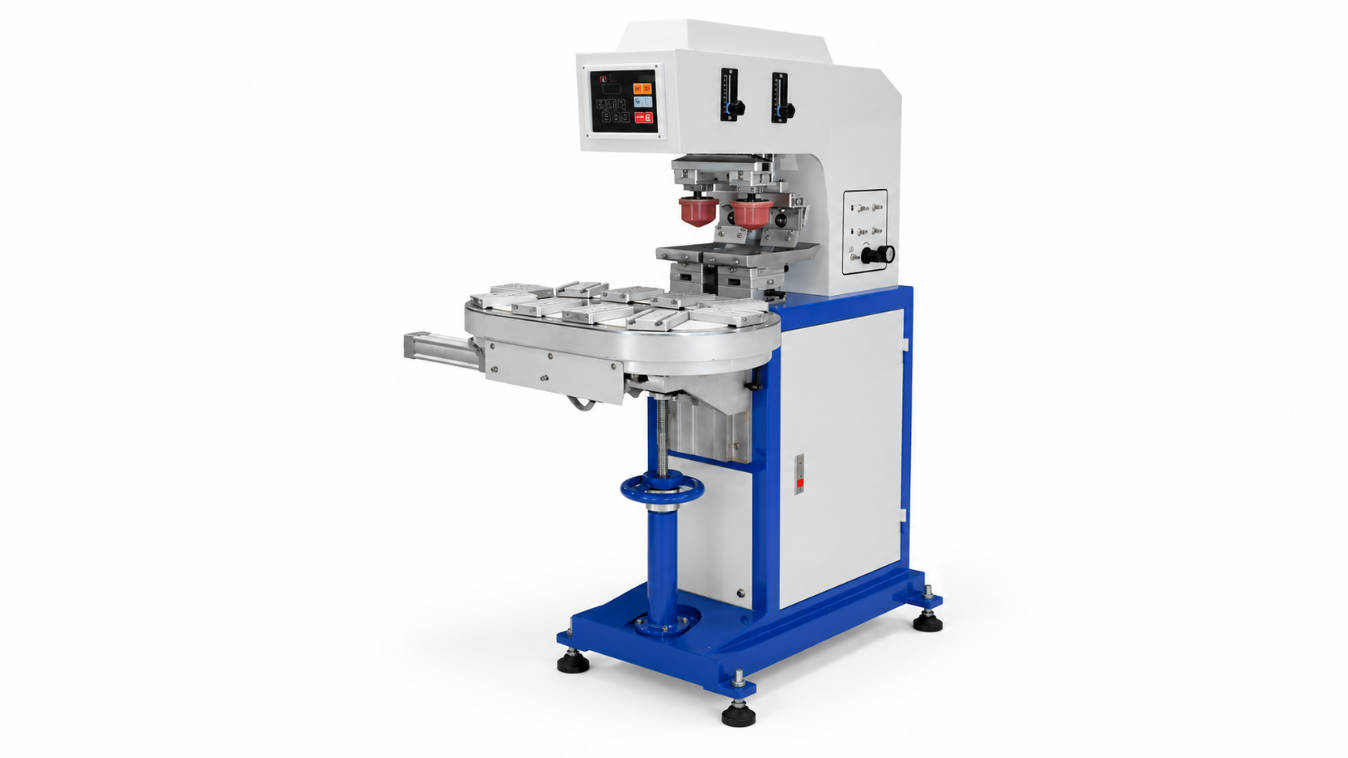
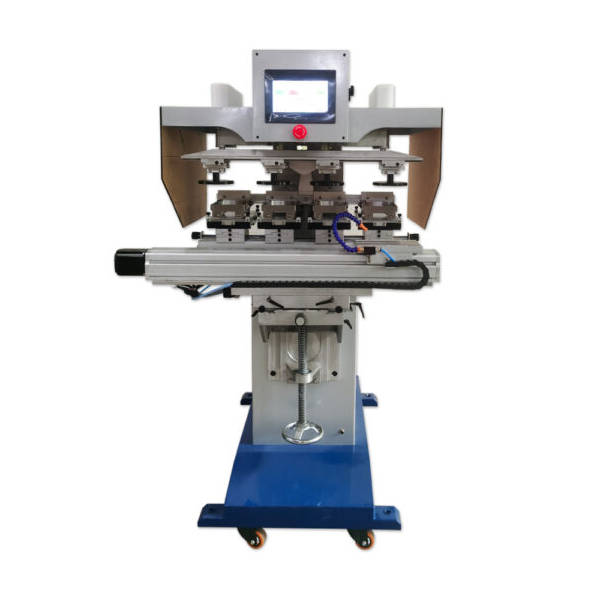
An industrial pad printer is different from a small pad printer in frame rigidity, motion repeatability, pneumatic or drive system stability, fixture integration, long-run durability, automation compatibility, and production consistency. A small pad printer may be suitable for samples, short batches, manual marking, or light-duty logo printing. An industrial pad printing machine is built for repeated production, more stable positioning, heavier fixtures, larger parts, multi-color processes, and longer operating hours.
For B2B buyers, the real question is not “Can this machine print the logo?” Most pad printers can produce a sample under controlled conditions. The better question is: can the machine hold the same print quality after hundreds or thousands of cycles, across real operators, real parts, real ink behavior, and real factory conditions?
This guide explains what separates an industrial pad printer from a small pad printer and how buyers should decide which machine level fits their production needs.
ENGY provides industrial pad printing machine options for one-color, multi-color, semi-automatic, automatic, standard, and customized product decoration applications.
The Fast Difference: Sample Printing vs Production Printing
A small pad printer is often designed for basic marking, simple logos, small parts, sample testing, or low-volume production. It may be compact, affordable, and easy to place on a bench. For many workshops, this is enough.
An industrial pad printer is designed for production stability. It must support stronger mechanical movement, more reliable repeat positioning, larger or more complex fixtures, higher duty cycles, and better integration with production workflow.
| Question | Small Pad Printer | Industrial Pad Printer |
| Main purpose | Samples, short runs, simple marking | Repeated production and long-run stability |
| Machine structure | Compact and light-duty | Stronger frame and more robust mechanism |
| Fixture capacity | Limited | Better support for heavier or custom fixtures |
| Repeatability | Suitable for simple jobs | Designed for more consistent batch output |
| Production hours | Intermittent or short runs | Longer daily operation |
| Automation | Limited or basic | Easier to integrate with feeders, conveyors, or rotary tables |
| Operator dependency | Higher | Can reduce variation with better structure and controls |
| Best fit | Small parts, low volume, simple logo | Industrial components, multi-shift production, precision marking |
A small pad printer is often judged by whether it can print a sample. An industrial pad printer should be judged by whether it can keep printing acceptable parts during real production.
1. Frame Strength: Why Machine Body Matters
The frame of a pad printer affects vibration, alignment, pressure stability, and long-term mechanical accuracy. Small pad printers may use lighter structures because they are designed for compact operation and simple workloads. Industrial machines usually require stronger frames because they must handle repeated pad movement, heavier tooling, larger parts, or longer shifts.
Frame strength matters when:
- The product is larger or heavier.
- The fixture is custom-machined and heavy.
- The print position must stay consistent.
- The machine runs for many hours per day.
- Multi-color registration is required.
- The pad stroke applies higher repeated force.
- The production environment has vibration or operator handling variation.
A weak frame may still print a good sample, but small mechanical flex can become visible in long-run production. This is especially true for fine logos, small text, multi-color graphics, and parts that require accurate positioning.
Industrial pad printing machines are typically selected when mechanical stability matters as much as print capability.
2. Repeatability: The Real Production Test
Repeatability means the machine can reproduce the same print position, pressure, and transfer behavior over repeated cycles. In pad printing, repeatability depends on the machine, fixture, pad, plate, ink, part loading, and operator setup.
An industrial pad printer should support more consistent repeatability through:
| Repeatability Factor | Why It Matters |
| Stable pad stroke | Controls print pressure and image transfer |
| Accurate shuttle or table movement | Keeps part and image aligned |
| Strong fixture support | Prevents part movement |
| Consistent ink system movement | Helps maintain image pickup |
| Reliable mechanical stops or controls | Reduces drift during production |
| Better component durability | Maintains performance over longer use |
For small pad printers, repeatability may be acceptable for basic marking. But when the printed part must pass appearance inspection, positioning tolerance, or customer approval, industrial-grade repeatability becomes more valuable.
Examples where repeatability matters:
- Logos on electronic housings
- Button icons on control panels
- Scale marks on medical parts
- Decorative graphics on toy components
- Brand marks on cosmetic packaging
- Functional symbols on switches
- Batch marks on industrial components
3. Pneumatic System or Drive System Stability
Many industrial pad printers use pneumatic systems, electric drives, or hybrid drive structures. The drive system controls how the pad, plate, shuttle, or table moves. For industrial use, stability of the drive system is critical.
In pneumatic pad printers, buyers should check:
- Air pressure stability
- Cylinder quality
- Valve response
- Speed control
- Air filtration
- Moisture control
- Compressor capacity
- Consistent motion under repeated cycles
In electric or servo-controlled systems, buyers should check:
- Motor control accuracy
- Sensor reliability
- Parameter repeatability
- Program storage
- Movement sequence control
- Maintenance and troubleshooting support
A small printer may run well for occasional use, but industrial production exposes weakness quickly. If the air supply is unstable, if the shuttle movement drifts, or if the pad stroke changes under repeated operation, print quality will fluctuate.
| Drive System Issue | Possible Print Result |
| Unstable air pressure | Uneven pad pressure or incomplete transfer |
| Worn cylinder or valve | Slower movement or inconsistent timing |
| Poor speed control | Smearing, distortion, or poor pickup |
| Weak shuttle repeatability | Misaligned print position |
| Poor sensor control | Process interruption or inconsistent sequence |
4. Fixture Integration: Small Machines Hold Parts; Industrial Machines Support Processes
Fixture design is one of the biggest differences between a small pad printer and an industrial pad printer. A small printer may include a simple product holder or adjustable table. This is suitable for basic products. Industrial printing often requires a more engineered fixture.
A production fixture may need to:
- Hold the part in a repeatable position
- Support irregular geometry
- Prevent part deformation
- Allow fast loading and unloading
- Protect cosmetic surfaces from scratches
- Maintain position for multi-color printing
- Work with rotary tables, conveyors, or shuttles
- Support multiple cavities or multiple parts per cycle
- Integrate with automatic feeding or unloading
For industrial pad printing, the fixture is not an accessory; it is part of the production process.
If the machine frame is too small or the worktable is too weak, a custom fixture may not fit or may not remain stable. This is why industrial machines often have stronger bases, larger work areas, better positioning systems, and more flexible integration options.
5. Long-Run Ink Control and Printing Stability
Pad printing quality is strongly affected by ink behavior. Over time, ink viscosity, solvent evaporation, plate cleanliness, pad condition, and environmental factors can change the print result.
Industrial pad printers often use closed ink cup systems for cleaner, more stable operation, especially for small to medium images. Open tray systems may still be used when the print area is larger or when the application requires more flexible plate coverage. Sealed ink cup systems act as ink supply and doctoring mechanism in one unit; open inkwell systems use an ink trough, flood bar, and doctor blade approach. (维基百科)
For long-run production, buyers should review:
| Ink Control Factor | Production Impact |
| Closed ink cup quality | Helps reduce open ink exposure |
| Plate surface stability | Affects image clarity |
| Doctoring consistency | Controls excess ink removal |
| Ink viscosity control | Affects transfer and edge definition |
| Cleaning access | Reduces downtime |
| Pad life | Affects long-run consistency |
| Operator procedure | Reduces batch-to-batch variation |
A small pad printer can often print well when carefully adjusted. Industrial production needs the machine to stay stable with less frequent intervention.
6. Production Capacity: Not Just Machine Speed
Many buyers ask for printing speed first. This is understandable, but machine speed alone does not define production capacity. A small machine may have a fast cycle time but still produce low output because of manual loading, slow alignment, frequent cleaning, or unstable positioning.
True production capacity depends on:
- Cycle time
- Loading method
- Fixture design
- Number of parts per cycle
- Ink drying time
- Operator handling time
- Scrap rate
- Setup and changeover time
- Inspection process
- Maintenance stops
| Capacity Factor | Small Pad Printer | Industrial Pad Printer |
| Manual loading | Usually slower and more operator-dependent | Can be optimized with fixtures or automation |
| Multi-part printing | Limited | More feasible with larger fixtures |
| Long-run operation | May require more pauses | Designed for longer production |
| Changeover | Simple for small jobs | Can support structured setup for repeated products |
| Scrap control | More dependent on operator skill | Better process control can reduce variation |
A production pad printer should be evaluated by acceptable output, not only theoretical cycle speed.
7. Automation Compatibility
Small pad printers are usually not designed for complex automation. They may work well as standalone machines. Industrial pad printers are more suitable when the buyer wants to add rotary tables, conveyors, automatic feeding, unloading, part detection, or integrated drying.
Automation may be useful when:
- Product volume is high.
- Parts are small and repetitive.
- Manual loading limits output.
- Multi-position printing is required.
- The process needs consistent timing.
- The buyer wants to reduce operator dependency.
- Inspection or drying needs to be integrated.
Common industrial configurations may include:
| Configuration | Suitable Use |
| Semi-automatic pad printer | Manual loading with automated print cycle |
| Rotary table pad printer | Multiple stations for loading, printing, drying, unloading |
| Conveyor pad printer | Repeated product flow |
| Multi-color pad printer | Logos or graphics requiring registration |
| Custom fixture system | Special parts or complex holding needs |
| Automatic feeding system | Small parts or high-volume batches |
ENGY’s pad printing machine category includes standard and customized options for different production needs.
8. Small Pad Printer vs Industrial Pad Printer: Cost Logic
An industrial pad printer usually costs more than a small pad printer. But the purchase price is only one part of the decision. A small printer may be cheaper, but if it creates more scrap, slower output, unstable prints, or frequent adjustment, the total cost may increase.
| Cost Area | Small Pad Printer | Industrial Pad Printer |
| Initial purchase | Lower | Higher |
| Fixture integration | Limited | Better support for custom tooling |
| Operator time | Often higher for repeated manual work | Can be reduced with better process design |
| Scrap risk | Higher if part positioning is unstable | Lower when properly configured |
| Maintenance demand | Lower for simple use, but less robust | Higher capability, needs regular maintenance |
| Production scalability | Limited | Better for volume growth |
| Long-term value | Good for small jobs | Better for repeated production |
Buyers should calculate cost based on the whole process, not only the machine quote.
9. When a Small Pad Printer Is Enough
A small pad printer may be a good choice when:
- You are printing samples or prototypes.
- Production volume is low.
- The product is small and easy to position.
- The logo is simple and one-color.
- The print area is small.
- You do not need automation.
- Budget is limited.
- The machine will not run long shifts.
- Operators can manually adjust the process.
Small machines are useful and practical in the right situation. They are not “bad” machines. They simply have a different purpose.
10. When You Should Choose an Industrial Pad Printer
Choose an industrial pad printer when:
- The product must be printed repeatedly in batches.
- Print position must remain stable.
- The part requires a custom fixture.
- The machine will run for long periods.
- You need better mechanical rigidity.
- Multi-color registration is required.
- The product is larger or heavier.
- You need semi-automatic or automatic production.
- The buyer wants room for future product expansion.
- The cost of scrap or downtime is high.
Industrial machines are especially suitable for electronic components, plastic housings, medical parts, toys, automotive components, cosmetic packaging, hardware products, bottle caps, and other B2B product decoration applications.
11. Questions to Ask Before Ordering
Before requesting an industrial pad printer recommendation, prepare answers to these questions:
| Question | Why It Matters |
| What product will be printed? | Determines machine size and fixture needs |
| What is the product material? | Affects ink and pretreatment |
| What is the logo size? | Determines plate, pad, and ink cup requirements |
| How many colors are needed? | Determines machine configuration |
| What is the expected output? | Determines manual, semi-auto, or automatic setup |
| How long will the machine run per shift? | Affects duty cycle requirements |
| Is print position critical? | Affects fixture and movement accuracy |
| Is the product heavy or irregular? | Affects frame and worktable strength |
| Will production expand later? | Affects future machine flexibility |
| What quality checks are required? | Affects process control and inspection planning |
For an application-based recommendation, buyers can send product photos, logo size, material, and output requirements through ENGY’s industrial pad printer product page.
12. Supplier Evaluation: What an Industrial Buyer Should Look For
A supplier should not only provide a machine model. For industrial production, the supplier should help evaluate the whole printing process.
Look for support in:
- Product sample review
- Print area evaluation
- Machine size recommendation
- Closed ink cup or open tray selection
- Pad and plate selection
- Fixture design
- Pneumatic or drive system recommendation
- One-color or multi-color configuration
- Semi-automatic or automatic process planning
- Sampling before delivery
- Operation training
- Engineering support
ENGY states that it offers standard and customized pad printers, along with sampling service before delivery, operation training, and engineering consultant support for production problems. This matters for industrial buyers because production success depends on setup and process support, not only the machine body. (ENGYPRINT)
You can also visit the ENGY website to review the company and its broader printing equipment background.
FAQ
1. What is an industrial pad printer?
An industrial pad printer is a pad printing machine designed for repeated production, stronger fixture support, better motion repeatability, longer operating hours, and more stable batch printing than a small light-duty pad printer.
2. What is the difference between an industrial pad printing machine and a small pad printer?
The main differences are frame strength, repeatability, fixture capacity, drive system stability, automation compatibility, and long-run performance. A small pad printer is often used for samples or simple jobs, while an industrial pad printer is built for production.
3. When should I choose a heavy duty pad printer?
Choose a heavy duty pad printer when the product is larger, the fixture is heavier, the machine runs for long shifts, print position is critical, or the production process requires stable repeated output.
4. Is a small pad printer enough for production?
A small pad printer can be enough for low-volume or simple production. It may not be suitable if you need long-run stability, custom fixtures, multi-color registration, or automation.
5. What should I check before buying a production pad printer?
Check product size, material, logo size, color count, output requirement, fixture design, print position tolerance, drive system, ink system, machine duty cycle, and supplier support.
6. Does an industrial pad printer need a custom fixture?
Not always, but many industrial applications benefit from a custom fixture. A custom fixture improves positioning, loading speed, repeatability, and multi-color registration.
7. Is an industrial pad printer more expensive than a small pad printer?
Usually yes, but the total cost should include scrap rate, labor time, downtime, output stability, fixture integration, and future scalability, not only the machine purchase price.
Conclusion
An industrial pad printer is different from a small pad printer because it is built around production stability. The key differences are stronger machine structure, better repeatability, more reliable drive systems, stronger fixture integration, longer operating capability, and better compatibility with semi-automatic or automatic production.
A small pad printer can be the right choice for samples, short runs, simple logos, and low-volume work. An industrial pad printing machine is more suitable when the buyer needs repeated output, stable print position, heavier tooling, long-run reliability, and future production scalability.
Before ordering, prepare product samples, material information, logo size, color count, output target, and quality requirements. ENGY can help review your application and recommend a suitable industrial pad printing machine for your production needs.