Are pad printing inks safe for toys and baby products?
The correct answer is: they can be, but safety cannot be determined simply by the fact that an ink is used for pad printing.
A pad printing ink is suitable for toys only when its formulation, cured print, substrate, intended use, child-accessibility, and finished product meet the applicable safety requirements of the target market.
This distinction is important.
Terms such as:
- non-toxic;
- lead-free;
- toy-safe;
- EN 71 compliant;
- low-VOC
may provide useful information about an ink formulation, but they do not automatically prove that the finished toy or baby product complies with every applicable regulation.
A printed toy combines several materials:
- molded plastic;
- coatings;
- primers;
- printing ink;
- hardener;
- additives;
- sometimes clear coatings.
For compliance purposes, manufacturers need to evaluate the finished product and its intended use—not just the printing machine or ink label.
Why Toy Printing Ink Gets More Scrutiny Than Ordinary Product Printing
A printed industrial tool and a printed baby toy may use similar decoration technology, but the risk assessment is very different.
Children may:
- touch toys repeatedly;
- put toys in their mouths;
- suck or lick surfaces;
- scratch printed areas;
- chew components;
- transfer substances from the toy to their hands and mouth.
Younger children are especially relevant because mouthing behavior is expected for many products.
That means the durability and chemical composition of printed decorations can matter much more than they would on an ordinary industrial component.
For a toy manufacturer, the question should therefore not be only:
“Will this ink stick to ABS?”
It should also be:
“Will the finished printed product comply with the requirements that apply to its age group, market, material, and intended use?”
“Non-Toxic Ink” Is Not a Complete Compliance Standard
This is one of the biggest misconceptions in toy manufacturing.
An ink supplier may describe a formulation as non-toxic.
That does not automatically tell you:
- which regulations were evaluated;
- which substances were tested;
- which test method was used;
- which substrate was printed;
- whether hardener was included;
- whether the sample was fully cured;
- whether the finished product is intended to be mouthed.
“Non-toxic” is a general description; toy compliance is based on specific requirements and testing.
Manufacturers should request actual technical and compliance documentation rather than relying only on marketing terminology.
What Do U.S. Toy Manufacturers Need to Consider?
For children’s toys sold in the United States, ASTM F963 is incorporated into federal requirements under 16 CFR Part 1250. The currently mandatory version is ASTM F963-23 for toys manufactured or imported on or after April 20, 2024. Toys intended primarily for children 12 and under generally require testing by a CPSC-accepted third-party laboratory for applicable requirements and certification.
Printed decorations can be relevant to several chemical requirements.
Lead in Paint and Similar Surface Coatings
For children’s products subject to the federal lead-in-paint requirement, paint and similar surface coatings must not contain more than 90 ppm lead. Accessible component parts of children’s products are also subject to a 100 ppm total lead content limit where applicable.
This is why simply asking whether an ink is “lead-free” is not enough.
Manufacturers need documentation and testing appropriate to the finished product.
Soluble Heavy Elements
ASTM F963 includes requirements concerning soluble heavy elements in relevant toy materials and surface coatings.
These can include elements such as:
- antimony;
- arsenic;
- barium;
- cadmium;
- chromium;
- lead;
- mercury;
- selenium.
Whether particular testing applies depends in part on the toy, accessibility, age grading, and whether components can reasonably be sucked, mouthed, or ingested.
Phthalates
Certain children’s toys and child-care articles are also subject to U.S. phthalate restrictions. CPSC guidance states that regulated phthalates may not exceed 0.1% in applicable accessible plasticized component parts.
Although phthalates are often discussed in relation to plastics, printing formulations, coatings, and related materials should not be ignored when assessing the complete product.
What About Toys Sold in the European Union?
As of 2026, the existing Toy Safety Directive 2009/48/EC remains the primary substantive toy-safety framework during the transition to Regulation (EU) 2025/2509. The new Regulation generally applies from August 1, 2030, while certain administrative and enforcement provisions already apply earlier.
For printed toy materials, chemical safety and migration requirements are particularly relevant.
The EU’s current harmonized toy standards include EN 71-3:2019+A2:2024, covering migration of certain elements.
This means manufacturers should not treat “EN 71 ink” as a shortcut that removes the need to understand the finished application.
A compliant production program needs to consider:
- the exact ink system;
- pigments;
- hardener;
- printed film;
- substrate;
- accessibility;
- intended child age;
- migration requirements;
- other applicable chemical restrictions.
REACH restrictions may also apply depending on the substances and product.
U.S. vs EU: What Does a Toy Printer Actually Need to Know?
| Market | Important Reference Areas | Printing-Relevant Concern |
|---|---|---|
| United States | CPSIA, ASTM F963, 16 CFR requirements | Lead, soluble elements, phthalates, finished-product testing |
| European Union | Toy Safety Directive during current transition, EN 71 series, REACH where applicable | Migration of elements, restricted chemicals, toy-material safety |
| Other markets | National or regional toy regulations | Requirements vary by destination |
The important lesson is not to memorize one standard number.
The destination market should be defined before ink and production specifications are finalized.
A toy manufactured for the U.S., EU, and other markets may need a broader compliance plan than a product sold only in one country.
Why Mouthing Changes the Risk Assessment
A decorative mark on the bottom of a toy for older children is not necessarily evaluated in the same way as a printed surface on a product that a baby is expected to put in their mouth.
U.S. toy guidance specifically distinguishes components that may be sucked, mouthed, or ingested when considering certain soluble-element testing requirements.
This matters for products such as:
- rattles;
- teething-related products;
- baby toys;
- toy figures for young children;
- toy components small enough to be mouthed.
If the printed area is likely to contact the mouth, manufacturers should tell both the ink supplier and compliance laboratory at the beginning of the project.
Do not wait until after production.
Toy Products and Baby Products Are Not Always the Same Regulatory Category
This distinction is especially important.
The term “baby product” can include:
- toys;
- teethers;
- pacifiers;
- feeding products;
- bottles;
- cups;
- child-care articles;
- non-toy accessories.
These products may fall under different regulatory frameworks.
For example, a toy designed for a baby and a feeding bottle are not automatically subject to exactly the same rules simply because both are used by infants.
Likewise, food-contact products may trigger additional requirements that do not apply to an ordinary toy.
Do not use “toy-safe ink” as proof that an ink is suitable for every baby product or food-contact application.
The exact product category needs to be established first.
What Makes a Pad Printing Ink Suitable for Toy Applications?
Ink selection should begin with four questions.
1. What Is the Toy Made From?
Common substrates include:
- ABS;
- PP;
- PE;
- PVC;
- PC;
- painted plastic;
- rubber-like materials;
- silicone.
Each material behaves differently.
Ink that bonds well to ABS may not bond properly to untreated PP.
Low-surface-energy plastics such as PP and PE may require surface treatment before printing.
Poor adhesion creates more than a cosmetic problem.
If printed material flakes or rubs away, it can change the exposure profile of the product and indicate that the manufacturing process is not stable.
2. Where Will the Printed Area Be Located?
Consider whether the print is:
- frequently touched;
- likely to be mouthed;
- on a removable part;
- exposed to saliva;
- on a toy face;
- inside a recessed area;
- on an electronic button.
Location influences both durability and compliance evaluation.
3. What Performance Must the Print Survive?
The finished decoration may require resistance to:
- rubbing;
- scratching;
- saliva;
- sweat;
- water;
- cleaning;
- packaging abrasion;
- household chemicals.
4. Which Market Will Receive the Product?
Do not develop the ink specification first and investigate regulations later.
Compliance requirements should be part of product development from the start.
Heavy Metals: Why Pigments Matter
Color is created using pigments.
Historically, certain pigments and formulations across the coatings industry could contain regulated metals.
Modern toy-grade systems are developed with safety restrictions in mind, but manufacturers should still verify documentation and finished-product compliance.
Bright colors should not be assumed safe or unsafe based simply on appearance.
A red, yellow, blue, black, or white ink must be evaluated according to its actual formulation and applicable testing.
This becomes especially important in multi-color toy printing because one toy may contain many separate ink formulations.
A twelve-color toy decoration project can involve substantially more chemical inputs than a simple one-color logo.
Does Curing Affect Toy Safety?
Yes, curing is important for both performance and process control.
Pad printing ink may cure through:
- solvent evaporation;
- chemical crosslinking;
- heat;
- UV energy;
- a combination of mechanisms.
A two-component ink may require a hardener.
If the mixing ratio is wrong or the print is not fully cured, expected mechanical and chemical performance may not develop correctly.
That can lead to:
- poor adhesion;
- rubbing;
- peeling;
- residual solvent issues;
- inconsistent finished parts.
A compliant ink formulation still needs to be processed according to its specified mixing and curing conditions.
ENGY’s pad printing ink types guide explains how solvent-based, UV-curable, and silicone ink systems differ in curing and substrate compatibility.
Durability Is Part of the Safety Conversation
A printed toy does not stop being evaluated once the first sample looks good.
Children repeatedly:
- handle;
- rub;
- drop;
- scratch;
- wash;
- mouth
products.
The print therefore needs sufficient adhesion for the intended use.
Useful production checks can include:
| Test | What It Helps Evaluate |
|---|---|
| Tape adhesion | Whether ink bonds to the substrate |
| Rub testing | Repeated handling resistance |
| Scratch testing | Surface mechanical durability |
| Chemical wipe | Resistance to specified cleaners or substances |
| Saliva-related testing | Relevant to applicable mouthing requirements |
| Migration testing | Chemical migration under applicable toy standards |
| Use-and-abuse testing | Whether accessible parts change after foreseeable use |
Not every product requires every test.
The final compliance program should be defined by the product and destination requirements.
Can a Toy Manufacturer Just Buy “EN 71 Ink”?
This is another common misunderstanding.
Suppose an ink supplier provides documentation showing that an ink sample has passed a particular EN 71 test.
That is useful.
But now the factory:
- mixes the ink with a hardener;
- adds thinner;
- prints onto a coated plastic part;
- adds another color;
- applies a clear coating;
- changes the curing process.
The final decorated product is no longer simply the original ink sample.
This is why compliance laboratories evaluate finished products or representative materials according to applicable requirements.
Supplier test reports are valuable supporting documents, but they should not automatically replace finished-product compliance testing.
What Documentation Should Toy Manufacturers Request From Ink Suppliers?
Depending on the project, request appropriate documentation such as:
- Safety Data Sheet (SDS);
- Technical Data Sheet (TDS);
- pigment or heavy-metal information;
- relevant toy-safety test reports;
- REACH information where applicable;
- recommended substrate list;
- hardener specification;
- mixing ratio;
- curing conditions;
- lot or batch traceability information.
Documentation should match the actual ink series being purchased.
Do not rely on a test report for one color or formulation and automatically assume every other formulation is identical.
Why the Pad Printing Machine Still Matters
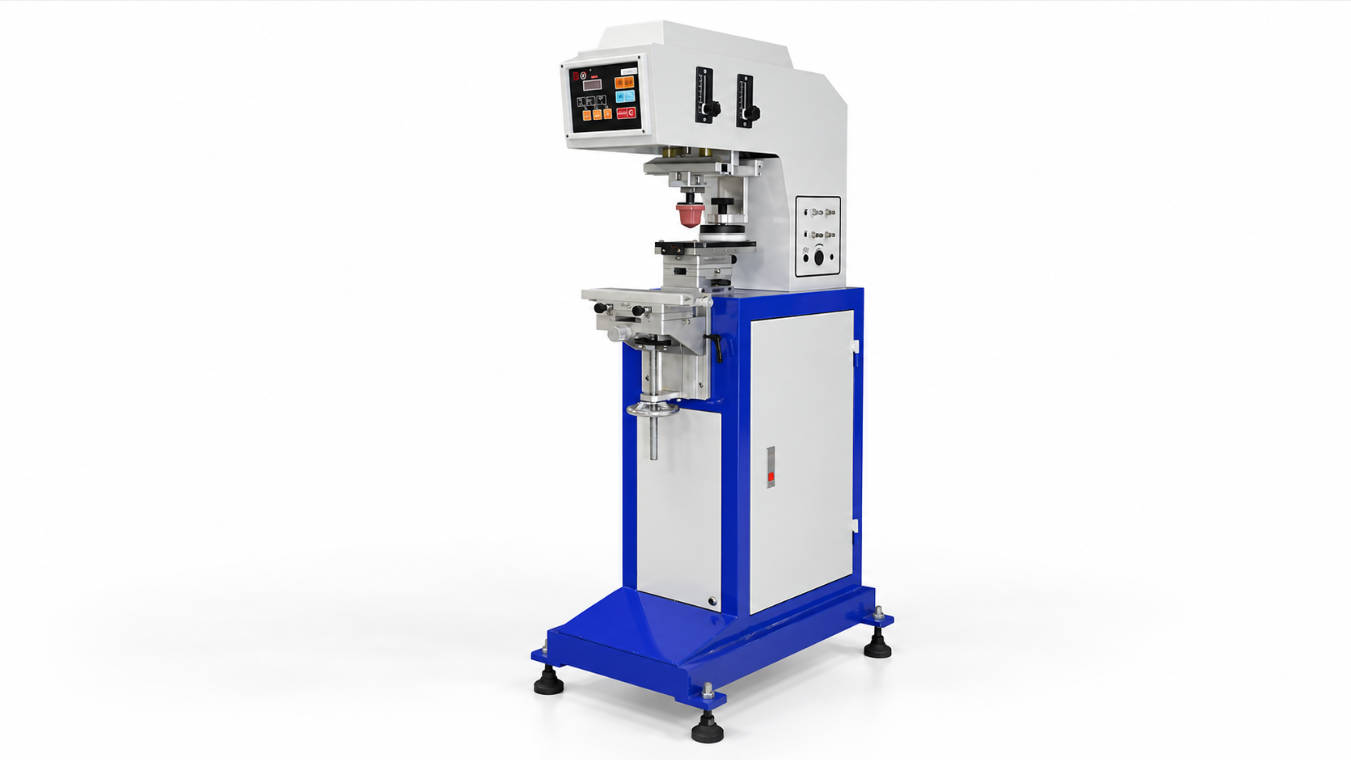
Chemical compliance comes primarily from materials and product design, but the machine affects production consistency.
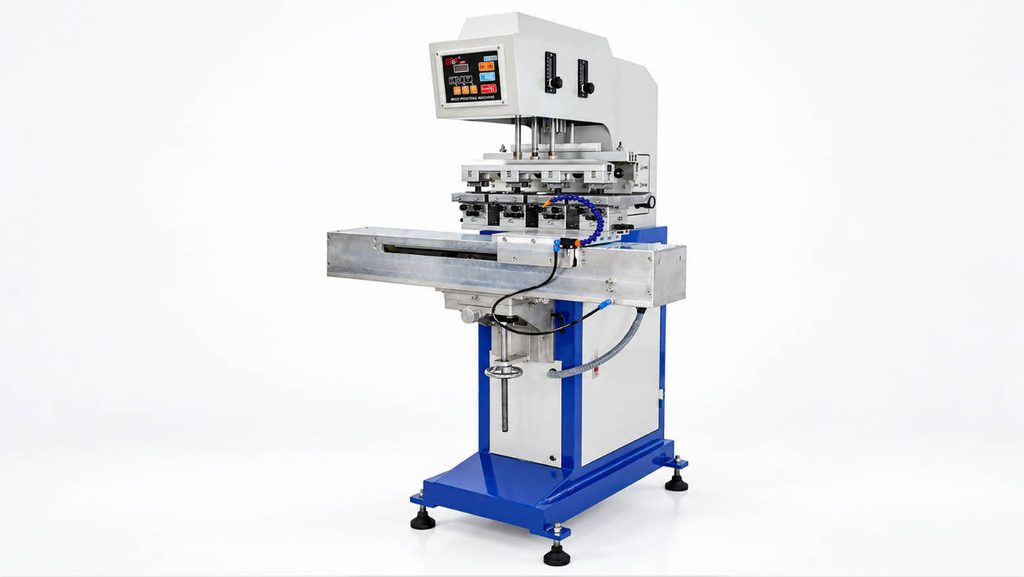
A stable toy pad printing machine helps control:
- ink transfer;
- print thickness;
- pressure;
- position;
- cycle timing;
- color registration.
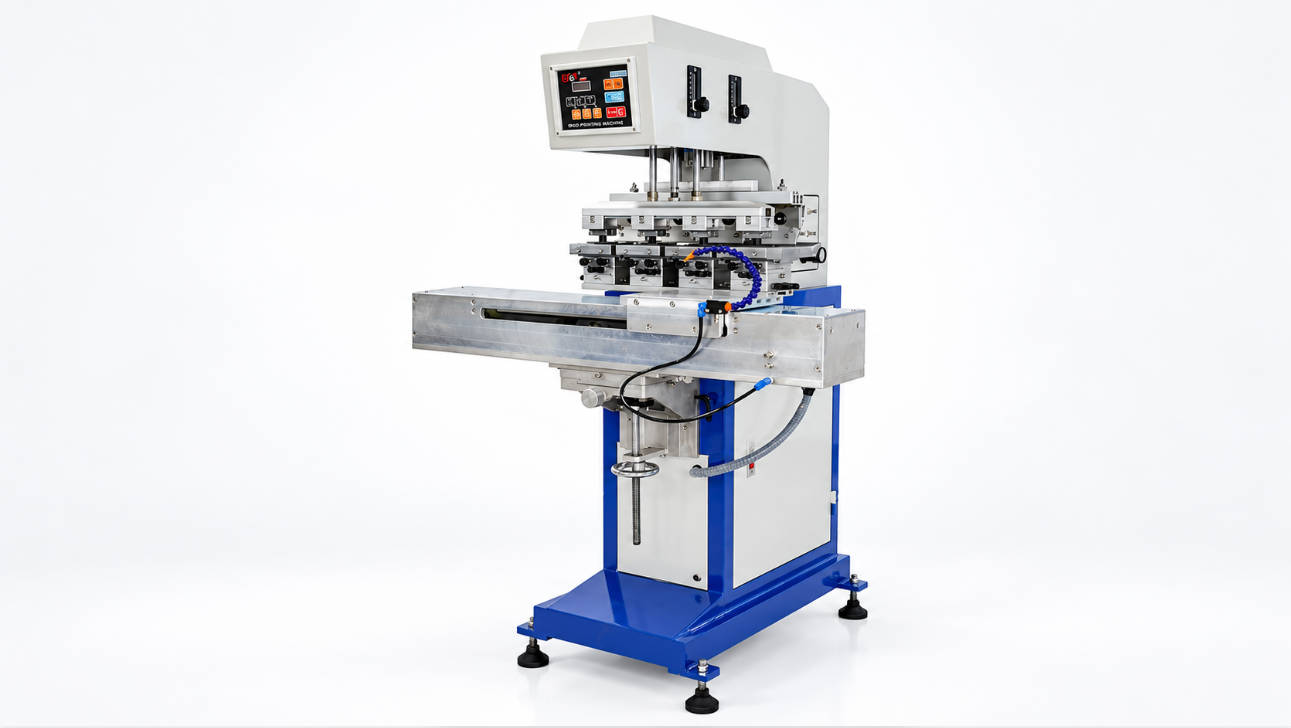
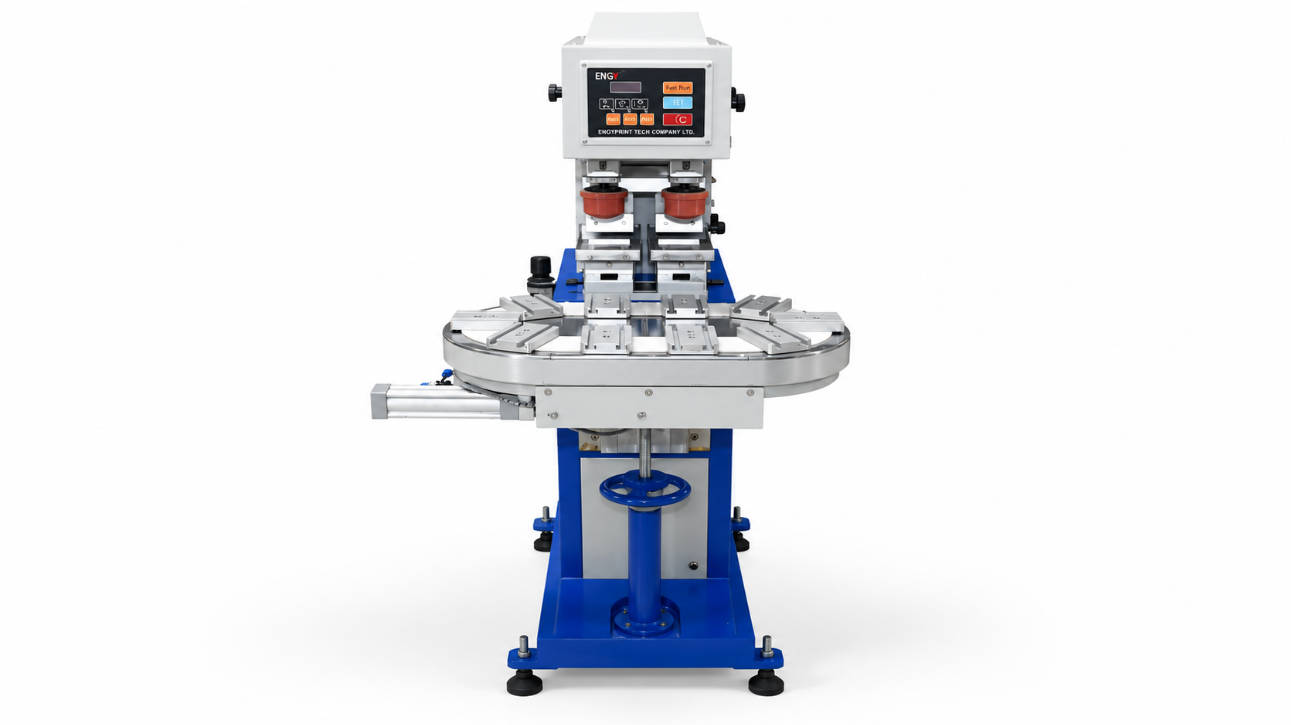
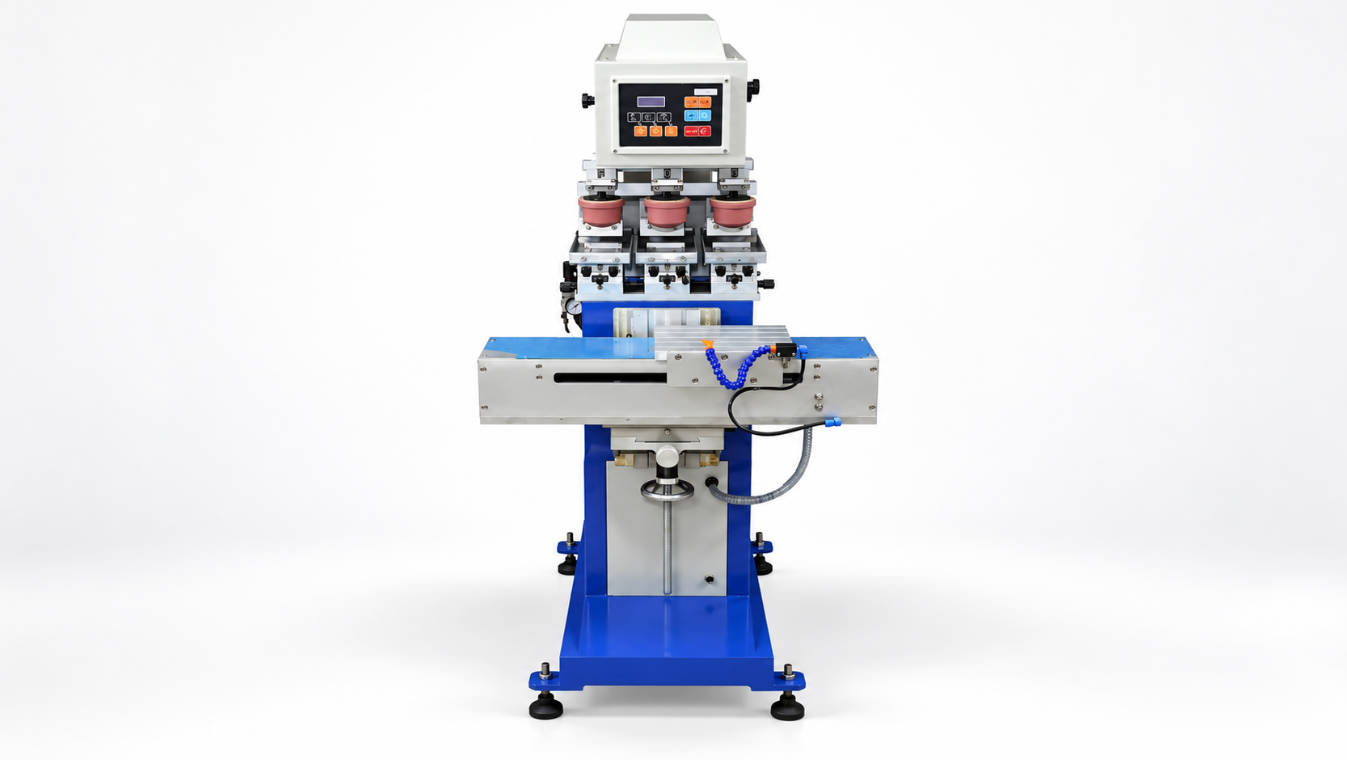
ENGY’s toy pad printing application includes multi-color toy systems using customized pads, rotating fixtures, PLC control, and configurations for complex toy printing.
For a toy face or character, the smallest positioning error can create visible problems.
Multi-color printing may require accurate alignment of:
- eyes;
- mouth;
- clothing;
- decorative lines;
- logos;
- different colors.
That is why toy production involves more than choosing a “safe ink.”
It needs a repeatable manufacturing process.
Multi-Color Toy Printing Creates More Variables
Consider a toy character printed in six colors.
Each color may involve:
- a separate cliché;
- separate ink;
- separate viscosity;
- separate transfer cycle;
- separate registration position.
A more complex character might require even more colors.
ENGY currently shows multi-color toy applications including four-color systems and customized twelve-color toy printing configurations.
The more complex the printing process becomes, the more important it is to control:
- formulation identification;
- ink preparation;
- production records;
- fixtures;
- machine repeatability;
- curing;
- test samples.
When Should a Toy Pad Printing Machine Be Customized?
A standard machine may be suitable for:
- one-color logos;
- simple flat toy parts;
- moderate production volumes;
- manual loading.
Customization becomes more relevant when products require:
- multiple colors;
- automatic feeding;
- several print locations;
- rotating fixtures;
- high output;
- surface pretreatment;
- unusual toy shapes.
ENGY’s customized pad printing machine solutions can incorporate special fixtures, feeding systems, pretreatment, multi-color printing, and other product-specific requirements.
This is especially useful when the manufacturer wants to reduce variation between operators.
Compliance Cannot Be “Built Into” the Machine
This distinction should be clear for equipment buyers.
A pad printing machine manufacturer can help with:
- machine configuration;
- pad selection;
- fixture design;
- printing trials;
- process repeatability;
- automation.
But the printing machine itself cannot certify a toy as compliant.
Final compliance depends on:
- toy design;
- raw materials;
- ink;
- coatings;
- additives;
- age grading;
- product category;
- destination market;
- finished-product testing.
ENGY’s own toy pad printing machine guide similarly notes that manufacturers need to consider material compatibility, heavy-metal restrictions, toy-safety requirements, supplier documentation, and third-party testing where applicable.
What Should You Send Before Developing a Toy Printing Process?
A useful project brief should include:
| Information | Why It Matters |
|---|---|
| Product category | Determines applicable requirements |
| Intended child age | Influences safety evaluation |
| Destination market | Determines regulatory framework |
| Toy material | Determines ink adhesion strategy |
| Printed area | Helps assess accessibility |
| Mouthing likelihood | Important for young-child products |
| Number of colors | Determines machine configuration |
| Artwork | Determines cliché and pad |
| Product dimensions | Determines fixture design |
| Required output | Determines automation |
| Durability requirement | Defines process testing |
| Existing compliance requirements | Helps select materials |
| Physical samples | Allows printing trials |
For complex products, ENGY’s custom pad printing machine service allows samples and production requirements to be evaluated before the final equipment configuration is confirmed.
A Practical Safety Workflow for Toy Pad Printing
Step 1: Classify the Product
Determine whether it is:
- a toy;
- child-care article;
- feeding product;
- another children’s product.
Step 2: Define the Destination Market
Identify applicable regulations and standards before selecting materials.
Step 3: Identify the Substrate
Confirm the exact plastic, coating, rubber, or silicone material.
Step 4: Select an Appropriate Ink System
Request relevant compliance and technical documentation.
Step 5: Confirm Every Ink Component
Include:
- pigment formulation;
- hardener;
- thinner;
- primer;
- clear coating where applicable.
Step 6: Develop the Printing Process
Control:
- cleaning;
- pretreatment;
- ink mixing;
- viscosity;
- print transfer;
- curing.
Step 7: Test Durability
Ensure the decoration remains stable under intended use.
Step 8: Perform Applicable Compliance Testing
Use qualified testing laboratories and test according to destination-market requirements.
Step 9: Maintain Production Traceability
Control ink lots, mixing, machine settings, and production changes.
This process is considerably more reliable than choosing an ink because the container says “toy safe.”
FAQ
Are pad printing inks safe for children’s toys?
They can be. Safety depends on the actual ink formulation, substrate, curing process, finished toy, intended age group, accessibility, and applicable market requirements. The finished product should be evaluated for compliance.
What ink is safe for printing on toys?
There is no single ink suitable for every toy. Manufacturers should select an ink compatible with the toy material and supported by documentation relevant to the required toy-safety standards.
Does toy printing ink need to pass EN 71?
For toys sold in the European market, applicable requirements under the EU toy-safety framework and relevant EN 71 standards should be evaluated. EN 71-3 covers migration of certain elements and can be particularly relevant to printed toy materials.
Does pad printing ink need ASTM F963 testing in the United States?
For children’s toys subject to ASTM F963, printed materials may be relevant to applicable chemical requirements. The complete toy should be evaluated based on age grading, accessibility, materials, and applicable test requirements.
What is the lead limit for toy surface coatings in the United States?
U.S. federal requirements limit lead in paint and similar surface coatings on children’s products to 90 ppm. Accessible component parts are also subject to applicable total lead requirements.
Is lead-free ink automatically safe for toys?
No. Lead is only one potential compliance concern. Depending on the product and market, manufacturers may also need to consider other heavy elements, phthalates, restricted substances, migration, and other requirements.
Can pad printing ink be used on baby toys that go in the mouth?
Potentially, but mouthing applications require additional attention. The finished product and printed area should be evaluated according to the applicable requirements for the exact product, age group, and destination market.
Is “non-toxic ink” enough for baby products?
No. “Non-toxic” alone is not a complete regulatory specification. Baby products may fall under different rules depending on whether they are toys, child-care articles, feeding products, or other product categories.
Can multi-color toys use pad printing safely?
Yes, provided all inks, additives, substrates, coatings, processing conditions, and the finished product meet the applicable requirements. Each additional color increases the number of materials that need to be controlled.
Does the pad printing machine affect toy safety compliance?
The machine affects process consistency, print transfer, registration, and repeatability, but it does not itself certify compliance. Toy safety depends on the complete finished product and applicable testing.
Conclusion
So, are pad printing inks safe for toys and baby products?
The answer is not determined by the printing process alone.
Pad printing can be used for compliant toy decoration, but safety must be demonstrated through correct material selection, controlled processing, applicable documentation, and finished-product testing.
Manufacturers should pay particular attention to:
- heavy metals;
- lead;
- applicable phthalate restrictions;
- chemical migration;
- substrate compatibility;
- ink additives and hardeners;
- curing;
- print durability;
- intended child age;
- mouthing behavior;
- destination-market regulations.
And baby products require an additional level of caution because “baby product” is a broad category. A toy, teether, feeding item, bottle, and child-care article may not share exactly the same regulatory requirements.
For B2B toy manufacturers, the practical workflow is therefore:
define the market → classify the product → select materials → develop the printing process → test the finished product → scale production.
That approach is considerably more reliable than assuming that any ink described as “non-toxic” or “toy safe” can automatically be used on every children’s product.