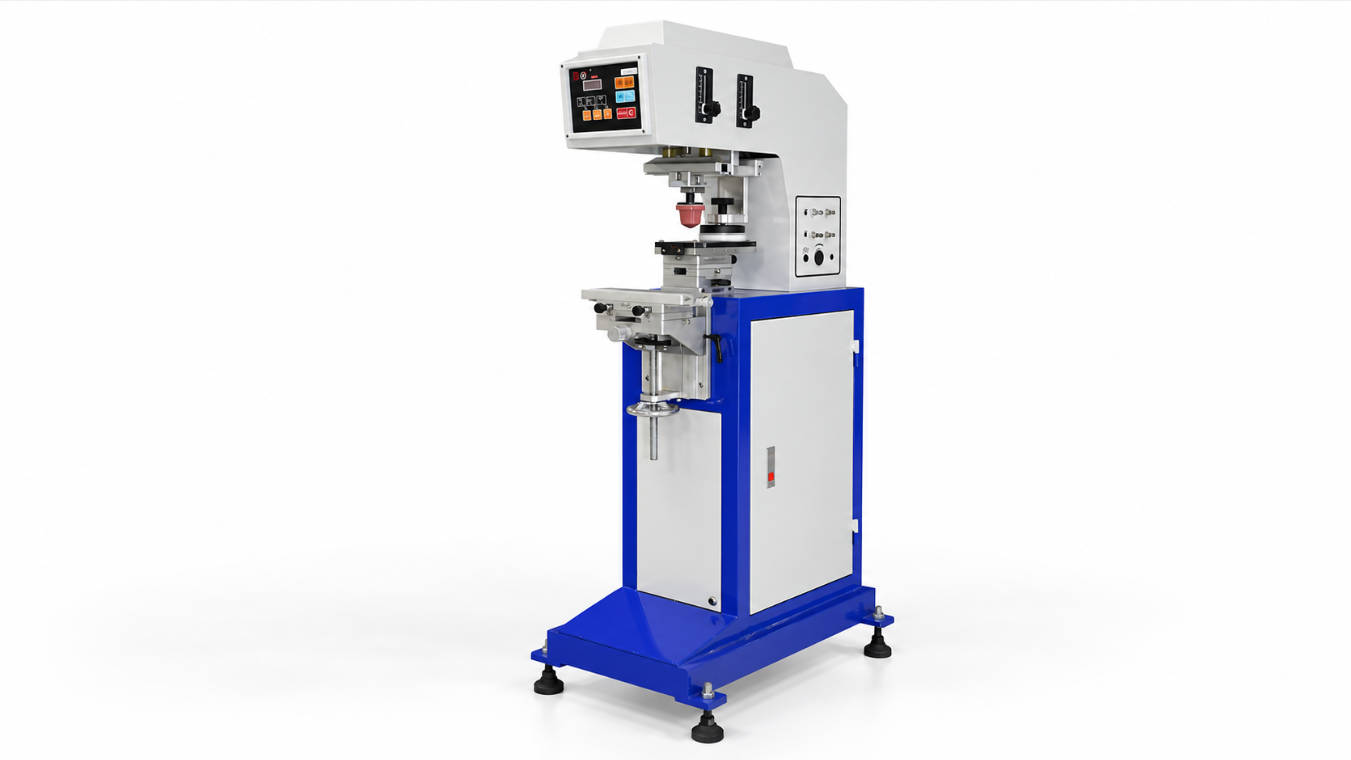
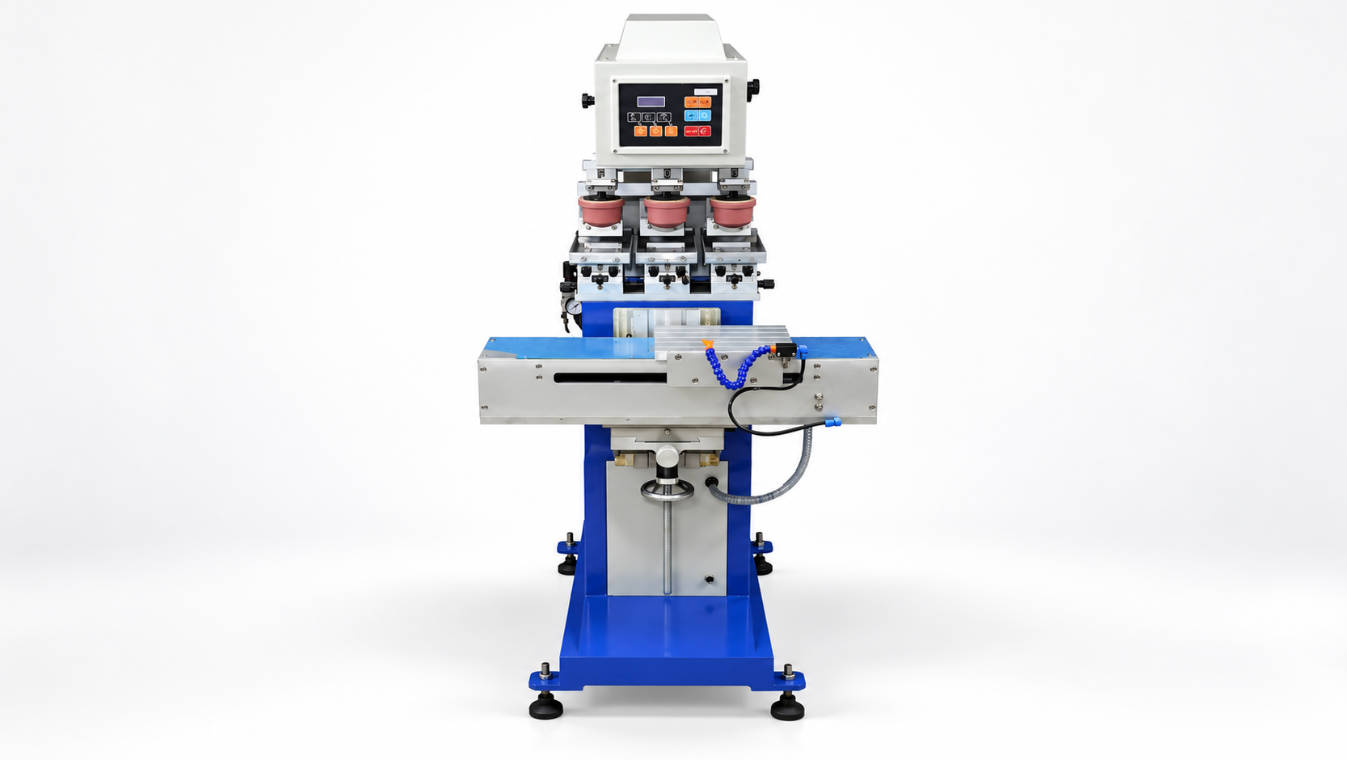
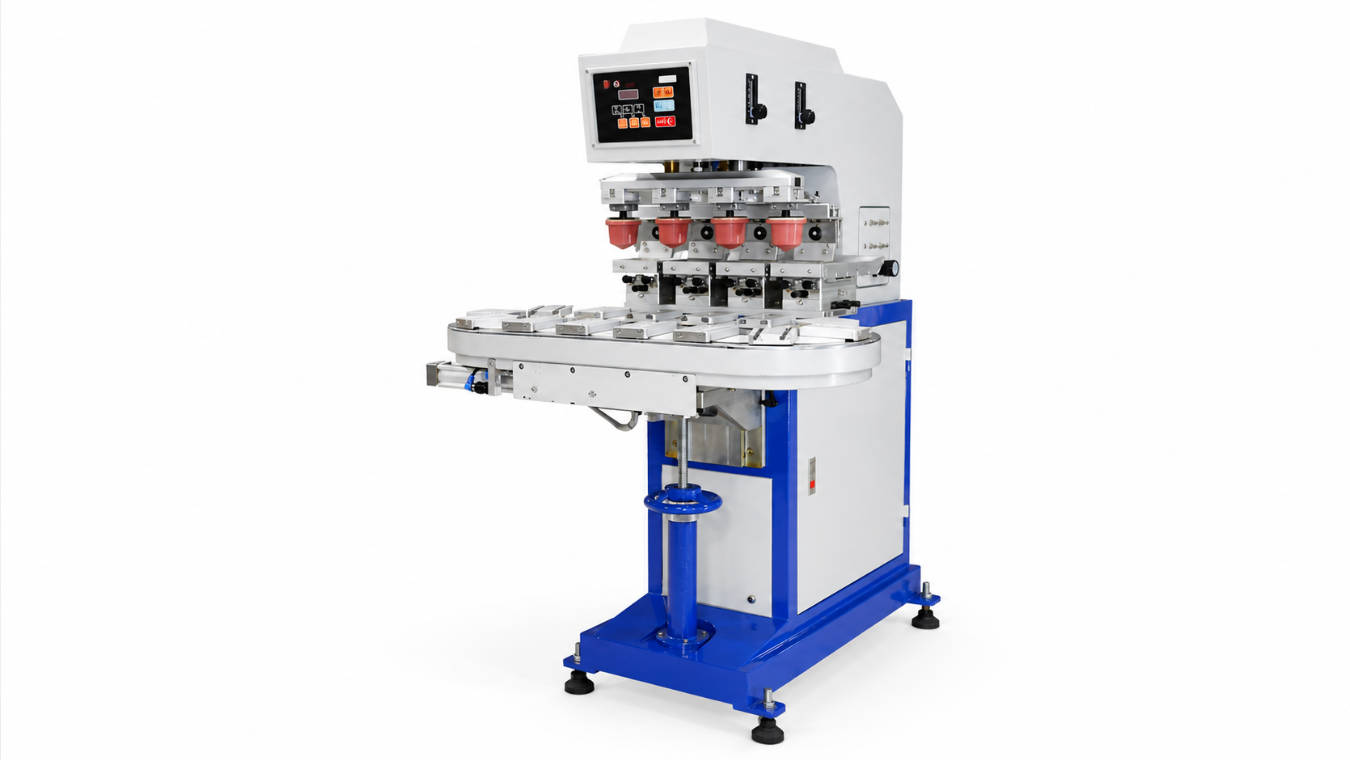
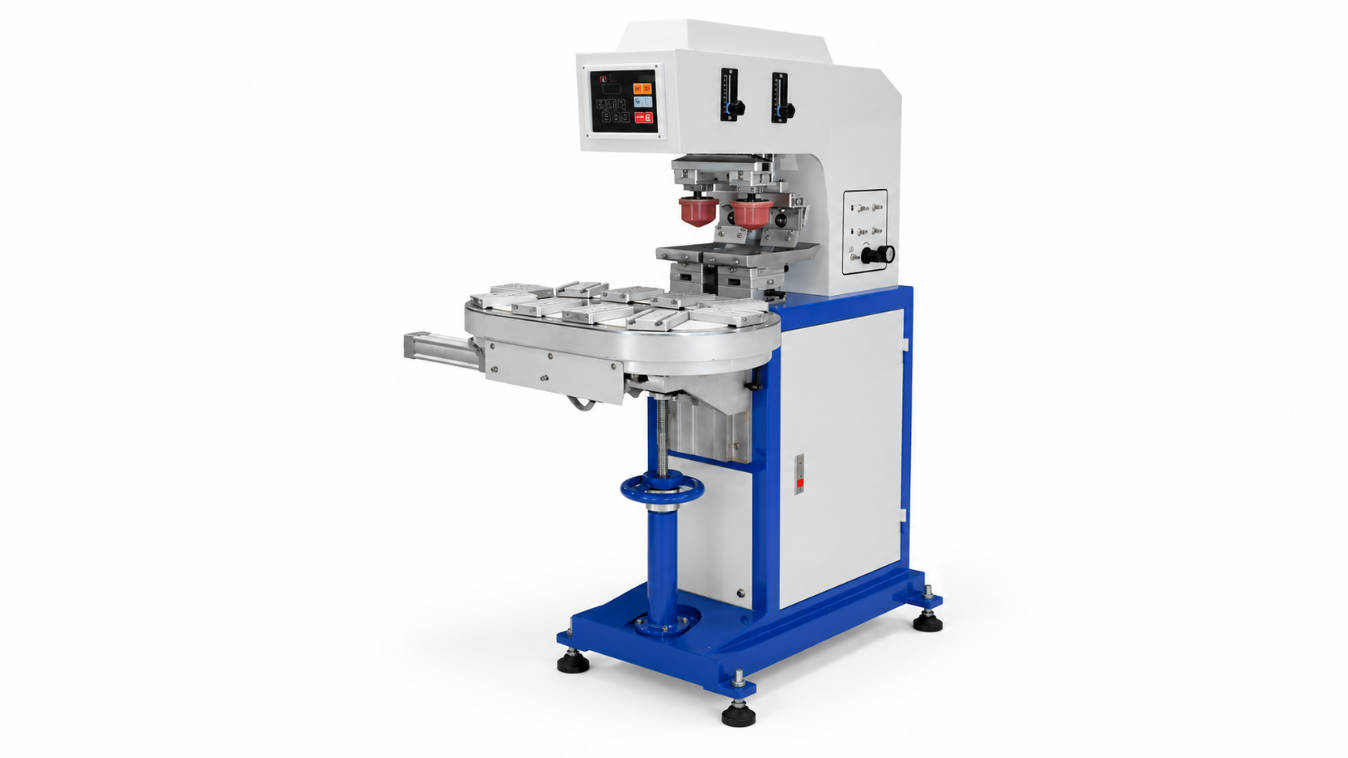
There is no single standard pad printing machine price because two machines that look similar can be configured for completely different products, print areas, color requirements and production volumes.
A basic one-color machine used for manual printing has a very different cost structure from a multi-color machine with custom fixtures, product indexing, automatic feeding and unloading.
The final pad printing machine price is mainly determined by machine type, number of colors, print area, ink system, fixture requirements, automation level and the amount of application-specific customization.
This is why asking only:
“How much is a pad printing machine?”
usually does not produce a useful comparison.
A better quotation request is:
“I need to print a 40 × 20 mm two-color logo on this plastic part, approximately 3,000 pieces per day, with manual loading. Please recommend a suitable configuration.”
The second request gives the supplier enough information to identify the actual equipment.
ENGY offers one-color, multi-color, open-tray, closed-ink-cup and automated pad printing machine configurations for different production requirements.
So before comparing prices, it helps to understand what is actually inside a pad printing machine quotation.
Think of the Price as a Stack, Not a Single Number
A pad printing machine quote can be broken into several layers:
Base machine
Color configuration
Printing area
Ink system
Fixture and tooling
Automation
Customization
Consumables and supporting equipment
Shipping, installation and service requirements
This is a much more useful way to understand cost than comparing machine photos.
For example, two machines may both be described as “two-color pad printers,” while one uses manual product positioning and the other includes a shuttle, precision fixture and automatic indexing.
Their prices should not be expected to match.
Where the Cost Usually Changes
| Configuration Factor | Typical Cost Impact | Why |
| One color to multiple colors | Moderate to high | More printing stations and components |
| Larger print area | Moderate | Larger plate, ink system, pad and machine structure may be required |
| Closed ink cup system | Configuration dependent | Requires ink cup, doctoring ring and compatible plate system |
| Open tray system | Configuration dependent | Uses different plate and doctoring arrangement |
| Custom fixture | Low to moderate | Requires product-specific design and machining |
| Shuttle or conveyor | Moderate | Adds movement, controls and mechanical structure |
| Automatic feeding | High | Requires product handling equipment |
| Vision positioning | High | Adds camera, controls and integration |
| Automatic unloading | Moderate to high | Adds transfer mechanism |
| Fully customized machine | High | Requires additional engineering, assembly and testing |
The key word in this table is configuration.
A feature does not have one fixed cost because its complexity depends on the product.
Cost Layer 1: The Base Machine Architecture
The first major price difference comes from the machine itself.
Pad printing equipment can range from compact manually loaded units to larger industrial machines designed for continuous production.
The base machine establishes:
- frame size
- printing stroke
- available printing force
- product clearance
- plate capacity
- ink system compatibility
- control system
- future automation potential
A buyer printing one small logo on compact plastic parts does not need the same mechanical platform as a manufacturer printing larger products over long production shifts.
Machine size should be selected from the application, not from the assumption that a larger machine is automatically more professional.
Paying for unused machine capacity increases the initial investment without necessarily improving print quality.
On the other hand, buying a machine that is too small can create problems when:
- the product barely fits
- the fixture has insufficient space
- the silicone pad is too large
- future logos exceed the plate capacity
- multi-color expansion becomes impossible
Machine sizing therefore has a direct effect on both purchase price and future flexibility.
Cost Layer 2: How Many Colors Do You Need?
Color count is one of the easiest specifications for buyers to understand—and one of the quickest ways for machine cost to increase.
One-Color Machine
A one-color pad printer normally has the simplest printing sequence.
Ink system → Cliché → Silicone pad → Product
For logos, product codes, warning marks and simple branding, this may be all that is required.
Fewer printing stations generally mean:
- simpler structure
- fewer ink systems
- fewer plates
- less complex product movement
- simpler registration
- easier setup
A one-color machine is therefore usually the starting point for price comparisons.
Two-Color Machine
Two-color printing introduces a new problem:
registration.
The second image needs to align with the first.
The machine may therefore require:
- two ink systems
- two clichés
- additional pad arrangement
- shuttle movement
- product indexing
- additional controls
The cost difference is not simply “one extra color.”
It may involve an entirely different machine architecture.
Four-Color or Multi-Color Machine
As color count increases, the system may need:
- several printing stations
- multiple clichés
- more ink cups or trays
- shuttle or conveyor movement
- additional product positioning
- more complex controls
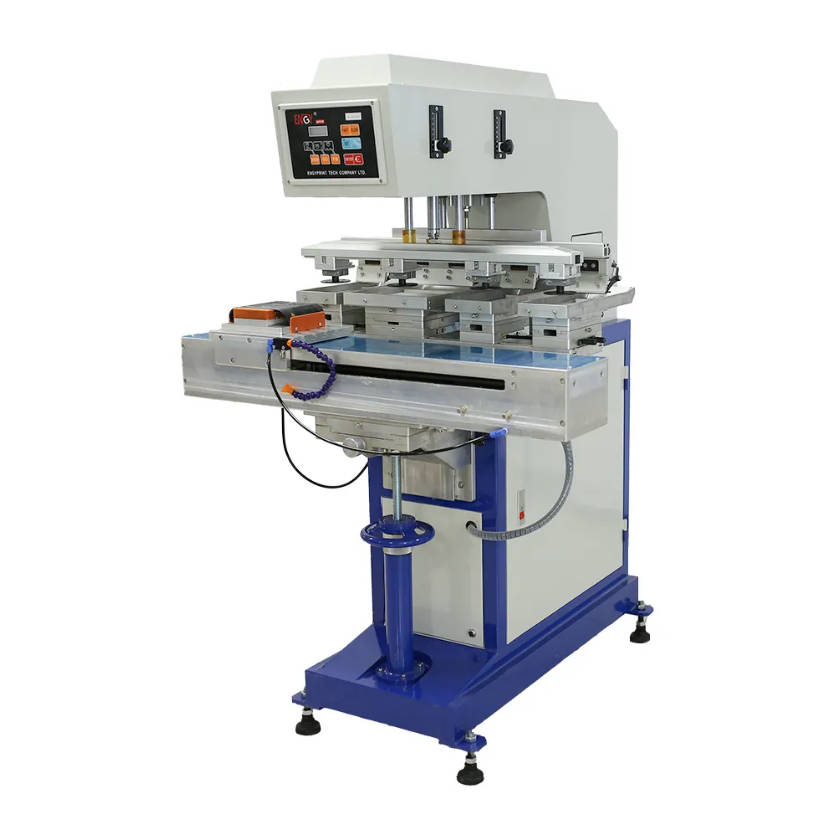
ENGY’s current Pad Printing Machine B Series includes one-color and multi-color configurations, including shuttle and conveyor arrangements.
When comparing pad printer cost, compare the complete color-handling method—not only the number written in the product title.
Cost Layer 3: Print Area Can Change More Than the Plate
A larger logo may require more than a larger cliché.
It can also affect:
- ink cup diameter
- ink tray dimensions
- silicone pad size
- pad holder
- machine stroke
- printing pressure
- machine structure
Suppose Buyer A needs a 25 × 15 mm logo.
Buyer B needs a 150 × 100 mm image.
Even if both applications are one-color pad printing, their machine requirements can be significantly different.
ENGY’s machine category includes both closed-ink-cup systems and open-tray equipment, with different print-area capabilities depending on configuration. (ENGYPRINT)
Why Artwork Size Should Be Provided Before Price
Do not ask for a quotation using only the product size.
Send:
Final artwork width × height
For example:
Logo size: 55 × 20 mm
This allows the supplier to evaluate:
- suitable plate size
- ink system
- pad dimensions
- machine stroke
A pad printing machine quote without the actual print dimensions is often only a rough starting price.
Cost Layer 4: Closed Ink Cup or Open Tray?
The inking system also affects machine configuration and operating cost.
Closed Ink Cup
In a closed system, ink is contained inside an ink cup that moves over the cliché.
The system includes components such as:
- ink cup body
- doctoring ring
- cliché
- cup mounting mechanism
ENGY’s machine range uses ceramic or carbide rings in closed-ink-cup configurations and supports several plate types.
When requesting a quote, cup size should match the artwork and machine.
A larger ink cup may require:
- larger plate
- wider machine structure
- different carriage
- larger working stroke
Open Tray
An open-tray pad printer uses a different inking arrangement with an open ink reservoir and doctor blade.
ENGY also provides open-tray machines for applications requiring different plate or larger-logo configurations.
The buying decision should therefore not be:
Which system is cheaper?
It should be:
Which system fits the artwork, production process and maintenance requirements?
The lower-priced configuration is not lower cost if it cannot reliably handle the job.
Cost Layer 5: The Fixture Is Small—but Important
The fixture is sometimes overlooked because it appears simple compared with the machine.
In production, however, it is what positions the product underneath the silicone pad.
A fixture may need to:
- locate the product
- prevent rotation
- support a curved surface
- protect cosmetic areas
- control print position
- allow fast loading
- hold several parts at once
For a simple rigid component, fixture design may be straightforward.
For an irregular product, the fixture can become a genuine engineering component.
ENGY notes that product-specific fixtures can be used to hold products stable during printing and recommends providing product size, logo size and print position when evaluating a machine. (ENGYPRINT)
Fixture Cost Depends on the Product
| Product Condition | Fixture Complexity |
| Flat rigid component | Low |
| Product with clear locating features | Low |
| Round or cylindrical product | Low to moderate |
| Irregular housing | Moderate |
| Soft or flexible component | Moderate |
| Cosmetic surface that cannot be scratched | Moderate |
| Several models sharing one fixture | Moderate to high |
| Product requiring rotation | High |
| Multiple parts printed per cycle | Moderate to high |
A realistic pad printing machine price should include the tooling required to actually print your product—not only the machine body.
Cost Layer 6: Manual, Semi-Automatic or Fully Automatic?
This is often the largest price jump in a pad printing project.
A manually loaded machine may require the operator to:
- Pick up the product
- Position it in the fixture
- Start the printing cycle
- Remove the product
- Place it into the next process
For low or moderate production volumes, this can be perfectly practical.
But when thousands of identical parts must be printed continuously, handling becomes part of the economics.
Automation Can Add
- automatic feeding
- vibratory bowl feeders
- conveyors
- rotary indexing
- product orientation
- pick-and-place systems
- automatic unloading
- multi-station transfer
- drying
- surface treatment
- inspection
Each additional function requires mechanical components, sensors and control integration.
This is why an automatic pad printing machine can cost substantially more than a manually loaded machine even when both print the same logo.
Ask What the Automation Removes
Do not automate because the equipment looks more advanced.
Ask:
Which manual step is costing us time or causing inconsistency?
If loading takes only a few seconds and production volume is low, automatic feeding may never recover its additional investment.
If one operator spends most of the shift loading identical parts, automation becomes much more meaningful.
Cost Layer 7: Standard Machine or Custom Pad Printer?
This distinction can create another major difference in quotations.
Standard Machine
A standard machine uses an existing platform.
The supplier mainly needs to select:
- machine model
- cup or tray configuration
- plate
- pad
- fixture
This reduces engineering complexity.
ENGY states that it supplies standard pad printer configurations as well as customized equipment based on the actual product. (ENGYPRINT)
Modified Standard Machine
This middle category is important.
The buyer may use a standard machine but add:
- custom fixture
- extended table
- shuttle
- special pad holder
- additional safety features
- product indexing
This can often solve the application without designing an entire machine from zero.
Fully Customized Machine
Customization becomes more significant when the production sequence requires:
- unusual product movement
- several print stations
- automated feeding
- automatic orientation
- conveyors
- integration with other processes
- nonstandard controls
Before paying for a custom machine, determine whether a standard platform plus custom tooling can solve the problem.
That can keep the system simpler to operate and maintain.
A Cheap Machine Quote and an Expensive Quote May Not Include the Same Things
This is one of the most important parts of price comparison.
Suppose Supplier A quotes:
Machine: $X
Supplier B quotes:
Machine + fixture + pad + cliché + ink cup + setup accessories: $Y
Supplier B appears more expensive.
But the quotations are not equivalent.
Before comparing numbers, create an inclusion checklist.
| Item | Quote A | Quote B |
| Pad printing machine | □ | □ |
| Ink cup / tray | □ | □ |
| Doctoring ring | □ | □ |
| Cliché plate | □ | □ |
| Silicone pad | □ | □ |
| Product fixture | □ | □ |
| Machine stand/table | □ | □ |
| Foot pedal/control accessories | □ | □ |
| Safety protection | □ | □ |
| Spare consumables | □ | □ |
| Training | □ | □ |
| Sample testing | □ | □ |
| Packing | □ | □ |
| Shipping | □ | □ |
The meaningful number is not the lowest machine price. It is the cost of a configuration that is ready to perform your actual printing process.
Do Consumables Affect the Real Cost?
Yes.
The machine is a capital purchase, but pad printing also uses consumables.
Depending on the setup, these can include:
- printing ink
- thinner
- silicone pads
- cliché plates
- ink cup rings
- doctor blades
- cleaning materials
ENGY manufactures pad printing machines as well as related consumables including plates, ceramic rings, ink cups and silicone pads.
This matters because buyers should evaluate more than initial machine CAPEX.
The operating question is:
How easy will it be to replace the components used regularly in production?
A machine with an attractive purchase price but difficult-to-source consumables can create higher operating friction later.
What Makes a Pad Printing Machine Quote More Accurate?
A supplier cannot accurately configure equipment from the sentence:
“Please quote one pad printer.”
Send these six pieces of information instead.
1. Product Photo
Show the complete product.
2. Product Dimensions
Provide:
Length × Width × Height
This determines whether the part and fixture fit the machine.
3. Product Material
For example:
- PP
- ABS
- PC
- metal
- glass
- rubber
Material is particularly relevant to ink selection and possible surface treatment.
4. Artwork Size
Provide the finished print dimensions.
Example:
Logo: 40 × 18 mm
5. Number of Colors
Specify:
- one color
- two colors
- four colors
- another configuration
6. Production Requirement
State:
- pieces per batch
- pieces per day
- manual loading acceptable or not
- expected working hours
- future automation plans
With these six pieces of information, a quotation becomes application-based instead of generic.
Three Example Projects and Why Their Prices Differ
Project A: Small One-Color Logo
Application
- compact plastic component
- one-color 25 × 10 mm logo
- manual loading
- simple fixture
- moderate batch volume
Main Cost Components
- standard one-color machine
- standard ink system
- cliché
- silicone pad
- simple fixture
Price direction: Lower complexity.
Project B: Two-Color Product Branding
Application
- medium-size plastic housing
- two-color logo
- precise color registration
- custom fixture
- manual loading
Additional Cost Components
- additional color station
- additional ink system
- additional cliché
- registration mechanism
- more complex machine configuration
Price direction: Higher than a comparable one-color system.
Project C: Automatic High-Volume Printing
Application
- small identical plastic components
- one-color logo
- continuous production
- automatic feeding
- automatic positioning
- automatic unloading
Interestingly, the logo itself may be simpler than Project B.
Yet this system may cost substantially more because the equipment is no longer only printing.
It is also:
feeding → positioning → printing → unloading
Automation complexity can affect pad printing machine price more than artwork size.
Price vs Cost per Printed Part
A higher machine price is not always the more expensive production choice.
Consider two approaches.
Machine A
Lower purchase price
Manual loading
One operator continuously required
Machine B
Higher purchase price
Automatic feeding
Lower direct operator involvement
Machine A wins on initial CAPEX.
Machine B may win when measured over a long production period.
This is why industrial buyers should evaluate:
Machine investment + labor + consumables + scrap + downtime + maintenance
rather than the purchase price alone.
The correct decision depends on production volume.
For occasional batches, paying heavily for automation may make little sense.
For stable high-volume production, reducing repeated manual handling can become more valuable.
When Should You Be Suspicious of an Extremely Low Quote?
A low quotation is not automatically problematic.
It may simply represent a smaller or simpler machine.
But ask more questions when the price difference is large.
Check whether:
- the machine has the required print area
- your product fits
- the fixture is included
- the ink system is included
- the machine supports the required colors
- the pad and plate are included
- customization has been considered
- the production volume is realistic
- shipping and packing are included
An inexpensive machine that requires replacement immediately after production starts is not an economical purchase.
How to Compare Pad Printing Machine Suppliers
Do not rank suppliers using price alone.
Compare four areas.
Application Understanding
Can the supplier explain why the selected machine fits:
- your product
- artwork
- print location
- production quantity?
Configuration Transparency
Can you identify exactly what the quotation includes?
Consumable Support
Can the supplier provide compatible:
- pads
- plates
- ink cups
- rings
- related replacement components?
ENGY’s product range covers both pad printing equipment and multiple related consumables. (ENGYPRINT)
Customization Capability
If your process changes, can the equipment be adapted with fixtures or other mechanisms?
For buyers comparing configurations, ENGY’s pad printing machine range provides standard and customized equipment options for different applications. (ENGYPRINT)
FAQ
How much does a pad printing machine cost?
Pad printing machine prices vary according to machine size, colors, print area, ink system, fixture requirements, automation and customization. An application-specific quotation is more useful than a generic market price.
Why are pad printing machine prices so different?
Two machines may differ in color stations, printing area, mechanical structure, ink cup size, fixture design, product movement and automation. Similar external appearance does not mean identical configuration.
Is a one-color pad printing machine cheaper than a two-color machine?
Generally, a one-color configuration is simpler. Two-color systems require additional printing components and may require product movement or registration mechanisms, which increases machine complexity.
Does a larger ink cup increase pad printer cost?
It can. A larger ink cup may require a larger cliché, carriage, machine stroke or frame configuration. The relationship depends on the specific machine design.
Is an automatic pad printing machine more expensive?
Generally yes, because automation may add feeders, conveyors, indexing systems, sensors, controls and unloading equipment. The commercial value depends on production volume and labor requirements.
Does a pad printing machine quotation include the fixture?
Not always. Buyers should confirm whether the product fixture is included and whether it is standard or customized for the part.
Do I need a custom pad printing machine?
Not necessarily. Many applications can use a standard machine with a customized fixture. Full machine customization becomes more relevant when the product requires unusual movement, automation or several integrated processes.
What information is needed to get a pad printing machine quote?
Provide the product photo, dimensions, material, artwork size, color count, print position and production requirement. These details allow the supplier to recommend an appropriate configuration.
Should I choose a pad printer based on price?
Price should be considered after technical compatibility. First confirm that the machine can handle the product, print area, colors, fixture and target production volume.
What other costs should I consider after buying a pad printer?
Consider pads, cliché plates, ink, thinner, ink cup rings or doctor blades, fixture replacement, maintenance, labor and possible production downtime.
Conclusion: Ask for the Cost of the Printing Solution, Not Just the Machine
The final pad printing machine price is the result of a complete equipment configuration.
The main cost drivers are:
- machine platform
- number of colors
- print area
- ink cup or open-tray system
- product fixture
- product movement
- automation
- customization
- consumables
- supporting equipment
A small manually loaded one-color machine and a fully automated pad printing line may technically use the same printing principle, but they solve completely different production problems.
The most useful pad printing machine quote is therefore not the lowest number—it is the quotation that clearly matches your product, artwork and required production process.
Before requesting a price, prepare:
Product photo + product dimensions + logo size + print position + color count + target production volume
This gives the supplier enough information to recommend the appropriate configuration without unnecessarily oversizing the machine.
You can review ENGY’s Pad Printing Machine B Series to compare available machine configurations.
For additional pad printing equipment and consumables, visit ENGY.