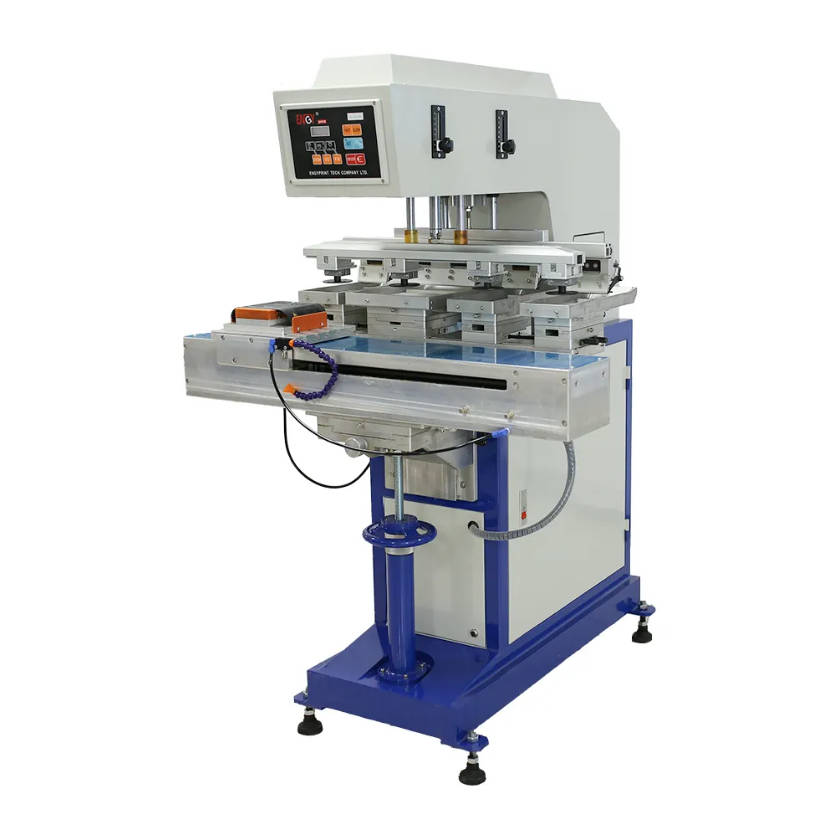
An open tray pad printer is often better than a closed ink cup system when the application requires a larger print image, flexible plate sizing, lower tooling cost, easier visual ink adjustment, or printing on special parts where image area is more important than maximum ink containment. A closed ink cup system is usually preferred for cleaner operation, reduced ink evaporation, and stable long-run production, but it is not always the most practical choice for every pad printing job.
For many buyers, the decision is not simply “old system vs modern system.” The better question is: what are you printing, how large is the artwork, how often will the job change, and how much control do you need over ink exposure, cost, and production speed?
This article explains when an open tray pad printer can be the more suitable option than a closed ink cup system, especially for large logos, cost-sensitive production, special part shapes, and flexible job setups. If you are comparing pad printing equipment for your production line, you can also review available pad printer models from ENGY and send your artwork size for a print area check.
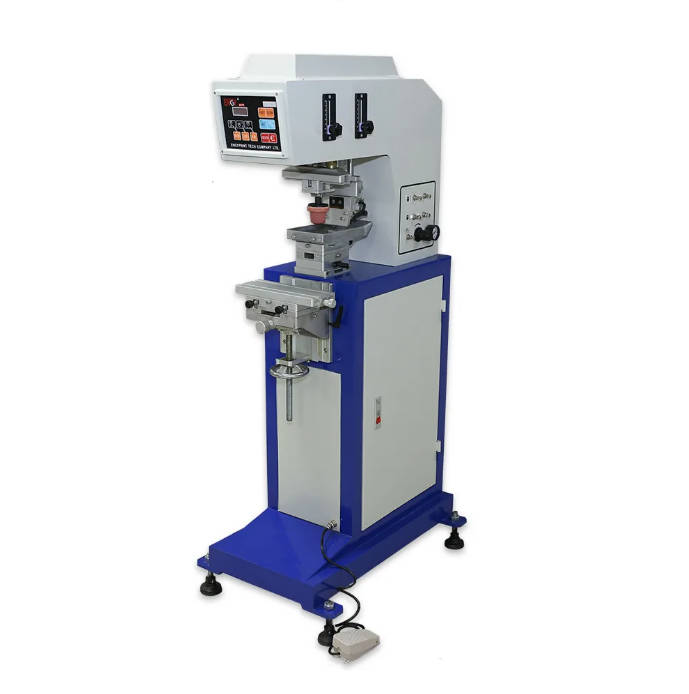
What Is an Open Tray Pad Printer?
An open tray pad printer, also called an open ink tray pad printer, open inkwell pad printer, or open well pad printer, is a pad printing machine where the ink is held in an open reservoir. During operation, the system spreads ink across the etched printing plate, and a doctor blade removes excess ink from the surface. Ink remains inside the etched image area, and the silicone pad picks up the image before transferring it to the product surface.
The basic process is:
- Ink is placed into the open tray.
- The plate is flooded with ink.
- A doctor blade scrapes excess ink from the plate surface.
- Solvent evaporates slightly from the etched image area.
- The silicone pad picks up the image.
- The pad transfers the image to the part.
The main feature of an open tray system is that the ink reservoir and doctor blade are separate, which gives the machine more flexibility for larger plates and larger print areas.
This structure is different from a closed ink cup pad printer. In a closed cup system, ink is sealed inside an inverted cup. The cup usually has a ceramic or carbide ring that both contains the ink and doctors the plate as it moves across the cliché.
What Is a Closed Ink Cup System?
A closed ink cup system uses a sealed cup to hold the ink. The cup slides over the printing plate, fills the etched image, and removes excess ink with the cup ring. Because the ink is mostly enclosed, it is less exposed to air during operation.
This design is widely used in modern pad printing because it helps reduce solvent evaporation, keeps ink viscosity more stable, and creates a cleaner production environment. It is often suitable for high-volume jobs, fine details, medical components, electronic parts, promotional products, and applications where consistent print quality over long runs is critical.
A closed ink cup system is usually stronger for clean, repeatable, high-volume printing, while an open tray pad printer can be stronger for larger image areas, flexible setup, and cost-sensitive applications.
Why This Choice Matters for B2B Buyers
For a factory, choosing the wrong pad printing system can create problems beyond the machine price. It can affect printing area, plate cost, ink consumption, operator training, maintenance workload, and even whether the job can run at all.
For example, if your logo or marking area is too large for the available ink cup diameter, a closed cup system may not cover the required print area efficiently. In that case, using a larger open tray system may be more practical.
On the other hand, if your factory prints small logos at high speed every day, and the main concerns are ink stability, clean operation, and lower solvent exposure, a closed ink cup system may be a better long-term investment.
The right choice depends on the production scenario, not only the machine type.
Open Tray Pad Printer vs Closed Ink Cup System: Key Comparison
| Factor | Open Tray Pad Printer | Closed Ink Cup Pad Printer |
| Ink reservoir | Open tray / open inkwell | Sealed ink cup |
| Doctoring method | Doctor blade scrapes the plate | Cup ring doctors the plate |
| Ink exposure | Higher exposure to air | Lower exposure to air |
| Print area flexibility | Usually more flexible for larger images | Limited by cup diameter and machine design |
| Ink viscosity stability | Requires more operator attention | More stable in many production runs |
| Setup cost | Commonly lower for some applications | Often higher due to ink cup, ring, and cup system |
| Cleaning | Tray and blade need regular cleaning | Cup cleaning and ring maintenance required |
| Operator skill | More skill needed for ink control | Easier to stabilize for repeat jobs |
| Best fit | Large logos, special parts, short runs, flexible jobs | High-volume, clean, repeatable production |
| Main trade-off | More ink exposure and maintenance | Print area and cup size limitations |
When Is an Open Tray Pad Printer Better?
1. When the Printed Image Is Large
One of the most common reasons to choose an open tray pad printer is print area. Closed ink cup systems are often limited by the diameter of the ink cup. If the image is too wide or too long, the cup may not be able to cover the artwork properly.
An open tray system can often use a larger plate and wider doctoring area, making it suitable for larger logos, long text, wide graphics, or special decorative marks.
Typical applications may include:
| Application | Why Open Tray Can Help |
| Large logo on plastic housing | More flexible print area |
| Long brand name or model marking | Easier to cover extended artwork |
| Large toy, appliance, or industrial part | Better support for bigger plates |
| Packaging component printing | Useful when logo size is larger than a standard cup area |
| Special-shaped part marking | More layout flexibility |
If the artwork size is the main technical challenge, an open tray pad printer may be more practical than forcing the job into a closed ink cup format.
Before choosing a machine, buyers should confirm the actual artwork size, part size, and print position. ENGY can help evaluate this by checking the product drawing, logo file, or sample image. You can review available pad printing equipment and prepare your artwork size for discussion.
2. When You Need Lower Initial Tooling or Consumable Cost
Open tray systems are often attractive for buyers who want a cost-sensitive pad printing solution. The doctor blade used in an open tray system can be simpler and less expensive than some closed cup rings. Closed ink cup systems may require ceramic rings, carbide rings, magnetic cups, or other specific components depending on the machine design.
This does not mean open tray printing is always cheaper in total cost. Because ink is exposed to air, solvent evaporation and viscosity adjustment may increase operating attention. However, for small workshops, lower-volume jobs, trial production, or special projects, the lower initial setup cost can be important.
Open tray systems may be suitable when:
- The production quantity is not extremely high.
- Jobs change frequently.
- The print image is large.
- The buyer wants to control machine investment.
- Operators are familiar with pad printing ink adjustment.
- Consumable cost is a major concern.
3. When the Job Changes Frequently
Some factories print many different products instead of running one repeated logo all day. In this situation, flexibility can be more valuable than maximum automation.
An open inkwell pad printer can be practical for small-batch production, sample testing, seasonal designs, promotional products, customized parts, and factories that need to test different inks or plates.
For frequent job changes, buyers should consider:
| Question | Why It Matters |
| How often does the artwork change? | Frequent changes may require flexible setup |
| How many colors are used? | Multi-color registration affects machine selection |
| Is the part shape stable? | Fixtures may need to be changed often |
| Is the print area large or small? | Large area may favor open tray |
| Is the operator experienced? | Open tray systems require more ink control |
A closed ink cup system can still handle job changes, but if the image size and plate format vary significantly, open tray printing may offer more flexibility.
4. When Operators Need to Visually Monitor Ink Condition
In an open tray pad printer, the ink is visible. This allows operators to observe ink flow, drying behavior, contamination, and viscosity changes directly. For experienced operators, this can be useful during process adjustment.
For example, during sample testing, the operator may need to adjust thinner ratio, ink pickup, plate depth, doctor blade pressure, or drying behavior. The open tray format makes these changes more visible.
However, this advantage also creates responsibility. Since ink is exposed, the operator must monitor it more carefully. If solvent evaporates too much, ink may become too thick, causing poor transfer, pinholes, incomplete images, or dirty edges.
Open tray printing can be flexible, but it depends more heavily on operator judgment, especially for ink viscosity, blade pressure, and cleaning discipline.
5. When the Product Shape Requires a Special Printing Setup
Pad printing is often used because it can print on curved, recessed, uneven, or irregular surfaces. However, special products may also require special pad shapes, fixtures, plate layouts, and print positions.
An open tray pad printer may be useful when the application requires a larger cliché area or special image placement. This can apply to products such as:
- Plastic housings
- Electrical components
- Toy parts
- Cosmetic packaging
- Appliance panels
- Industrial tools
- Promotional products
- Large molded parts
- Custom packaging parts
For these projects, the print area and product positioning may be more important than the benefits of a sealed ink system. The practical question becomes: can the machine hold the part, reach the print area, and transfer the image cleanly?
If you are unsure, the better approach is to send the product size, logo size, printing position, material, and expected output. A supplier can then recommend whether an open tray or closed ink cup configuration is more suitable.
When Is a Closed Ink Cup System Better?
An open tray pad printer is not always the better choice. Closed ink cup systems remain very important in professional pad printing because they solve several common production problems.
A closed ink cup system is usually more suitable when:
- The printed image is small or medium-sized.
- The production run is long.
- Ink consistency is critical.
- The factory wants to reduce solvent smell and exposure.
- The printing environment needs to stay cleaner.
- The operator skill level is limited.
- The job runs repeatedly with little change.
- Fine detail and repeatability are more important than large print area.
For many factories, the closed cup system is the standard choice for stable, efficient production. It helps reduce ink exposure to air and can make printing easier to control over time.
Closed Ink Cup Advantages
| Advantage | Practical Meaning |
| Less ink exposure | Slower solvent evaporation in many applications |
| Cleaner operation | Less open ink around the machine |
| Better viscosity stability | More consistent transfer during repeated runs |
| Easier operation for repeat jobs | Less manual adjustment compared with open tray |
| Suitable for automation | Often used in higher-volume production lines |
The main limitation is that the print image must fit within the effective cup and plate design. For large graphics, open tray may still be the more practical solution.
Key Technical Factors Before Choosing
1. Artwork Size
Artwork size is the first thing to confirm. A small logo can usually be handled by either system. A large logo, long text, or wide graphic may push the buyer toward an open tray pad printer.
Provide the supplier with:
- Artwork width and height
- Product size
- Printing position
- Number of colors
- Required print quality
- Sample photos or drawings
2. Product Material
The printing material affects ink selection more than the ink system itself. Pad printing can be used on many substrates, including plastics, metal, glass, wood, ceramic, rubber-like materials, and coated surfaces, depending on the ink and pretreatment.
Common material questions include:
| Material Question | Reason |
| Is the surface plastic, metal, glass, or coated? | Determines ink type |
| Is the surface smooth, textured, or curved? | Affects pad selection |
| Does it require adhesion testing? | Important for durability |
| Will the product contact chemicals or abrasion? | Affects ink and curing choice |
3. Production Volume
Production volume affects whether flexibility or stability matters more.
| Production Situation | More Likely Fit |
| Low-volume custom jobs | Open tray may be practical |
| Sample testing and trial production | Open tray may be flexible |
| Medium-volume mixed products | Depends on print area and operator skill |
| High-volume repeated logo printing | Closed ink cup often preferred |
| Automated production line | Closed ink cup often preferred |
4. Ink Management
Open tray systems require more active ink management. Operators need to watch viscosity, thinner evaporation, dust contamination, and drying behavior.
Closed cup systems reduce many of these issues, but they still require proper ink mixing, cup maintenance, ring inspection, and plate cleaning.
Neither system eliminates process control. The difference is where the control effort is concentrated.
5. Plate and Machine Compatibility
Some open tray pad printers work especially well with thicker plates. Depending on the machine structure, thin plates may require additional support or magnetic holding to prevent movement during operation.
Before ordering, confirm:
- Plate type
- Plate thickness
- Maximum plate size
- Print area capacity
- Doctor blade structure
- Fixture requirements
- Pad stroke and product clearance
This is especially important if you are replacing an old machine, upgrading from manual printing, or trying to run a larger logo than before.
Common Mistakes When Comparing Open Tray and Closed Ink Cup Systems
Mistake 1: Assuming Closed Cup Is Always Better
Closed ink cup systems are cleaner and more stable in many production environments, but they are not automatically better for every application. If the logo is too large for the cup system, print quality and efficiency may suffer.
Mistake 2: Ignoring the Actual Print Area
Some buyers compare machine prices before confirming artwork size. This can lead to a machine that cannot print the required image. Always check actual print width, height, and product positioning first.
Mistake 3: Underestimating Operator Skill
An open tray pad printer can be cost-effective and flexible, but it requires better operator attention. Ink viscosity, doctor blade pressure, plate cleaning, and environmental conditions all affect print quality.
Mistake 4: Looking Only at Machine Price
Machine price is only one part of the cost. Buyers should also compare consumables, ink waste, setup time, cleaning time, production stability, and maintenance parts.
Mistake 5: Not Sending Samples or Artwork Before Buying
Pad printing is application-specific. A small difference in logo size, surface curvature, or material can change the recommended machine. Sending artwork and product photos helps avoid wrong selection.
How to Choose the Right Pad Printer Supplier
A good supplier should not simply recommend one machine type to every buyer. The supplier should first understand the actual printing application.
Before choosing a pad printer supplier, check whether they can help with:
- Print area evaluation
- Artwork size review
- Product material analysis
- Ink and plate recommendation
- Pad shape selection
- Fixture design
- One-color or multi-color configuration
- Manual, semi-automatic, or automatic machine selection
- Sample testing when needed
For an open tray pad printer, supplier experience is especially important because large print areas and special parts often require customized setup. The machine must match not only the logo size, but also the part height, printing angle, pad movement, and fixture stability.
If you are comparing systems now, you can visit the ENGY pad printer shop and prepare your artwork size, product dimensions, material, and target output. This information helps the technical team recommend whether an open tray or closed ink cup system is more suitable.
Practical Selection Guide
| Your Requirement | Recommended Direction |
| Large logo or wide graphic | Consider open tray pad printer |
| Small logo, long production run | Consider closed ink cup system |
| Lower initial setup cost | Consider open tray system |
| Cleaner production environment | Consider closed ink cup system |
| Frequent job changes | Open tray may offer flexibility |
| Less operator adjustment | Closed ink cup may be easier |
| Special product shape | Depends on print area, fixture, and pad |
| High-volume automation | Closed ink cup often fits better |
| Sample testing and process trial | Open tray may be practical |
FAQ
1. What is an open tray pad printer used for?
An open tray pad printer is used for transferring logos, text, graphics, or markings onto products through pad printing. It is often selected for larger print areas, flexible job setups, special product shapes, and cost-sensitive applications where an open inkwell structure is practical.
2. Is an open ink tray pad printer better for large logos?
Yes, in many applications an open ink tray pad printer can be better for large logos because the open tray and doctor blade structure may support a larger plate and wider print area than a standard closed ink cup system.
3. What is the difference between open inkwell and closed ink cup pad printing?
The main difference is ink containment and doctoring method. An open inkwell pad printer uses an open ink reservoir and doctor blade, while a closed ink cup pad printer uses a sealed cup with a ceramic or carbide ring to contain ink and doctor the plate.
4. Does an open well pad printer use more ink?
An open well pad printer may require more ink management because the ink is exposed to air, which can increase solvent evaporation. Actual ink use depends on production time, operator control, ink type, environment, and cleaning habits.
5. When should I choose a closed ink cup pad printer instead?
Choose a closed ink cup pad printer when you need cleaner operation, lower ink exposure, more stable viscosity, repeatable long-run production, or easier process control for small to medium-sized print images.
6. Can an open tray pad printer print on plastic, metal, or glass?
Yes, pad printing can be used on many materials, including plastic, metal, glass, ceramic, wood, and coated surfaces. The key is selecting the correct ink, pad, plate, and pretreatment method for the substrate.
7. What information should I send before buying an open tray pad printer?
Send the product size, artwork size, printing position, material, number of colors, expected output, and sample photos or drawings. This helps the supplier check whether the print area and machine structure are suitable.
Conclusion: Choose Based on Print Area, Stability, and Production Needs
An open tray pad printer is better than a closed ink cup system when your application requires a larger print image, flexible plate setup, visual ink adjustment, lower initial tooling cost, or special part printing. It is especially useful for large logos, custom products, sample testing, and production scenarios where print area flexibility matters.
A closed ink cup system is usually better for clean, stable, high-volume production with smaller or medium-sized images. It helps reduce ink exposure and can make repeat printing easier to control.
The right choice depends on your artwork size, product material, production volume, operator skill, and quality requirements. To avoid choosing the wrong machine, send your artwork size and product details before ordering. ENGY can help check the print area and recommend a suitable pad printing machine solution for your application.