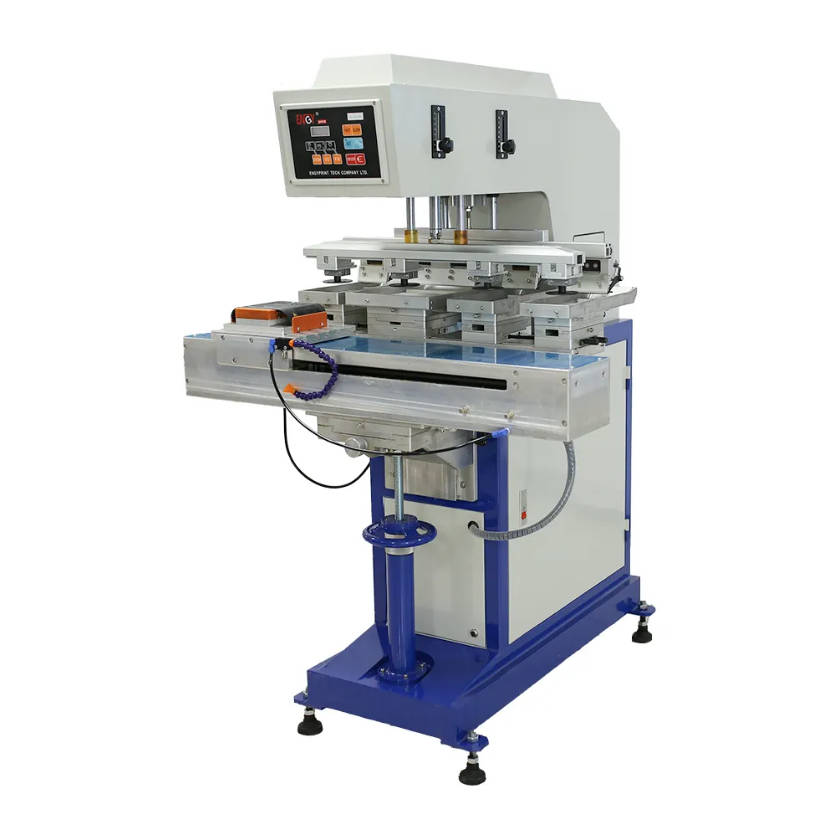
When choosing a product decoration printing process, many buyers compare pad printing vs screen printing. Both methods can print logos, graphics, text, and markings on different materials, but they are not used for the same type of products.
Pad printing is better for curved, irregular, recessed, or small product surfaces, while screen printing is better for flat or slightly curved surfaces with larger print areas.
If you need to print on pens, bottle caps, golf balls, toys, medical parts, electronic components, cosmetic packaging, or small plastic products, a pad printing machine may be the better choice. If your product has a large flat surface, such as panels, signs, bags, sheets, or flat plastic parts, screen printing may be more suitable.
This guide compares pad printing machine vs screen printing machine from shape compatibility, print area, color printing, setup cost, production volume, and final application, helping you choose the right printing process for your product.
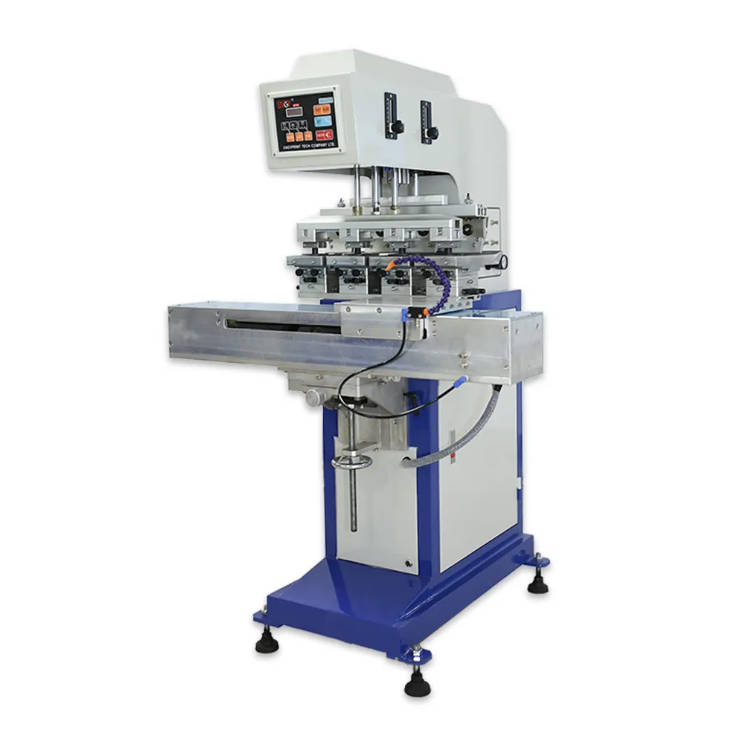
What Is Pad Printing?
Pad printing is an indirect printing process. The image is first etched on a printing plate, then ink is picked up by a soft silicone pad and transferred onto the product surface.
Because the silicone pad is flexible, it can adapt to curved, uneven, concave, convex, or irregular surfaces. This makes pad printing highly suitable for many industrial products that cannot be printed easily by screen printing.
Common products printed by pad printing include:
- Pens and promotional gifts
- Bottle caps and closures
- Golf balls and sports products
- Toys and plastic parts
- Medical devices
- Electronic components
- Camera parts
- Watch parts
- Automotive parts
- Cosmetic packaging
For small logos, fine text, and accurate positioning, a pad printing machine is often the preferred solution.
What Is Screen Printing?
Screen printing is a direct printing process. Ink is pushed through a mesh screen onto the product surface. The design area on the screen allows ink to pass through, while the non-printing area blocks the ink.
Screen printing is widely used for flat products and large-area printing. It can create strong ink coverage and is suitable for many materials, especially when the print area is large and the product surface is relatively flat.
Common products printed by screen printing include:
- Flat plastic panels
- Metal plates
- Glass sheets
- Signs and labels
- Bags and packaging
- Textile products
- Large flat parts
- Display panels
- Control panels
Screen printing is a good choice when the product surface is flat and the artwork is larger than what pad printing can easily handle.
Pad Printing vs Screen Printing: Main Differences
| Comparison Item | Pad Printing Machine | Screen Printing Machine |
| Printing method | Silicone pad transfers ink to product | Ink passes through mesh screen |
| Best surface type | Curved, irregular, recessed, small surfaces | Flat or slightly curved large surfaces |
| Print area | Small to medium | Medium to large |
| Detail printing | Good for fine logos and small text | Good for larger graphics and solid ink coverage |
| Product shape compatibility | Very strong | Limited on irregular shapes |
| Setup cost | Usually suitable for small and medium product decoration | Can be cost-effective for larger graphics |
| Production volume | Good for small to medium industrial products | Good for larger flat products and batch printing |
| Color printing | Multi-color possible with accurate fixture design | Multi-color possible but needs screen alignment |
| Typical applications | Pens, caps, toys, medical parts, electronics | Panels, signs, sheets, bags, flat plastic parts |
| Best choice for | Irregular product decoration | Large flat surface printing |
Shape Compatibility: Which Process Handles Irregular Products Better?
Shape compatibility is the biggest difference between pad printing and screen printing.
A pad printing machine can print on surfaces that are curved, round, uneven, recessed, or hard to reach. The soft silicone pad can deform slightly and contact the product surface evenly. This is why pad printing is widely used for small industrial products with complex shapes.
Examples include:
- Printing a logo on a pen barrel
- Printing text on a bottle cap
- Printing a mark on a golf ball
- Printing a symbol on a medical device
- Printing a logo on a toy part
- Printing a mark on an electronic component
Screen printing has more limitations when the product shape is not flat. Since the screen needs to contact the surface properly, it is harder to print clearly on deep curves, small areas, or uneven surfaces.
If your product is not flat, pad printing is usually the better product decoration printing process.
Print Area: Which Process Is Better for Large Designs?
When comparing pad printing machine vs screen printing machine, print area is another important factor.
Pad printing is usually better for small to medium print areas. It is excellent for logos, product marks, small text, symbols, codes, and decorative graphics. However, the print size is limited by the pad size, plate size, and ink cup or ink tray system.
Screen printing is better for larger print areas. If the design is wide, long, or requires strong ink coverage across a flat surface, screen printing may be more efficient.
Choose screen printing when:
- The product surface is flat
- The print area is large
- The design requires thick ink coverage
- The artwork is not located on a difficult curved surface
- The product can be fixed under the screen easily
Choose pad printing when:
- The print area is small or medium
- The surface is curved or irregular
- The logo position is difficult to reach
- The design requires accurate positioning
- The product is small or three-dimensional
Color Printing: Which Method Is Better for Multi-Color Logos?
Both pad printing and screen printing can produce multi-color results, but the way they handle color registration is different.
For pad printing, multi-color printing usually requires accurate fixtures, stable product positioning, and precise machine adjustment. Multi-color pad printers can print two-color, four-color, or even six-color designs depending on the machine structure.
Pad printing is suitable for multi-color logos on small products, especially when the print area is not flat.
For screen printing, each color usually requires a separate screen. Color registration is important, especially when printing detailed multi-color designs. Screen printing works well for larger flat designs, but it may be less flexible for complex three-dimensional products.
For small curved products with multi-color logos, pad printing is often more suitable. For large flat graphics with strong color coverage, screen printing may be better.
Setup Cost: Which Process Is More Cost-Effective?
The setup cost depends on product shape, artwork size, number of colors, fixture requirements, and production volume.
For pad printing, setup may include:
- Printing plate
- Silicone pad
- Fixture
- Ink cup or open tray system
- Ink and thinner
- Machine adjustment
For screen printing, setup may include:
- Mesh screen
- Frame
- Squeegee
- Fixture or positioning table
- Ink
- Drying process
If your product is small, irregular, and needs accurate logo placement, pad printing can be more cost-effective because it is designed for this type of application.
If your product is flat and requires a large printing area, screen printing may be more efficient and economical.
Buyers should not choose only by machine price. The better process is the one that reduces printing defects, improves production stability, and matches the product structure.
Production Volume: Which Machine Is Better for Mass Production?
Both pad printing machines and screen printing machines can be used for mass production. The right choice depends on the product and print design.
A pad printing machine can be manual, semi-automatic, or automatic. For higher output, it can be equipped with turntables, conveyors, automatic feeding systems, and customized fixtures.
Pad printing is especially useful for high-volume production of small parts, such as caps, pens, toys, and electronic components.
A screen printing machine can also be semi-automatic or fully automatic. It is efficient for flat products, panels, films, sheets, and packaging materials.
For production volume, ask these questions:
- Is the product flat or irregular?
- Is the print area small or large?
- How many colors are required?
- Does the product need precise positioning?
- Can the product be loaded automatically?
- How many pieces need to be printed per hour?
Production volume alone does not decide the process. Product shape and print area are more important when choosing between pad printing and screen printing.
Application Comparison: Which Process Fits Your Product?
Pens and Promotional Products
Pens are usually cylindrical and small. A pad printing machine can transfer logos clearly onto the curved pen barrel.
Recommended process: Pad printing
Bottle Caps and Closures
Bottle caps often have small circular surfaces or curved edges. Pad printing is suitable for logos, symbols, and small text.
Recommended process: Pad printing
Golf Balls
Golf balls have a round and textured surface. Pad printing is widely used because the silicone pad can contact the curved surface effectively.
Recommended process: Pad printing
Medical Devices
Medical parts often need accurate marks, small symbols, and clean printing. Pad printing is suitable for small and irregular medical components.
Recommended process: Pad printing
Electronic Components
Electronic parts are often small and require precise positioning. Pad printing is suitable for markings, logos, and identification symbols.
Recommended process: Pad printing
Flat Plastic Panels
Flat plastic panels usually have a larger print area. Screen printing can provide good ink coverage and efficient production.
Recommended process: Screen printing
Signs and Display Panels
Signs, labels, and display panels usually have flat surfaces and larger graphics. Screen printing is often a better choice.
Recommended process: Screen printing
Bags and Flat Packaging
For large flat packaging surfaces, screen printing can be more efficient.
Recommended process: Screen printing
When Should You Choose a Pad Printing Machine?
You should choose a pad printing machine if your product has one or more of these features:
- Curved surface
- Round surface
- Uneven surface
- Recessed area
- Small print area
- Fine logo or small text
- Complex product shape
- High positioning requirement
- Small industrial parts
- Three-dimensional products
A pad printing machine is the right choice when your product shape makes direct printing difficult.
Pad printing is especially suitable for plastic products, metal parts, medical devices, toys, promotional items, bottle caps, golf balls, and electronic components.
When Should You Choose a Screen Printing Machine?
You should choose a screen printing machine if your product has these features:
- Flat surface
- Large print area
- Simple product shape
- Strong ink coverage requirement
- Large graphics
- Panels or sheets
- Packaging surfaces
- Textile or bag printing
- Less complex positioning requirement
A screen printing machine is the right choice when your product has a large flat surface and needs strong ink coverage.
Screen printing is commonly used for signs, panels, flat plastic products, glass sheets, metal plates, bags, labels, and packaging.
Common Mistakes When Choosing Between Pad Printing and Screen Printing
Many buyers choose the wrong process because they only compare printing cost or machine price. In real production, the wrong process can lead to poor adhesion, unclear edges, misalignment, low efficiency, or high defect rates.
Avoid these common mistakes:
Mistake 1: Choosing screen printing for irregular products
If the surface is curved or uneven, screen printing may not contact the product evenly. This can cause distorted graphics or incomplete ink transfer.
Mistake 2: Choosing pad printing for very large flat designs
Pad printing is not always the best choice for large-area graphics. If the product is flat and the design is large, screen printing may be more efficient.
Mistake 3: Ignoring fixtures
Whether you choose pad printing or screen printing, the fixture is important. Poor product positioning can cause color shift, blurred edges, or inconsistent placement.
Mistake 4: Ignoring ink compatibility
Different materials require different inks. Plastic, metal, glass, rubber, and coated surfaces may need different ink systems and pretreatment.
Mistake 5: Not testing real samples
A real sample test can show whether the process is suitable before placing a large order.
How to Choose the Right Printing Process
Before choosing between pad printing vs screen printing, prepare the following information:
- Product photos
- Product material
- Product size
- Printing position
- Logo size
- Artwork file
- Number of colors
- Required output per hour
- Surface shape: flat, curved, uneven, or recessed
- Adhesion and durability requirements
If the product is curved, small, or irregular, start with pad printing.
If the product is flat and the print area is large, start with screen printing.
The easiest way to choose the right printing process is to evaluate product shape first, then print area, color requirement, production volume, and budget.
Final Recommendation
So, pad printing vs screen printing: which is better for your product?
The answer depends on your product shape and printing requirements.
Choose a pad printing machine if your product is curved, irregular, small, recessed, or difficult to print directly. Pad printing is ideal for pens, caps, toys, golf balls, medical devices, electronic parts, and other industrial products.
Choose a screen printing machine if your product is flat, large, and requires strong ink coverage. Screen printing is better for panels, signs, sheets, bags, packaging, and flat plastic or metal parts.
For many industrial product decoration projects, pad printing offers better flexibility for complex product shapes, while screen printing offers better efficiency for large flat surfaces.
Need Help Choosing the Right Printing Process?
If you are not sure whether your product needs a pad printing machine or a screen printing machine, send us your product photo, logo size, material, and printing requirements.
Our team can help you evaluate the product shape, print area, fixture design, ink system, and suitable machine model.
Choose the right printing process before ordering a machine. This can reduce printing defects, save setup cost, and improve production efficiency.
FAQ
What is the main difference between pad printing and screen printing?
The main difference is the printing method and suitable surface. Pad printing uses a silicone pad to transfer ink onto curved or irregular products. Screen printing pushes ink through a mesh screen onto flat or slightly curved surfaces.
Is pad printing better than screen printing?
Pad printing is better for small, curved, irregular, or three-dimensional products. Screen printing is better for large, flat surfaces with strong ink coverage.
Can pad printing print on plastic products?
Yes. Pad printing is widely used for plastic products, including bottle caps, toys, pens, cosmetic packaging, electronic components, and medical parts.
Can screen printing print on curved surfaces?
Screen printing can print on slightly curved surfaces in some cases, but it is not ideal for complex curved, recessed, or irregular products. Pad printing is usually better for these applications.
Which process is better for small logos?
Pad printing is usually better for small logos, fine text, and accurate marks on small industrial products.
Which process is better for large graphics?
Screen printing is usually better for large graphics on flat surfaces, such as panels, signs, sheets, and packaging.
Which is better for multi-color printing?
Both processes can print multiple colors. Pad printing is often better for small curved products, while screen printing is better for large flat graphics.
How do I know which machine my product needs?
Check the product shape first. If the product is curved, irregular, or small, choose pad printing. If the product is flat and the print area is large, choose screen printing. A sample printing test is recommended before final purchase.