Introduction
Choosing the right pad printing plate is essential for maintaining consistent printing quality and efficient production. While steel and polymer clichés are widely used in the industry, aluminum pad printing plates offer another practical option, particularly for manufacturers using fiber laser engraving.
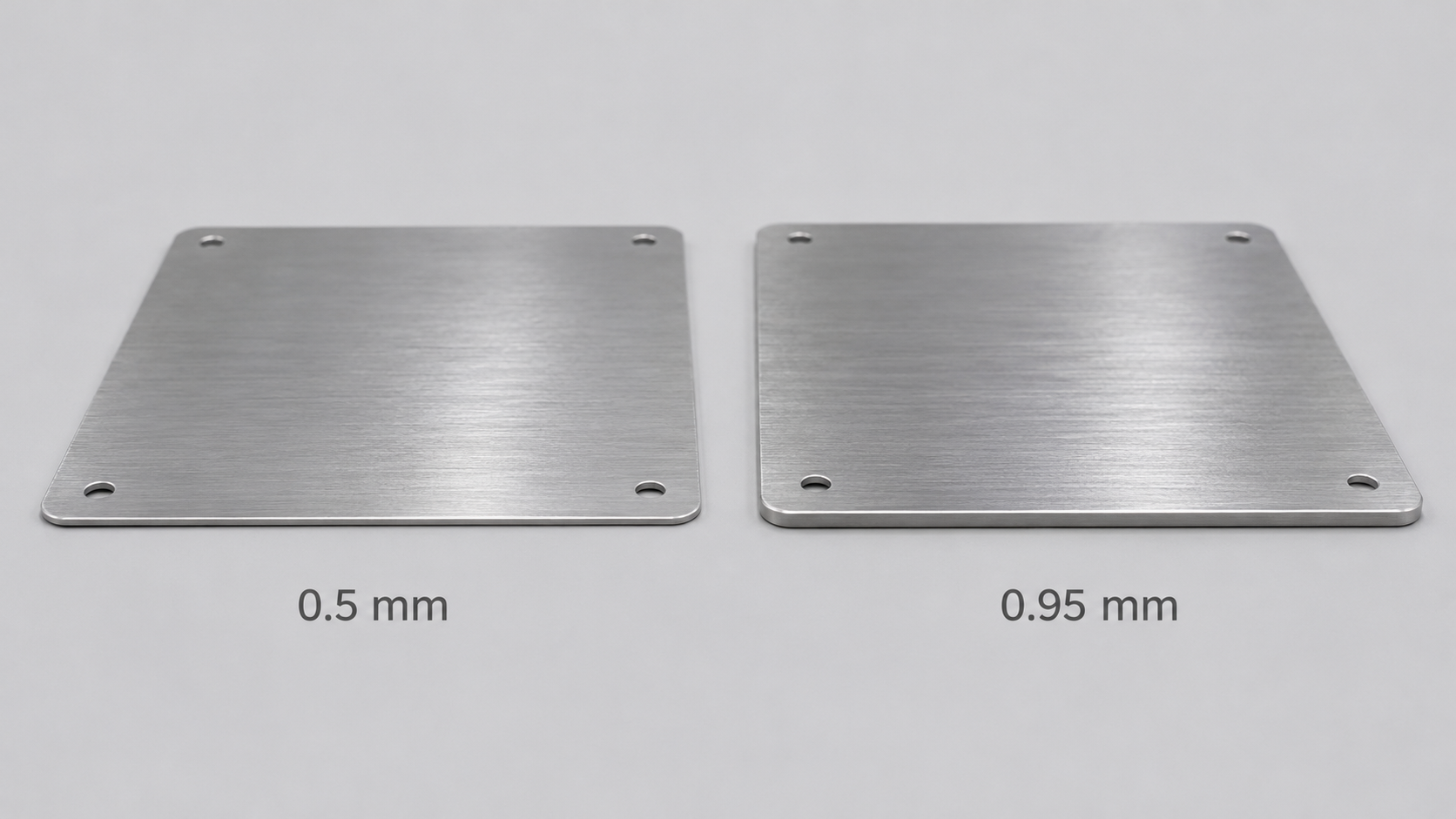
Two common configurations are 0.5mm and 0.95mm aluminum plates. Although the thickness difference appears small, these options have an important structural distinction: the 0.5mm version is generally supplied without a steel backing, while the 0.95mm version includes a steel backing layer.
Understanding this difference helps manufacturers select a plate that fits their machine, mounting requirements, and production setup.
So, which one should you choose? Let’s examine their construction, practical differences, and key selection factors.
1. What Are 0.5mm and 0.95mm Aluminum Pad Printing Plates?
Aluminum pad printing plates, also called aluminum clichés, are image carriers used in pad printing. The desired logo, text, or graphic is engraved into the plate using a fiber laser engraving machine.
During printing, the ink fills the engraved areas. An ink cup or doctor blade removes excess ink from the surface, leaving ink inside the recessed image. A silicone pad then picks up the ink and transfers it onto the product.
Unlike conventional chemical etching methods, fiber laser engraving allows the artwork to be processed directly onto suitable aluminum plates without a chemical etching process.
ENGYPRINT offers two common aluminum plate configurations:
| Feature | 0.5mm Aluminum Plate | 0.95mm Aluminum Plate |
| Base material | Aluminum | Aluminum |
| Steel backing | Without steel back | With steel back |
| Overall thickness | 0.5mm | 0.95mm |
| Engraving method | Fiber laser engraving | Fiber laser engraving |
| Mounting | Depends on machine design | Depends on machine design |
| Custom dimensions | Available | Available |
The key distinction is not simply the additional 0.45mm of thickness. The 0.95mm version incorporates a steel backing layer, giving it a different overall construction.
This backing can influence how the plate is supported, positioned, and secured in a pad printing machine.
2. What Is the Difference Between Aluminum Plates With and Without Steel Backing?
The most important difference between these two configurations is their supporting structure.
0.5mm Aluminum Plate Without Steel Backing
A 0.5mm aluminum plate is a thin, standalone aluminum sheet without an additional steel backing layer.
Its relatively thin construction makes it suitable for machines designed to accept thin aluminum clichés directly.
Key characteristics include:
- Thin construction: The plate has a nominal thickness of 0.5mm.
- Lightweight structure: Without an additional steel backing layer, the plate has less overall material.
- Direct mounting: It can be installed using a compatible plate holder, clamping system, or other machine-specific mounting arrangement.
- Laser engraving compatibility: Logos and other artwork can be engraved directly onto the aluminum surface.
One important consideration is mechanical support. Because the plate is thin, its flatness and stability depend partly on the machine’s plate holder and mounting arrangement.
Manufacturers should confirm that their equipment is designed for a 0.5mm aluminum plate before ordering.
0.95mm Aluminum Plate With Steel Backing
The 0.95mm configuration combines an aluminum engraving surface with a steel backing layer.
The backing provides additional structural support compared with a standalone 0.5mm aluminum sheet.
Its main characteristics include:
- Additional backing: A steel layer is incorporated into the plate assembly.
- Greater overall thickness: The finished plate has a nominal thickness of 0.95mm.
- Different mounting requirements: The additional backing changes the plate’s overall dimensions and installation characteristics.
- Structural support: The backing helps provide a more substantial plate assembly.
This configuration may be suitable for pad printing machines designed specifically for aluminum plates with steel backing.
However, a thicker assembly does not automatically mean better printing quality or longer engraving life. Actual performance also depends on the aluminum surface, engraving quality, plate flatness, doctoring conditions, and machine compatibility.
3. How Does Steel Backing Affect Pad Printing Performance?
Steel backing is primarily a structural feature. Its purpose is to provide additional support to the aluminum plate rather than to serve as the engraving surface.
There are several practical considerations.
Plate Support and Stability
A thin aluminum sheet needs appropriate support to maintain its position during printing.
An integrated steel backing provides a more substantial assembly, which can be beneficial when the machine is designed around this configuration.
However, the actual stability of the plate also depends on the quality of the backing, plate holder, and mounting arrangement.
Mounting Compatibility
Not every pad printing machine accepts both configurations.
Some machines use specific plate holders or mounting systems designed for a particular plate thickness.
For example, a machine designed for a standalone 0.5mm aluminum plate may not accept a 0.95mm backed assembly without adjustments.
Before ordering, check:
- Plate holder dimensions
- Total plate thickness
- Mounting and clamping method
- Hole positions, if applicable
- Available clearance around the ink cup or doctor blade
Correct compatibility is more important than simply choosing the thicker option.
Consistent Doctoring
During pad printing, the ink cup’s ceramic ring or the doctor blade must make consistent contact with the plate surface.
Poor plate installation, uneven support, or incorrect positioning can affect this contact and potentially lead to ink residue, incomplete doctoring, or inconsistent ink transfer.
Steel backing can contribute to a more substantial plate assembly, but it does not eliminate the need for proper installation and surface flatness.
4. Which Aluminum Plate Should You Choose?
The right option depends on your existing machine configuration and production requirements.
Here are some practical guidelines.
Choose 0.5mm Aluminum Plates If:
- Your machine is designed for standalone 0.5mm aluminum plates.
- Your existing plate holder supports thin aluminum sheets.
- You want a lightweight plate without additional steel backing.
- Your production setup already uses this configuration.
Choose 0.95mm Aluminum Plates If:
- Your machine is designed for aluminum plates with steel backing.
- You require the additional structural support provided by the backing.
- Your existing plate assembly uses a nominal thickness of 0.95mm.
- You want to maintain compatibility with your current mounting arrangement.
Important: Do not choose a plate based on thickness alone. Always check the machine manufacturer’s specifications and the actual plate holder dimensions.
If you are replacing an existing cliché, using the original plate as a reference is often the easiest way to avoid compatibility problems.
5. Can Both Aluminum Plate Types Be Laser Engraved?
Yes. Both configurations are intended for fiber laser engraving.
ENGYPRINT specifies 20W and 30W fiber laser machines for its aluminum plate engraving process.
Unlike traditional photosensitive plate-making methods, direct laser engraving does not require a separate film exposure and chemical etching process for this application.
A typical workflow includes the following steps:
Step 1: Prepare the Artwork
Create the logo or graphic in Adobe Illustrator and prepare the artwork as a suitable vector file.
The artwork should have clean outlines and correctly defined dimensions.
Step 2: Set Up the Fiber Laser Machine
Select the appropriate laser parameters according to the aluminum plate, surface treatment, and required engraving characteristics.
Power, speed, frequency, and engraving passes may need adjustment.
Step 3: Position the Aluminum Plate
Secure the plate properly on the laser machine’s working surface.
Correct positioning helps ensure that the engraved image matches the intended layout.
Step 4: Engrave the Artwork
The fiber laser processes the image directly onto the aluminum surface, creating recessed areas that hold the printing ink.
Step 5: Inspect the Finished Plate
Check the engraved image for clarity, consistency, and surface defects before installing the plate in the pad printing machine.
Although both configurations support fiber laser engraving, the actual laser settings should be verified for each plate construction.
6. What Other Specifications Should You Check Before Ordering?
Thickness and backing configuration are only two parts of a complete plate specification.
Before purchasing an aluminum pad printing plate, consider the following factors.
Plate Dimensions
The length and width must match the machine’s plate holder and artwork layout.
Common dimensions offered by ENGYPRINT include:
- 70 × 140mm
- 75 × 100mm
- 100 × 100mm
- 100 × 150mm
- 100 × 200mm
- 100 × 215mm
- 100 × 250mm
- 100 × 300mm
- 150 × 300mm
- 312 × 600mm
Custom dimensions are also available.
Surface Treatment
Surface condition affects how the plate interacts with the doctoring system and how the engraved image is produced.
ENGYPRINT lists black, blue, and red aluminum plate options. Its production specifications also identify a black oxide layer with a thickness of 0.008–0.01mm.
When selecting a surface treatment, confirm that the plate is suitable for the intended laser engraving process.
Hole Punching and Mounting
Some aluminum plates require mounting holes to fit specific machine fixtures.
ENGYPRINT supports hole punching by laser machine or punching mold.
If your existing plate has mounting holes, provide their positions and dimensions when requesting a replacement.
Artwork and Engraving Requirements
The final engraving quality depends on more than the aluminum plate itself.
Artwork dimensions, line thickness, engraving parameters, and image depth all influence the finished cliché.
For custom production, providing an original vector artwork file can help the supplier evaluate the engraving requirements.
7. Common Mistakes When Selecting Aluminum Pad Printing Plates
Even when the correct material is selected, ordering mistakes can cause installation and production problems.
Here are several issues to avoid.
Choosing by thickness alone
A 0.95mm plate is not automatically suitable for every machine. The presence of steel backing changes the assembly, so compatibility must be confirmed.
Ignoring the plate holder
A plate that has the correct length and width may still be incompatible if its thickness or mounting holes do not match the machine.
Assuming thicker means more durable
The steel backing provides structural support, but it does not necessarily make the aluminum engraving surface more resistant to doctoring wear.
Using unsuitable laser settings
Incorrect laser parameters can produce inconsistent engraving depth or damage the surface treatment.
Always verify the engraving settings with the plate supplier or conduct a sample test before production.
Not checking the artwork dimensions
An incorrectly scaled logo or improperly prepared vector file can result in an engraving that does not match the intended printed image.
Frequently Asked Questions
1. What is the main difference between 0.5mm and 0.95mm aluminum pad printing plates?
The 0.5mm version is a standalone aluminum plate without steel backing, while the 0.95mm version includes a steel backing layer. The main difference is their construction and overall thickness.
2. Is a 0.95mm aluminum plate better than a 0.5mm plate?
Not necessarily. The 0.95mm version provides a more substantial assembly through its steel backing, but the best choice depends on the machine’s mounting requirements and plate holder design.
3. Can aluminum pad printing plates be engraved with a fiber laser?
Yes. Aluminum pad printing plates can be directly engraved using a compatible fiber laser machine. ENGYPRINT specifies 20W and 30W fiber laser machines for its plate-making process.
4. Can I order custom-sized aluminum pad printing plates?
Yes. Standard dimensions are available, and custom sizes can be manufactured according to the machine’s requirements. Mounting holes and other specifications can also be discussed with the supplier.
5. Do aluminum pad printing plates require chemical etching?
No. For the fiber laser engraving process used with these aluminum plates, the artwork can be engraved directly without a chemical etching process.
6. How do I know which aluminum plate fits my pad printing machine?
Check the original plate’s thickness, overall dimensions, backing configuration, and mounting arrangement. If you are unsure, provide your machine model and photographs of the existing plate to the supplier for compatibility confirmation.
Conclusion
The difference between 0.5mm and 0.95mm aluminum pad printing plates is primarily their construction.
A 0.5mm plate is a standalone aluminum sheet, while a 0.95mm plate incorporates steel backing for additional structural support.
Neither option is universally better. The right choice depends on your pad printing machine, plate holder, mounting requirements, and production setup.
Before purchasing a replacement or custom aluminum cliché, confirm the complete plate specifications rather than relying on thickness alone.
ENGYPRINT supplies aluminum pad printing plates in both configurations, with standard and custom dimensions available. If you need help selecting the correct plate for your equipment, contact our team with your machine model and existing plate specifications.
Explore ENGYPRINT Aluminum Pad Printing Plates:
https://engyprint.com/product/aluminum-plate-for-pad-printing-machine/
Contact ENGYPRINT for Custom Plate Solutions:
https://engyprint.com/contact-us/