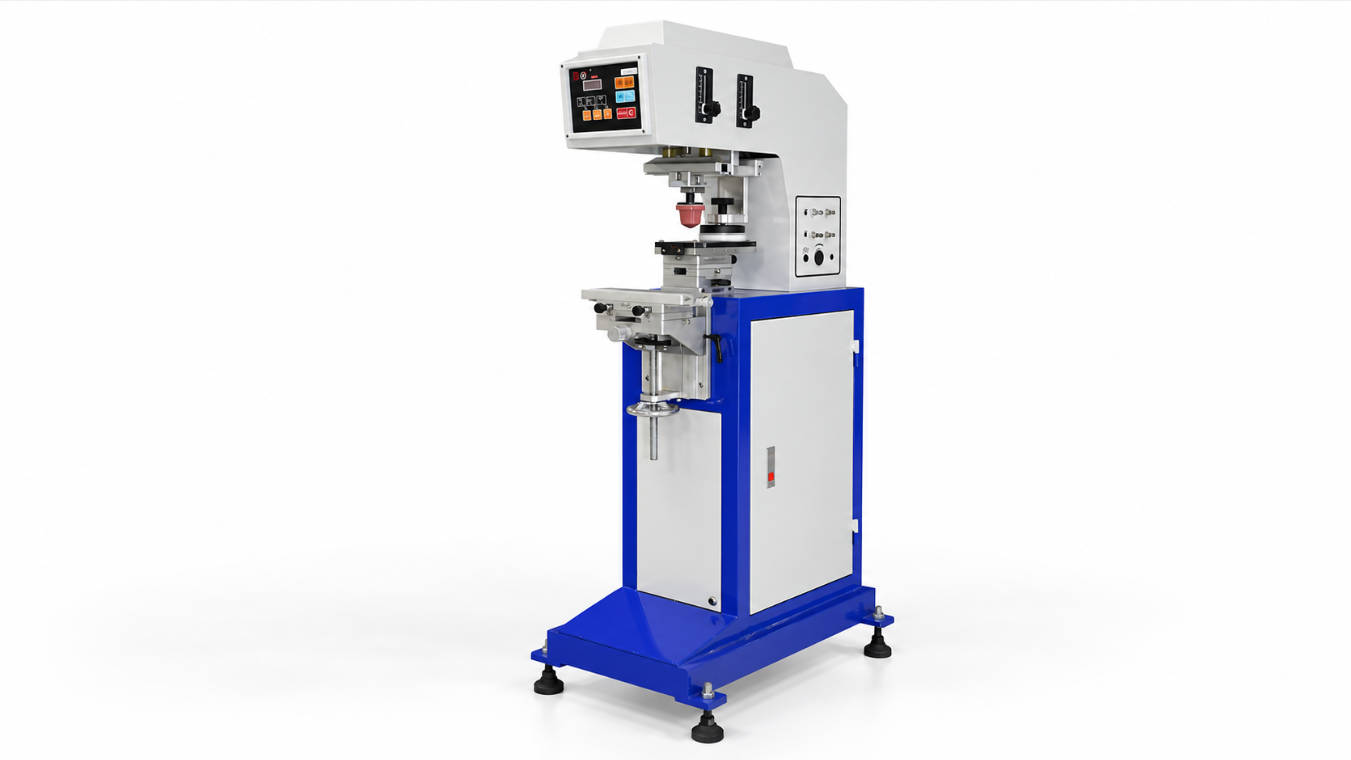
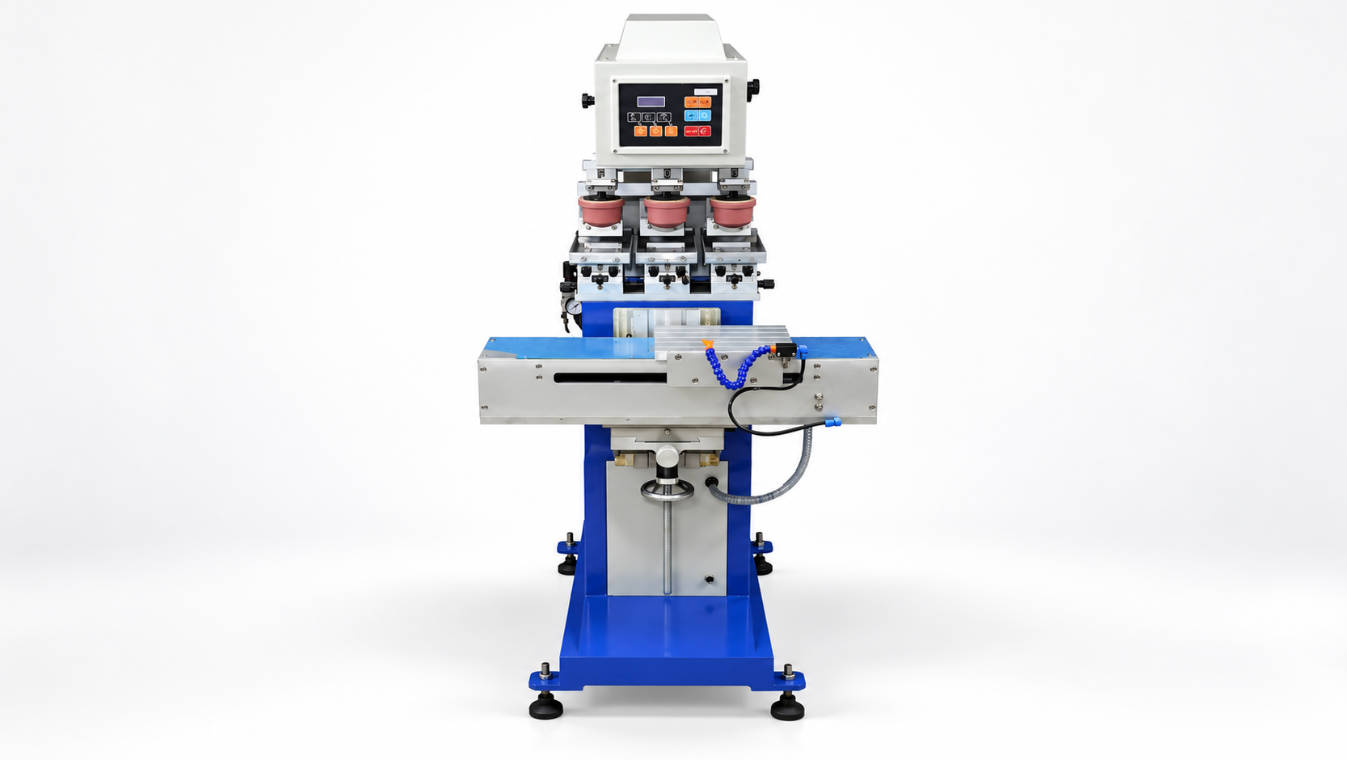
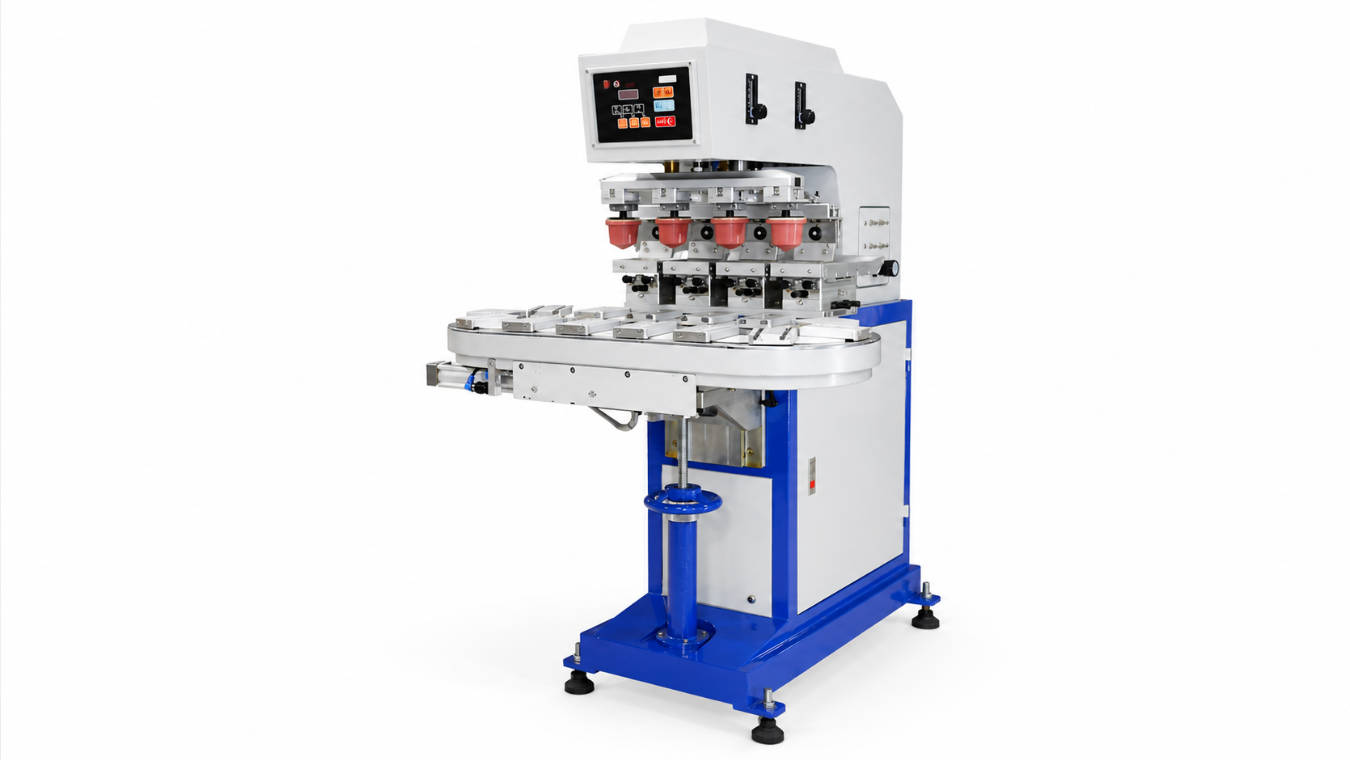
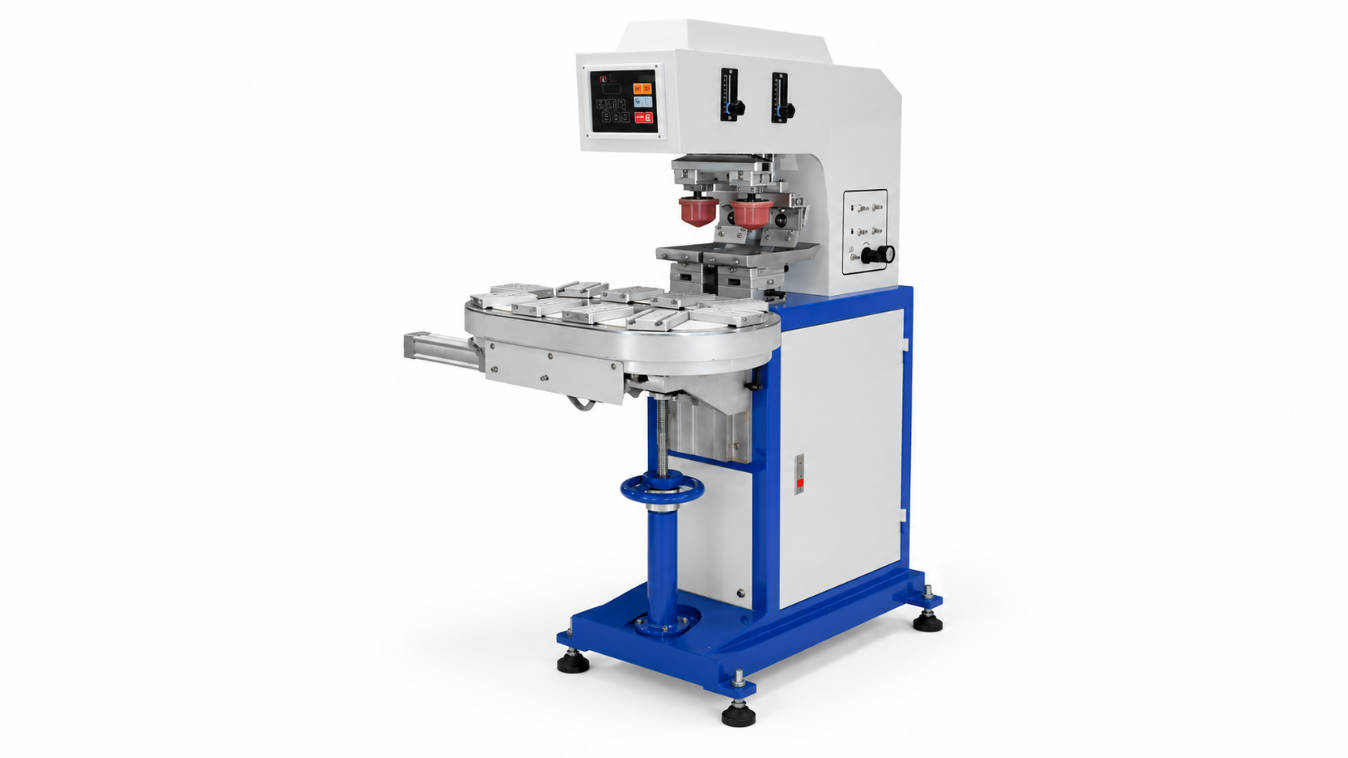
A one color pad printing machine is suitable for simple logos, single-color markings, and cost-sensitive production. A two color pad printer is better when the artwork has two separated colors and requires accurate registration. A four color pad printing machine is used when the product needs richer decoration, multi-color logos, or higher visual value. The right choice depends on artwork complexity, print size, registration tolerance, production volume, operator skill, and future product plans.
For many B2B buyers, the key question is not simply “How many colors can the machine print?” The more important question is: how many colors do your products actually need to print reliably, repeatedly, and profitably?
This guide explains how to choose between one color, two color, and four color pad printing machines for industrial product decoration. It also covers key technical factors such as registration accuracy, fixture design, ink cup system, production speed, cost, and supplier support. If you are comparing equipment options, you can review ENGY’s pad printing machine range for one-color and multi-color applications.
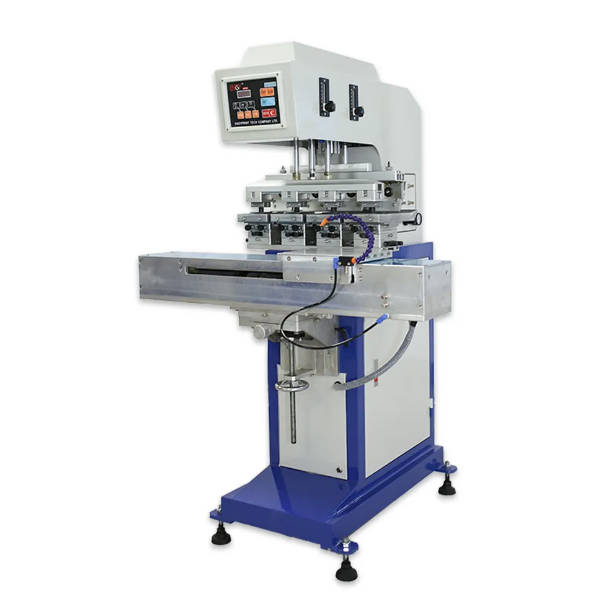
What Is a Pad Printing Machine?
A pad printing machine is an indirect printing machine used to transfer ink from an etched printing plate to a product surface through a silicone pad. It is widely used for printing logos, text, symbols, marks, and decorative graphics on plastic, metal, glass, ceramic, rubber-like, coated, and irregular-shaped products.
The basic process includes:
- The artwork is etched onto a cliché plate.
- Ink fills the etched image area.
- Excess ink is removed from the plate surface.
- A silicone pad picks up the image.
- The pad transfers the image onto the product.
- The printed part is dried or cured according to the ink system.
Pad printing is especially useful when the product surface is curved, recessed, uneven, or difficult to print with flat screen printing. This makes it common in toys, electronics, home appliances, cosmetic packaging, medical parts, automotive components, promotional products, tools, and industrial parts.
What Does “Color Count” Mean in Pad Printing?
Color count means how many separate ink colors the machine can print onto the product in one printing cycle or production sequence.
A one color pad printing machine prints one ink color. A two color pad printer prints two different ink colors, usually with two plates, two ink cups or trays, and a product movement system for registration. A four color pad printing machine can print four different ink colors, often using a shuttle, rotary table, conveyor, or indexing system depending on the machine design.
Color count affects not only the final visual result, but also machine structure, registration accuracy, setup time, operator skill, fixture design, and total investment.
One Color vs Two Color vs Four Color Pad Printing Machine: Quick Comparison
| Item | One Color Pad Printing Machine | Two Color Pad Printer | Four Color Pad Printing Machine |
| Best for | Simple logo, text, symbols, single-color marking | Two-color logos, dual-tone graphics, brand + accent color | Multi-color logos, decorative graphics, premium product appearance |
| Machine complexity | Low | Medium | Higher |
| Setup time | Short | Moderate | Longer |
| Registration requirement | Low | Medium to high | High |
| Operator skill | Basic to moderate | Moderate | Higher |
| Fixture importance | Important | Very important | Critical |
| Cost level | Lower | Medium | Higher |
| Production flexibility | Good for simple products | Good for two-color branding | Strong for complex decoration |
| Common use | Industrial marking, simple branding | Logo + text, two-color icons | Cosmetics, toys, promotional items, premium packaging parts |
When to Choose a One Color Pad Printing Machine
A one color pad printing machine is the most practical option when the product only needs a simple logo, product code, icon, technical mark, or single-color brand decoration. It is usually easier to operate, faster to set up, and more cost-effective than a multi-color pad printer.
Choose a one color pad printing machine when your artwork does not require color registration and the main goals are stable printing, lower cost, and simple operation.
Suitable Applications for One Color Pad Printing
| Application | Why One Color Works |
| Product logo printing | Many industrial logos use one solid color |
| Model number or product code | Clear marking is more important than decoration |
| Warning symbols | Usually printed in one high-contrast color |
| Simple brand icon | Low setup complexity |
| Electrical parts | Suitable for text and functional marks |
| Plastic housings | Good for basic branding |
| Tools and hardware | Durable single-color marking |
| Promotional items | Suitable for simple batch printing |
A one color machine is often a good entry point for factories that are starting pad printing in-house. It can also be suitable for workshops that handle many simple printing jobs but do not need multi-color registration.
Advantages of One Color Pad Printing Machines
| Advantage | Practical Value |
| Lower machine cost | Easier to control initial investment |
| Simple setup | Shorter preparation time |
| Easier operation | Lower training requirement |
| Faster changeover | Useful for mixed small batches |
| Lower registration risk | No multi-color alignment issue |
| Easier maintenance | Fewer stations and components |
However, one color machines are limited when the product requires more decorative value. If the brand logo has two or more colors, or if the product appearance needs to match retail packaging standards, a one color machine may not be enough.
When to Choose a Two Color Pad Printer
A two color pad printer is suitable when the artwork includes two different colors that must be printed in accurate positions. This may include a logo with a main brand color and accent color, a symbol plus text, or a product design that needs two separated visual elements.
A two color pad printer is often the right balance when buyers need better visual decoration than one-color printing but do not require the complexity of four-color printing.
Suitable Applications for Two Color Pad Printing
| Application | Why Two Colors Help |
| Brand logo with two colors | Matches brand identity more accurately |
| Logo + text combination | Separates brand icon and product information |
| Decorative icons | Adds visual contrast |
| Control panels | Different colors can identify functions |
| Toy components | Improves product appearance |
| Cosmetic caps or bottles | Creates a more refined look |
| Electronic accessories | Supports brand + functional graphics |
Two color printing requires better product positioning than one color printing. If the second color is not aligned correctly, the final print may look blurry, shifted, or unprofessional. This is why fixture design and machine movement accuracy are more important.
Key Factors for Two Color Pad Printer Selection
| Factor | Why It Matters |
| Registration accuracy | Determines whether two colors align cleanly |
| Fixture stability | Prevents product movement between prints |
| Pad shape | Affects image transfer and distortion |
| Plate layout | Controls image position for each color |
| Machine movement | Shuttle, turntable, or conveyor affects repeatability |
| Operator adjustment | Setup skill affects final quality |
A two color pad printer is suitable for many B2B buyers because it provides stronger decoration capability without the full complexity of four-color equipment.
When to Choose a Four Color Pad Printing Machine
A four color pad printing machine is used when the product requires richer decoration, multi-color branding, or more complex visual effects. It is commonly used for products where appearance strongly affects customer perception, retail value, or brand recognition.
Choose a four color pad printing machine when the artwork has multiple separated colors and the product requires accurate multi-color registration across repeated production.
Suitable Applications for Four Color Pad Printing
| Application | Why Four Colors May Be Needed |
| Cosmetic packaging | Higher visual value and brand differentiation |
| Toys and game parts | Colorful graphics improve appearance |
| Promotional products | Multi-color logos are often requested |
| Consumer electronics | Premium branding may require multiple colors |
| Sports goods | Decorative designs and brand marks |
| Bottle caps and closures | Multi-color decoration for packaging |
| Custom industrial parts | Complex symbols or color-coded information |
A four color machine is not always necessary. It makes sense when the product value, brand requirement, or order demand justifies the additional machine cost and setup complexity.
Challenges of Four Color Pad Printing
| Challenge | Practical Impact |
| Higher registration requirement | Small alignment errors become visible |
| More setup time | Each color needs adjustment |
| More plates and inks | Higher preparation cost |
| More fixture precision | Product position must remain stable |
| More operator skill | Process control becomes more demanding |
| Higher maintenance workload | More stations and components |
Four color machines can deliver better decoration capability, but buyers should confirm that their production team, fixture design, and artwork preparation can support multi-color printing.
How to Choose the Right Color Count
1. Start with the Artwork
The artwork is the first decision point. Do not choose the machine before checking the actual artwork file.
Ask these questions:
| Artwork Question | Selection Impact |
| How many ink colors are in the logo? | Determines required color stations |
| Are the colors separated or overlapping? | Affects registration difficulty |
| Is the artwork simple text or complex graphics? | Affects plate and pad selection |
| Is the printed image small or large? | Affects machine size and plate area |
| Will the logo change frequently? | Affects setup and changeover requirements |
If your artwork is only one solid color, a one color pad printing machine may be enough. If the logo has two brand colors, choose a two color pad printer. If the design has multiple colors and strong visual requirements, consider a four color pad printing machine.
2. Evaluate Registration Accuracy
Registration accuracy means how well each printed color aligns with the other colors. In one-color printing, registration is relatively simple because there is no second color to match. In two-color and four-color printing, registration becomes critical.
Multi-color registration depends on:
- Machine movement accuracy
- Fixture stability
- Product loading repeatability
- Plate position
- Pad compression
- Ink drying behavior
- Operator setup skill
For multi-color printing, the supplier should review the product shape and artwork before recommending the machine. A flat, stable product is easier to register than a curved, flexible, or irregular product.
3. Consider Production Volume
Production volume affects whether a simple machine or a more automated system is more suitable.
| Production Situation | Suggested Direction |
| Low-volume simple marking | One color pad printing machine |
| Small batch custom logo printing | One color or two color machine |
| Medium-volume branded products | Two color pad printer |
| High-volume decorative products | Two color or four color machine |
| Large-scale multi-color production | Four color or customized automatic system |
If your orders are small and change often, a simple machine may be more flexible. If your production runs are long and repetitive, a more advanced multi-color system may reduce manual handling and improve output consistency.
4. Check Product Shape and Fixture Requirements
Pad printing can decorate irregular shapes, but fixture design becomes more important as color count increases. A product that moves even slightly between color stations can create misalignment.
For one-color printing, the fixture needs to hold the product in the correct position. For two-color and four-color printing, the fixture must also maintain repeatable position across multiple printing actions.
Fixture quality affects:
- Print position accuracy
- Color registration
- Product loading speed
- Operator consistency
- Scrap rate
- Long-term production stability
For multi-color printing, buyers should send real samples or detailed product drawings before finalizing the machine.
5. Consider Ink Cup or Open Tray System
Many one color, two color, and four color pad printing machines can be built with closed ink cup or open tray systems depending on the application. Closed ink cup systems are commonly used for cleaner operation and better ink stability, while open tray systems may be selected for larger logos or special print sizes.
For most industrial product decoration, closed ink cup machines are practical when the artwork fits the cup size. For larger images, an open tray system may be considered.
ENGY’s pad printing machine category includes different machine structures for various color-count and application needs.
Cost Considerations: One Color, Two Color, and Four Color Machines
Color count affects the total investment in several ways. A multi-color pad printer may require more plates, ink cups, pads, fixtures, adjustment time, and operator training.
| Cost Factor | One Color | Two Color | Four Color |
| Machine investment | Lower | Medium | Higher |
| Plate cost | Lower | Medium | Higher |
| Ink preparation | Simple | Moderate | More complex |
| Fixture requirement | Basic to moderate | High | Very high |
| Setup time | Short | Medium | Longer |
| Operator training | Easier | More detailed | More demanding |
| Maintenance | Lower | Medium | Higher |
The right machine is not always the cheapest machine. A one color machine may be cheaper, but it will not solve a two-color branding requirement. A four color machine may offer more capability, but it may be unnecessary if your product only uses one or two colors.
Common Mistakes When Choosing Pad Printer Color Count
Mistake 1: Buying Too Few Colors to Save Cost
Some buyers choose a one color machine because it is cheaper, then later discover that customer logos require two or more colors. This can lead to outsourcing, rework, or buying another machine later.
Mistake 2: Buying Too Many Colors Too Early
A four color pad printing machine is useful for complex decoration, but it may be excessive for simple industrial marking. More colors mean more setup, higher cost, and more registration control.
Mistake 3: Ignoring Registration Difficulty
Multi-color printing is not only about adding more ink stations. The product must be positioned accurately, and the machine must maintain alignment between colors. Poor registration can make a multi-color print look worse than a clean one-color print.
Mistake 4: Not Considering Future Product Plans
If your current logo is one color but future product lines may require two-color or multi-color decoration, it may be worth discussing upgrade options with the supplier.
Mistake 5: Choosing Without Sending Artwork
Machine selection should be based on real artwork size, product shape, material, and output requirement. Verbal descriptions are often not enough.
Supplier Selection Tips
A reliable supplier should help you choose the right color count instead of simply recommending the largest or most expensive machine. The supplier should understand artwork evaluation, machine structure, fixture design, pad selection, plate preparation, ink choice, and production workflow.
Before requesting a quote, prepare:
- Product photos or samples
- Artwork file
- Logo size
- Printing position
- Number of colors
- Product material
- Expected daily output
- Required print durability
- Current production pain points
A professional recommendation should consider both current needs and future product expansion. ENGY provides pad printing machine solutions for one-color and multi-color printing, as well as customized options for different product shapes and production setups. You can also visit the ENGY website to learn more about the company and related printing equipment.
Practical Selection Checklist
| Question | Choose One Color If… | Choose Two Color If… | Choose Four Color If… |
| How many colors are in the logo? | One solid color | Two separated colors | Three to four colors |
| Is registration required? | Minimal | Moderate | High |
| How complex is the artwork? | Simple text/logo | Logo + accent color | Decorative or premium graphics |
| What is the production volume? | Low to medium | Medium | Medium to high |
| How skilled are operators? | Basic training | Moderate skill | Higher skill needed |
| Is product positioning stable? | Basic fixture is enough | Accurate fixture needed | High-precision fixture needed |
| Is future expansion likely? | Limited product range | Some product variation | Many SKUs or brand designs |
FAQ
1. What is a one color pad printing machine used for?
A one color pad printing machine is used for printing single-color logos, product codes, symbols, warning marks, and simple brand graphics on industrial products. It is suitable when the artwork does not require multi-color registration.
2. When should I choose a two color pad printer?
Choose a two color pad printer when your logo or product decoration has two ink colors that must align accurately. It is commonly used for brand logos, control panels, toys, cosmetic packaging, and consumer products with two-color graphics.
3. Is a four color pad printing machine necessary for all multi-color logos?
No. A four color pad printing machine is only necessary when the artwork requires three to four separate colors or more complex decorative printing. If the logo has only two colors, a two color pad printer may be more practical.
4. How do I choose between one color and multi color pad printer models?
Start with the artwork file, number of colors, print size, registration requirement, production volume, and product shape. A simple one-color mark may only need a one color machine, while complex branding may require a two color or four color machine.
5. Does a multi color pad printer reduce production speed?
A multi color pad printer can require more setup and registration adjustment. Actual production speed depends on machine structure, product loading method, fixture design, drying behavior, and operator skill.
6. Can one pad printing machine print different color logos?
Yes, many pad printing machines can print different logos by changing the plate, ink, pad, and fixture. However, the machine’s color count limits how many different colors can be printed in one setup or production sequence.
7. What information should I send to get a color-count recommendation?
Send your artwork file, logo size, number of colors, product photos, material, print position, and expected output. This helps the supplier recommend whether a one color, two color, or four color pad printing machine is suitable.
Conclusion
Choosing between a one color pad printing machine, two color pad printer, and four color pad printing machine depends on artwork complexity, registration accuracy, product shape, production volume, and budget.
A one color machine is suitable for simple logos and cost-sensitive industrial marking. A two color machine is a practical choice for two-color branding and moderate decoration needs. A four color machine is better for richer product decoration, premium appearance, and more complex multi-color graphics.
Before buying, do not rely only on machine price or color count. Send the artwork, product details, material, and output requirement for technical review. ENGY can help evaluate your application and recommend a suitable pad printing machine based on your color-count, registration, and production needs.
Related Reading
- Pad Printing Machine vs Screen Printing Machine
- What are the advantages of a 4-color pad printing machine over other printing
- How Does a Four Color Closed Ink Cup Pad Printer Compare to Other Printing
- How Four-Color Closed Ink Cup Pad Printers Compare to Other Printing
- Technological Advancements in Four Color Pad Printing Systems for Improved