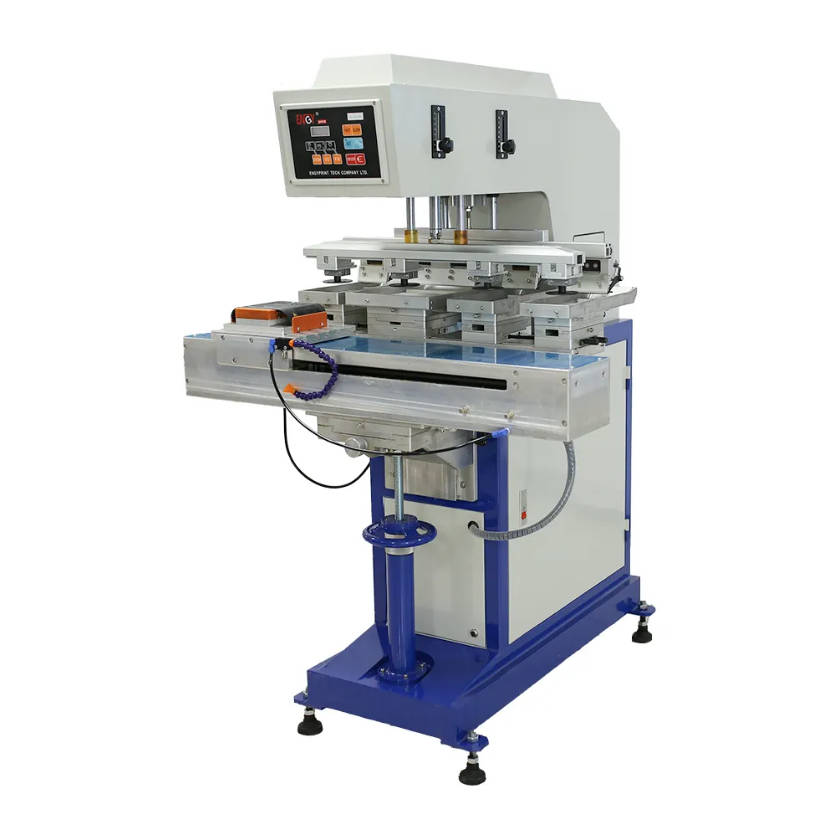
In the precision-driven world of modern manufacturing, the difference between a high-quality product and a rejected part often comes down to fractions of a millimeter. For industries like medical device manufacturing, automotive electronics, and aerospace, “accuracy” is the most critical metric when investing in a pad printing machine.
If you are evaluating equipment for your production line, understanding the technical limits and variables of pad printing accuracy is essential for ensuring a high Return on Investment (ROI) and low scrap rates.
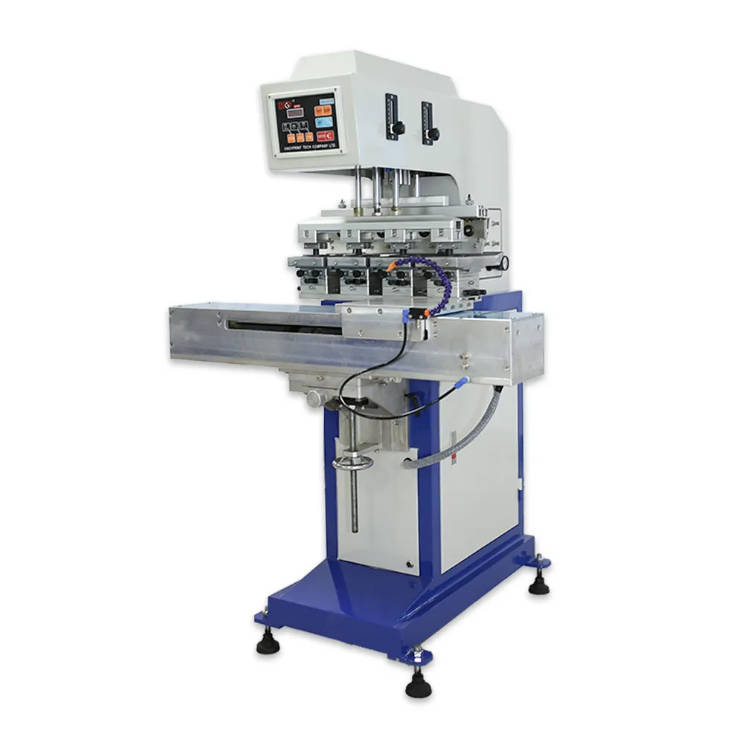
I. Defining Accuracy in Pad Printing: More Than Just a Number
In an industrial context, accuracy is not a single value but a combination of three distinct factors:
- Registration Accuracy (Positional Precision): This refers to the machine’s ability to place the image in the exact same X and Y coordinates on every part.
- Repeatability: This is the machine’s ability to maintain that precision over thousands or even millions of cycles without “drifting.”
- Image Fidelity: This refers to how well the machine reproduces fine lines, small text, and sharp edges without distortion or blurring.
The standard printing accuracy of a high-quality pad printing machine typically ranges from +/- 0.02 mm to +/- 0.1 mm. While pneumatic machines usually offer a tolerance of +/- 0.1 mm, high-end servo-driven systems can achieve precision as tight as +/- 0.02 mm under controlled conditions.
II. Technical Data: Accuracy Comparison by Machine Type
To help you make an informed purchasing decision, the following table compares the typical performance metrics of different pad printing drive systems.
Pad Printing Machine Performance Matrix
| Machine Drive System | Typical Accuracy (Registration) | Repeatability | Best Applications |
| Pneumatic (Air-Powered) | +/- 0.10 mm to 0.15 mm | Moderate | Toys, basic consumer goods, large logos |
| Motor-Driven (Cam) | +/- 0.05 mm to 0.08 mm | High | Automotive switches, appliances |
| Servo-Driven (Electronic) | +/- 0.02 mm to 0.05 mm | Ultra-High | Medical syringes, micro-electronics, aerospace |
III. The Five Critical Factors That Influence Printing Accuracy
Achieving high-precision results requires more than just a good machine; it requires a perfectly synchronized system. Here are the five “pillars” of pad printing accuracy:
1. Machine Rigidity and Drive Technology
The foundation of accuracy is the machine frame. Heavy-duty cast iron or reinforced steel frames absorb vibrations better than light aluminum structures.
- Servo Control: Unlike pneumatic cylinders that rely on air pressure and physical stops, servo-driven pad printing machines provide absolute control over the pad’s travel distance and speed, eliminating the “bounce” effect and ensuring sub-millimeter precision.
2. Silicone Pad Characteristics (The Durometer)
The pad is the “transfer vehicle” for your ink. Its hardness (measured in Shore A durometer) directly affects image distortion.
- Hard Pads (50-70 Shore A): These resist compression and provide the highest accuracy for flat surfaces.
- Soft Pads (10-30 Shore A): These conform to curved surfaces but are prone to image stretching if not managed correctly.
3. Cliché (Printing Plate) Quality
The accuracy of your print can never be better than the accuracy of your plate.
- High-quality steel plates are usually etched to a depth of 20 to 25 microns with a tolerance of +/- 2 microns. This ensures that exactly the right amount of ink is picked up every time.
4. Ink Viscosity and Environmental Control
Ink is sensitive to its environment. If the solvents evaporate too quickly, the ink becomes “tacky,” leading to incomplete transfers or blurred edges.
- To maintain maximum printing accuracy, production facilities should be kept at a constant temperature (typically 20°C to 24°C) and a humidity level of 45% to 55%.
5. Part Fixturing (The Nest)
If the part moves even 0.05 mm during the print, your accuracy is lost. Precision-machined aluminum jigs or vacuum-suction fixtures are required for high-tolerance industrial applications to ensure the substrate remains perfectly stationary.
IV. Accuracy in Multi-Color Registration
When a project requires printing 2, 4, or 6 colors, the challenge shifts from simple accuracy to “color-to-color registration.”
In these scenarios, the transport system becomes the most important component. Rotary indexing tables and linear shuttle systems are the industry standard for multi-color accuracy, as they mechanically lock the part into position at each printing station to prevent cumulative alignment errors.
V. Troubleshooting Accuracy Issues: A Maintenance Checklist
If you notice a decline in print quality or positional drift, use this professional checklist to diagnose the problem:
- Check for Mechanical Play: Ensure all bolts on the pad holder and cliché plate are tight. Even a 0.01 mm “wiggle” can ruin a print.
- Inspect the Doctor Blade: A worn doctor blade or ceramic ring will leave an uneven ink film on the plate, causing “ghosting” or blurred edges.
- Evaluate Pad Wear: Silicone pads have a finite lifespan. Once the surface oils are depleted, the pad loses its ability to pick up and release ink accurately.
- Monitor Static Electricity: In dry environments, static can cause ink to “spider” or jump, creating an inaccurate image outline. Using an ionizing bar can solve this.
VI. Why Pad Printing Wins for Complex Geometries
While digital inkjet and screen printing are popular, pad printing remains the king of accuracy for 3D shapes. Because the silicone pad can wrap around curves and recessed areas without losing image integrity, pad printing offers a level of geometric accuracy that other technologies simply cannot match on irregular surfaces.
VII. Conclusion: How to Choose the Right Machine for Your Needs
When selecting a pad printing machine for your facility, don’t just look at the price tag. Consider the cost of “non-conformance”—the price you pay for every rejected part.
- For Standard Applications (Logos, branding): A high-quality pneumatic machine is usually sufficient.
- For Technical Applications (Scales, electronic symbols): Invest in a motor-driven or cam-operated machine.
- For Critical Applications (Medical, Aerospace): Only a High-Precision Servo-Driven Pad Printing Machine will provide the +/- 0.02 mm accuracy required.