In the world of industrial manufacturing, the challenge of decorating or marking small plastic components is a recurring hurdle. Whether it’s the microscopic dial on a medical device, a textured button on a car dashboard, or a branded electronic connector, the requirements are always the same: extreme precision, high durability, and cost-effectiveness.
While digital inkjet and screen printing have their places, pad printing (also known as tampon printing) remains the undisputed industry standard for high-fidelity transfers on small, complex plastic geometries. This article explores the technical superiority of pad printing and provides a roadmap for buyers looking to optimize their production lines.
I. The Mechanics of Precision: How Pad Printing Works
To understand why pad printing is ideal for small parts, one must understand the unique physics of the process. Unlike screen printing, which pushes ink through a mesh, pad printing is an indirect offset process.
- The Cliché (Plate): The artwork is etched into a flat metal or photopolymer plate.
- Inking: A “sealed ink cup” slides over the etching, filling it with ink and doctoring off the excess.
- The Transfer: A soft, flexible silicone pad presses down onto the etching, picking up the ink film.
- The Deposit: The pad then moves to the plastic part. Because the silicone pad is compressible, it wraps around the contours of the small part, depositing the ink with 100% registration accuracy.
The flexibility of the silicone pad acts as a “universal vehicle,” allowing the machine to print on surfaces that are concave, convex, or even textured without distorting the image.
II. Key Reasons Why Pad Printing Dominates Small Plastic Parts
When dealing with small plastic substrates, manufacturers face specific technical constraints. Here is why pad printing is the most viable solution:
1. Unmatched Resolution on Minimal Surface Area
Small parts often require legibility in tiny fonts (down to 2-point or 4-point size). Pad printing machines are ideal for small plastic parts because they can maintain crisp edge definition and intricate detail on surface areas as small as a few millimeters.
2. Geometry Independence
Plastic moldings are rarely perfectly flat. They have parting lines, recessed areas, and compound curves. A silicone pad’s ability to conform to 3D shapes ensures that the logo or safety warning remains undistorted, regardless of the part’s complex geometry.
3. Chemical Bonding and Material Versatility
Plastic substrates like ABS, Polycarbonate (PC), and Polypropylene (PP) have varying surface energies. Pad printing utilizes specialized solvent-based or UV-curable inks that chemically bond with these plastics. For low-surface-energy plastics like PE or PP, integrated pre-treatment systems (flame or corona) ensure the ink achieves permanent adhesion.
4. High-Speed Multi-Color Registration
On a small scale, even a 0.1mm misalignment in color is visible to the naked eye. Pad printing machines equipped with “shuttles” or “carousels” allow for multi-color printing in a single cycle with repeatable accuracy that digital methods struggle to match at high speeds.
III. Technical Comparison: Pad Printing vs. Alternative Methods
To help you make an informed procurement decision, the following table compares pad printing with the two most common alternatives for plastic marking.
| Feature | Pad Printing | Screen Printing | Industrial Inkjet (Digital) |
| Ideal Part Shape | 3D, Curved, Recessed | Flat or Cylindrical | Mostly Flat |
| Image Detail | Very High (Fine lines) | Moderate | High |
| Setup Cost | Low to Moderate | Low | High (Equipment cost) |
| Ink Durability | Excellent (Chemical bond) | High | Variable (Depends on UV) |
| Substrate Variety | Almost all plastics | Limited | Limited by surface tension |
| Production Speed | High (Up to 3,000 pph) | Moderate | Low to Moderate |
IV. Addressing Common Buyer Concerns (FAQ)
Q: Will the ink scratch off during daily use?
A: The durability of pad printing on plastic depends on the ink system used; 2-component inks (ink + hardener) create a cross-linked chemical bond that is resistant to abrasion, chemicals, and oils. This is why pad printing is the preferred choice for automotive and medical applications where longevity is non-negotiable.
Q: Can I achieve high opacity on dark plastic parts?
A: Yes. Unlike inkjet, which uses thin layers, pad printing can transfer a thicker, more opaque film of ink. For extreme cases, a “double hit” (printing the same spot twice) can be programmed into the machine cycle to ensure vivid whites or bright colors on black substrates.
Q: How do I handle different plastic types?
A: You must match the ink to the resin.
- ABS/PC: Standard solvent inks.
- PP/PE: Requires pre-treatment and specific “PP inks.”
- Nylon: Requires high-adhesion 2-component inks.
V. Choosing the Right Machine Configuration
When sourcing a Pad Printing Machine, the configuration should be dictated by your production volume and the complexity of the part.
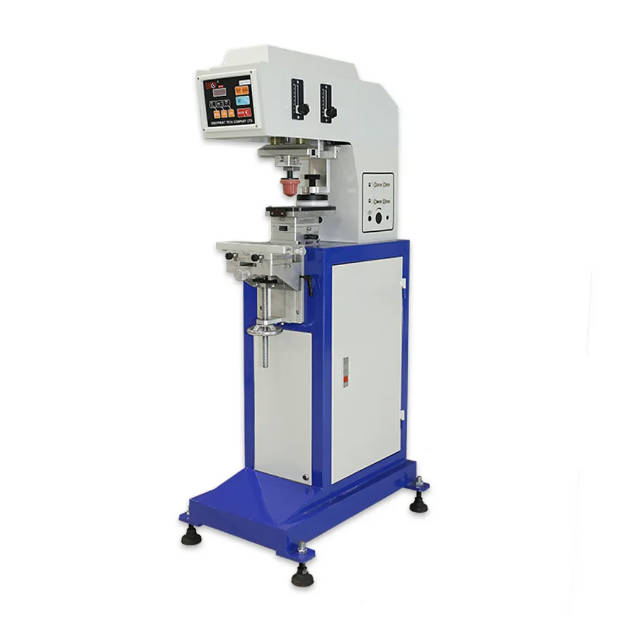
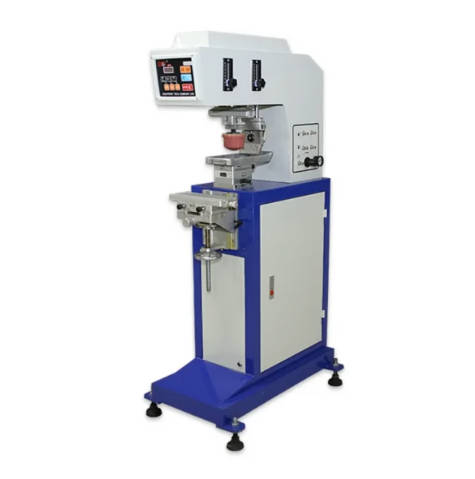
- Sealed Ink Cup Systems: This is the modern standard. The sealed ink cup prevents solvent evaporation, keeps ink viscosity stable, and reduces waste, making it the most cost-effective choice for 24/7 production environments.
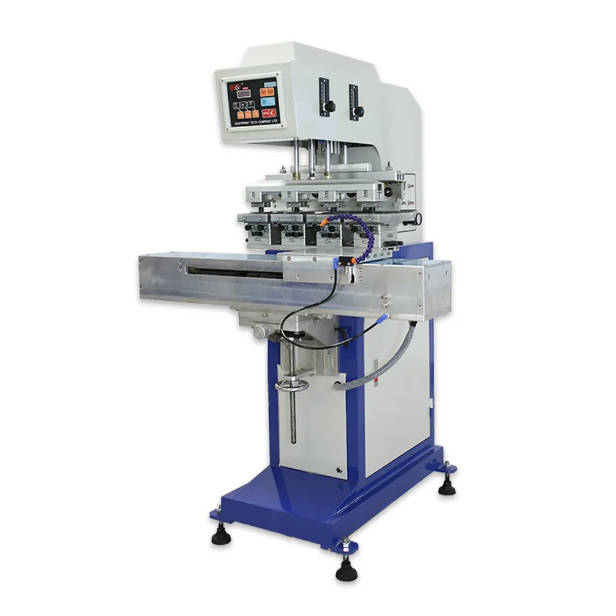
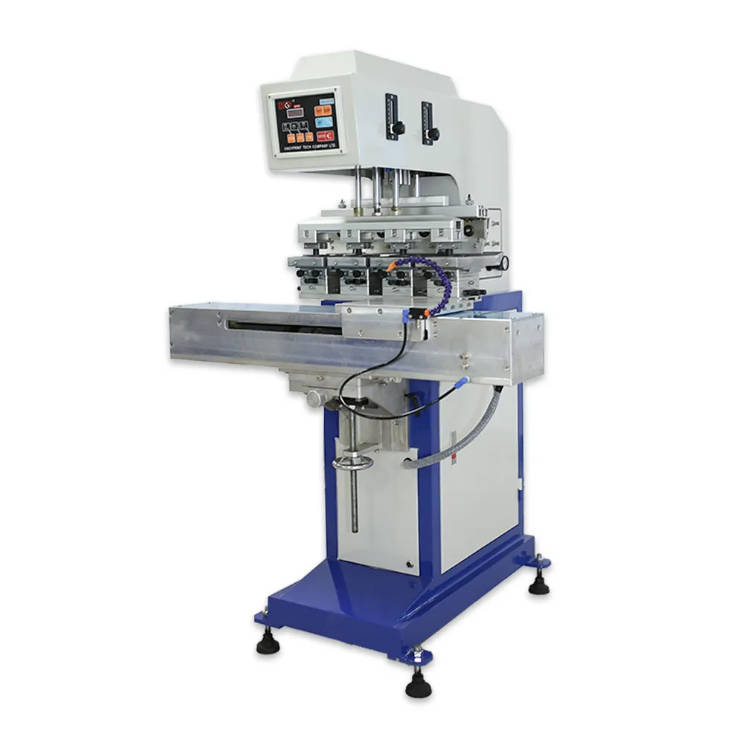
- Multi-Color Shuttles: If your logo has 2-4 colors, a shuttle system moves the part under different pads sequentially, ensuring the part never leaves its fixture, which maintains perfect registration.
- Automation Integration: For high-volume electronics or medical manufacturing, pad printing heads can be integrated into fully automated assembly lines with robotic loading and unloading.
VI. Critical Success Factors: The Importance of Fixturing
The secret to successful small-part printing isn’t just the machine—it’s the jig (fixture). Because the part is small, even a tiny movement during the “deposit” phase will ruin the print.
To achieve 0.01mm registration accuracy on small plastic parts, custom-machined aluminum or 3D-printed resin fixtures must be used to hold the component perfectly stationary against the pressure of the silicone pad.
VII. Applications of Pad Printing in Modern Industry
- Medical Industry: Marking graduation scales on syringes and identification codes on catheters. Inks used are typically medical-grade and biocompatible.
- Electronics: Printing icons on earbud cases, micro-switches, and internal circuit housing.
- Automotive: Backlit buttons, gear shift knobs, and steering wheel controls.
- Promotional Products: Branded pens, USB drives, and golf balls.
VIII. Conclusion: Maximizing Your ROI
Investing in a pad printing machine for small plastic parts offers a unique combination of high aesthetic quality and low per-print cost. By selecting the right pad durometer, matching the ink to your specific plastic resin, and ensuring rigid fixturing, you can achieve a level of detail that no other technology can replicate.
When selecting a supplier, look for a partner who provides a “turnkey” solution—including ink testing on your specific parts, custom pad selection, and cliché production—to ensure your line is optimized from day one.