I. Introduction: The Manufacturing Dilemma
For production managers and manufacturing engineers, procuring capital equipment is never just about the initial purchase price. It is a calculation of long-term efficiency, scalability, and Return on Investment (ROI). When it comes to product marking and decorating, the choice between standard pad printing machines and custom automated pad printing systems is a pivotal decision that impacts your entire production line.
The dilemma is common: Do you opt for a readily available, lower-cost standard machine that requires manual operation? Or do you invest in a purpose-built, high-speed custom system that automates the entire process but demands a longer lead time and higher upfront capital?
Making the wrong choice has consequences. Under-investing in a standard model for high-volume needs can lead to labor bottlenecks and inconsistent quality. Conversely, over-investing in a complex custom system for low-volume, high-mix products can result in a machine that sits idle, unable to adapt to new designs.
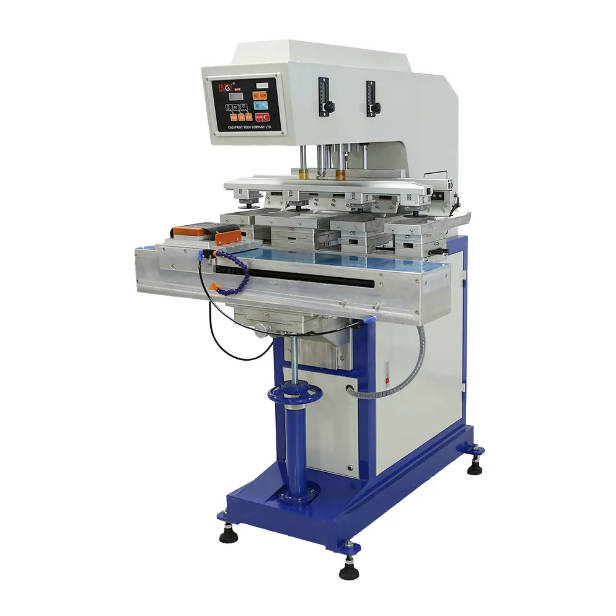
The primary difference between standard and custom pad printing machines lies in the trade-off between immediate flexibility and long-term volume efficiency. Standard models offer versatility for changing jobs quickly, while custom models are engineered to maximize throughput and minimize cost-per-part for specific applications.
This guide provides a deep dive into the three critical decision factors—Cost, Lead Time, and Flexibility—to help you calculate the best ROI for your manufacturing facility.
II. Defining the Contenders
Before comparing the metrics, it is essential to define exactly what separates these two categories of industrial printing equipment.
Standard Pad Printing Models (The “Off-the-Shelf” Solution)
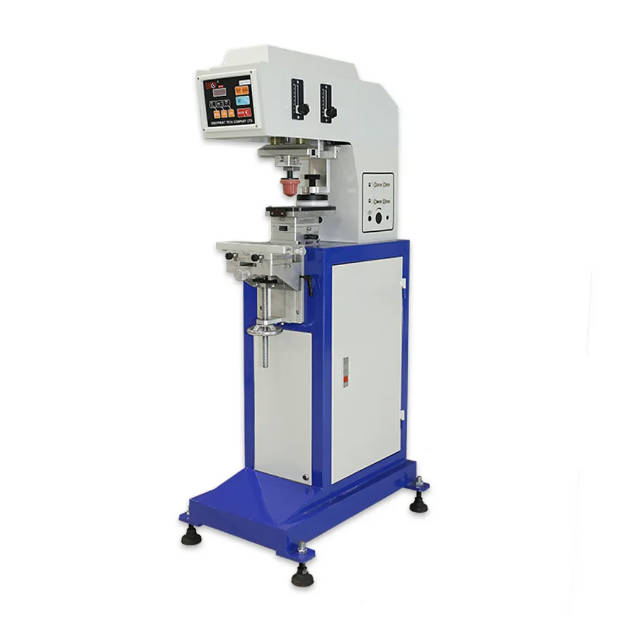
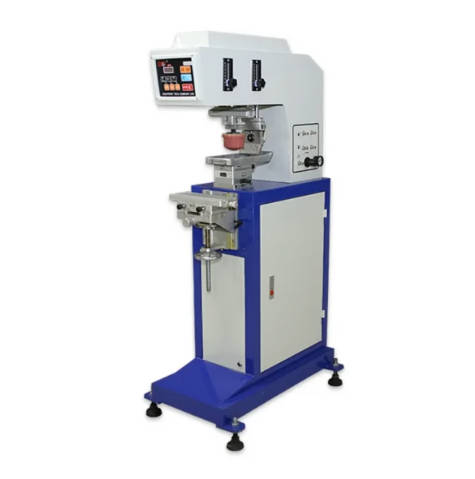
Standard pad printers are pre-engineered, catalog items. They are designed to be “universal,” meaning they can print on a wide variety of parts with minimal modification.
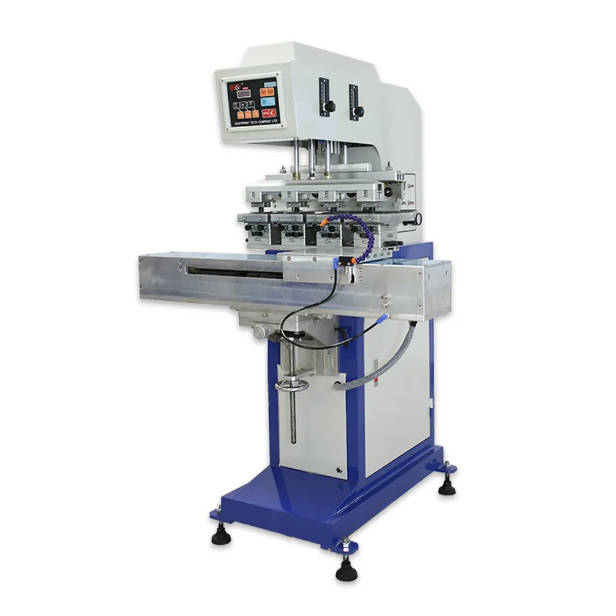
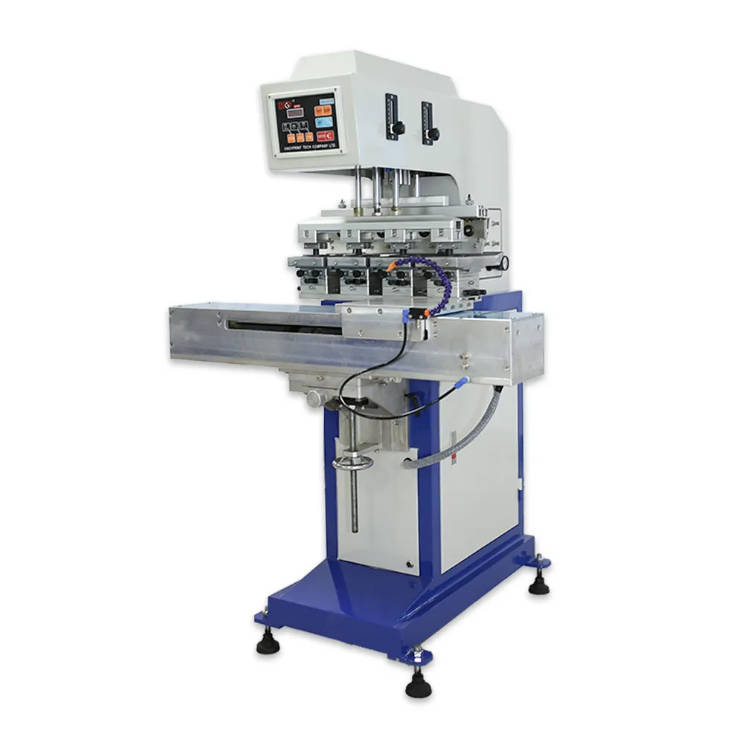
- Configuration: Typically available as 1-color to 6-color standalone units.
- Operation: Semi-automatic. An operator sits in front of the machine, manually loads the part onto a fixture, triggers the print cycle (via foot pedal or sensor), and manually unloads the part.
- Key Features: Adjustable work tables, standard sealed ink cup sizes (e.g., 60mm, 90mm, 130mm), and user-friendly programmable logic controllers (PLCs).
- Best For: Contract packagers, promotional product companies, and manufacturers with “high mix, low volume” production runs.
Custom Pad Printing Systems (The “Bespoke” Automation)
Custom systems are not just printers; they are integrated manufacturing solutions. These machines are engineered from the ground up (or built around a standard print engine) to handle a specific part or a specific family of parts.
- Configuration: Multi-station systems often integrating rotary tables, linear conveyors, or racetrack shuttles.
- Operation: Fully automated. Parts can be fed via bowl feeders, pick-and-place robots, or linear belts. The machine handles pre-treatment, printing, drying, and vision inspection without human intervention.
- Key Features: Surface activation (Flame/Corona/Plasma), automatic pad cleaning, vision systems for quality control, and auto-eject mechanisms.
- Best For: Automotive components, medical devices, bottle caps, and any scenario requiring “low mix, high volume” output (typically 1+ million parts per year).
III. Factor 1: Cost Analysis (Upfront vs. Total Cost of Ownership)
Cost is invariably the first question, but focusing solely on the sticker price is a novice mistake. To understand the true value, we must analyze the Total Cost of Ownership (TCO) over a 3 to 5-year period.
1. Initial Investment (CapEx)
Standard machines are significantly cheaper upfront. Because engineering costs are amortized over hundreds of units, you are paying primarily for hardware. A standard 2-color pad printer might cost between $5,000 and $15,000 depending on the brand and size.
Custom machines involve Non-Recurring Engineering (NRE) costs. You are paying for a team of mechanical and electrical engineers to design a unique solution. A fully automated system with a rotary table and vision inspection can range from $50,000 to over $200,000.
2. Operational Costs (OpEx) and Labor
This is where the math flips. The hidden cost of standard machines is labor.
- Standard Scenario: If you need to print 500,000 parts per month using standard machines, you might need 3 machines and 3 operators working two shifts. The ongoing salary, benefits, and training for these operators constitute a massive OpEx.
- Custom Scenario: A custom automated system might output those same 500,000 parts with a single machine and one supervisor who only needs to refill ink and clear jams occasionally.
3. ROI Calculation
A custom pad printing machine typically offers a better ROI when production volumes exceed 500,000 to 1 million units annually. While the initial check is larger, the reduction in labor costs often results in the machine paying for itself within 12 to 18 months.
Table 1: Cost Comparison Overview
| Cost Factor | Standard Model | Custom Automated System |
| Initial Purchase Price | Low ($) | High ($$$$) |
| Engineering Costs | Included in price | Charged as NRE |
| Labor Requirement | High (1 operator per machine) | Low (1 operator per line) |
| Throughput Speed | 400 – 1,000 parts/hour | 1,500 – 4,000+ parts/hour |
| Reject Rate | Variable (Human error dependent) | Low (Consistent mechanical precision) |
| Cost Per Part (5 Years) | Higher (due to wages) | Lowest (due to automation) |
Pro Tip: When requesting a quote, ask your supplier to calculate the “Cycle Time” for your specific part. Divide your annual volume by this cycle time to determine how many standard machines (and operators) you would need versus one custom machine.
IV. Factor 2: Lead Time (Speed to Market)
In today’s “Just-in-Time” manufacturing environment, lead time can be a deal-breaker.
Standard Models: The Need for Speed
If you have a contract starting next month, a standard machine is likely your only option.
- Availability: Many manufacturers keep standard 1-color and 2-color sealed cup printers in stock.
- Setup: Once delivered, a standard machine can be up and running in 1-2 days, requiring only fixture fabrication and plate making.
- Typical Lead Time: 1 to 4 weeks.
Custom Machines: The Engineering Lifecycle
Custom automation cannot be rushed without risking reliability. The timeline includes:
- Design & Approval: 2-4 weeks.
- Parts Fabrication: 4-8 weeks.
- Assembly & Wiring: 2-4 weeks.
- Programming & Testing: 2-4 weeks.
- Factory Acceptance Testing (FAT): 1 week.
Custom pad printing projects typically require a lead time of 12 to 24 weeks.
The Trade-off
If your product launch is immediate, you may need to start production with a standard machine (or outsource to a contract printer) while your custom machine is being built. This “bridge production” strategy allows you to hit market dates while still working toward long-term automation goals.
V. Factor 3: Flexibility and Technical Capabilities
Flexibility refers to how easily a machine can switch between different products or adapt to complex part geometries.
Part Geometry & Fixturing
Standard machines struggle with complex geometries. If a part requires printing on a 90-degree slope, or on three different sides simultaneously, a standard machine requires the operator to manually rotate the part for each impression. This destroys cycle time and introduces registration errors.
Custom machines are purpose-built for geometry. They utilize servo-controlled fixtures that can rotate the part 360 degrees or articulate it to present different faces to the print pads. Custom systems are the only viable solution for 360-degree cylindrical printing or multi-sided marking in a single pass.
Changeovers and Job Switching
Here, the standard machine wins.
- Standard: Changing from printing a golf ball to a sunglasses temple is simple. You swap the fixture, change the cliché plate, and adjust the pad position. Total time: 15–30 minutes.
- Custom: A machine designed with a specific bowl feeder and custom nesting for a specific automotive switch is dedicated to that switch. Retrofitting it to run a completely different product is expensive and time-consuming.
Process Integration
Custom machines allow for the integration of pre- and post-print processes that ensure ink adhesion and durability.
- Pre-treatment: Materials like Polypropylene (PP) and Polyethylene (PE) have low surface energy and require flame or corona treatment before printing. In a custom line, this station is inline. In a standard setup, the operator must manually flame the part before loading it, adding danger and inconsistency.
- Vision Inspection: Custom lines can automatically reject parts with smudged logos or missing prints using cameras. Standard machines rely on the operator’s tired eyes.
VI. Decision Matrix: Which Should You Choose?
To simplify the decision, apply your production data to this matrix.
Choose a Standard Model If:
- Volume is Low to Medium: Under 100,000 parts per year.
- High Mix: You print on 10 different products per week.
- Budget is Tight: You have limited CapEx availability.
- Space is Limited: You need a compact tabletop or stand-alone unit.
- Time is Critical: You need to be printing within 30 days.
Choose a Custom Automated System If:
- Volume is High: Over 500,000 to 1 million parts per year.
- Precision is Critical: You need tolerance within +/- 0.05mm (common in medical/electronics).
- Complex Process: You need flame treatment, printing, and UV curing in one cycle.
- Labor is Scarce: You cannot find or retain reliable machine operators.
- Safety is Priority: You want to minimize human interaction with hazardous inks and solvents.
Ultimately, automation is not an expense; it is a strategy to stabilize production costs.
VII. The “Hybrid” Approach: A Professional Insight
There is a middle ground that savvy manufacturers often overlook: Standard Machines with Custom Automation.
You do not always need to build a machine from scratch. Many equipment suppliers can take a standard 4-color pad printer and mount it over a programmable rotary table or a linear shuttle.
- How it works: You buy the reliability and parts availability of a standard print head, but you add an automated indexing table that allows an operator to load/unload while the machine is printing.
- The Benefit: This increases output by 30-50% compared to a purely manual machine, without the massive price tag and long lead time of a fully custom system. This is often the “sweet spot” for mid-sized manufacturers.
VIII. Conclusion
Choosing between custom and standard pad printing machines is a balancing act between your current budget and your future production goals.
While standard models offer an attractive entry price and flexibility for job shops, they often become money pits in high-volume environments due to labor costs. Custom systems require patience and capital, but they deliver the lowest cost-per-print and highest quality consistency over the machine’s lifespan.
Key Takeaway: Do not buy a machine based on the price of the hardware. Buy the machine based on the cost of the printed part over five years.
Before signing a purchase order, consult with an application engineer. Ask for a cycle time simulation and a sample print test. Seeing your part run on a standard vs. automated setup is often the only way to truly visualize the ROI.