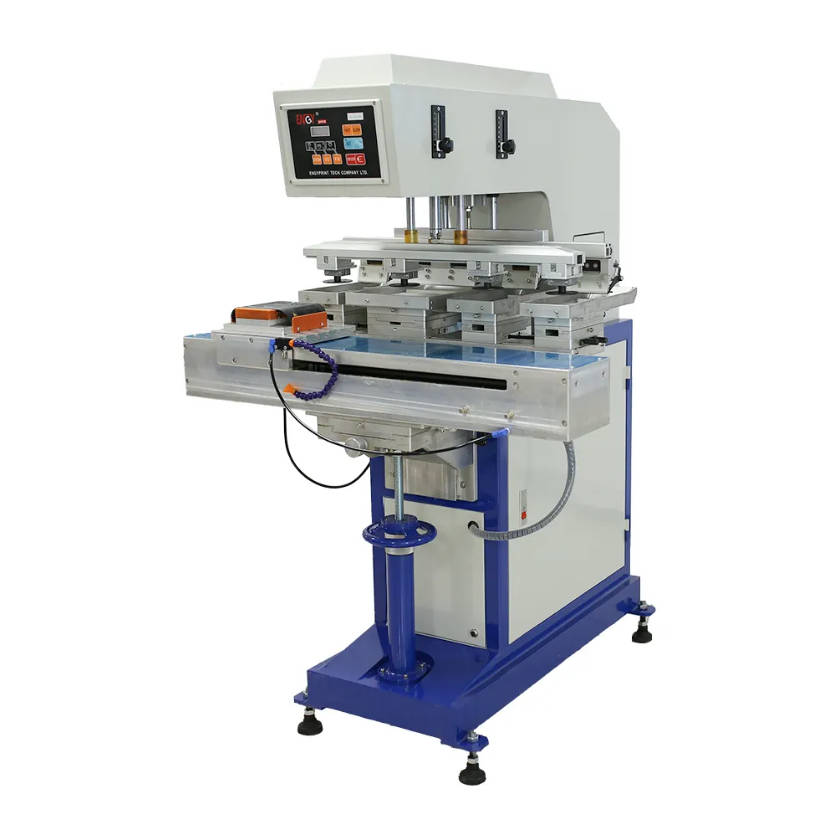
In the world of industrial manufacturing, precision is not just a preference—it is a requirement. Whether you are branding medical devices, marking automotive components, or detailing electronic interfaces, the question of “how accurate” a machine is often determines the success of the entire production line.
Pad printing accuracy is defined by its ability to transfer an image with high fidelity and repeatable registration; standard industrial pad printing machines typically achieve tolerances between $\pm 0.05mm$ and $\pm 0.1mm$, while high-precision servo-driven systems can reach tolerances as tight as $\pm 0.02mm$.
This guide provides a deep dive into the mechanical, chemical, and environmental factors that define pad printing tolerances, helping you choose the right pad printing machine for your specific application.
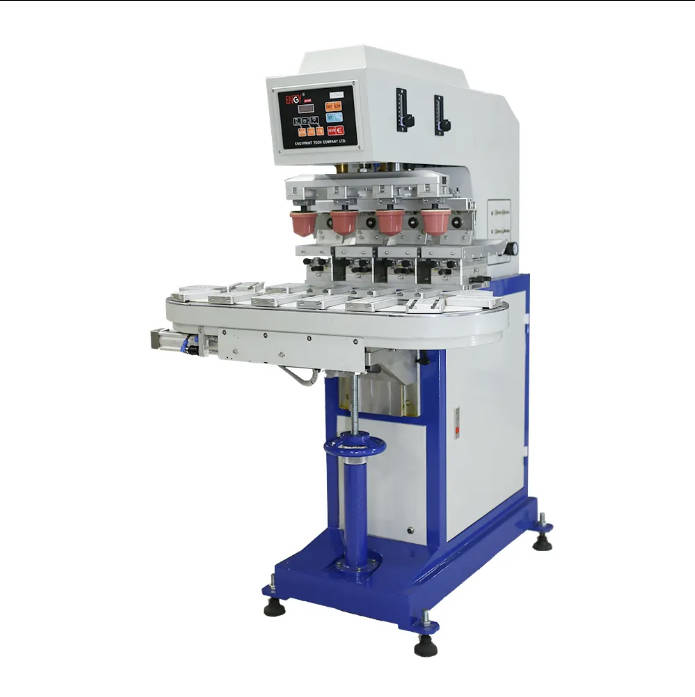
I. Introduction to Precision in Pad Printing
For decades, pad printing (also known as tampography) has been the “go-to” solution for printing on irregular, curved, or recessed surfaces. Unlike screen printing, which requires a flat or cylindrical surface, pad printing utilizes a flexible silicone pad to “wrap” around complex geometries.
However, this flexibility introduces variables. In high-stakes industries like medical manufacturing, a shift of even $0.1mm$ on a syringe scale can have critical consequences. Therefore, understanding the limits and possibilities of pad printing tolerances is essential for quality control and equipment ROI.
II. Understanding Pad Printing Tolerances
When discussing accuracy, we must differentiate between Registration Accuracy (where the image lands) and Image Fidelity (how much the image distorts).
Standard vs. High-Precision Benchmarks
Most manufacturers categorize accuracy based on the drive system of the machine. Below is a breakdown of what you can expect from different classes of equipment:
Table 1: Accuracy Comparison by Machine Type
| Machine Type | Typical X/Y Tolerance | Repeatability | Best Use Case |
| Manual Machines | $\pm 0.20mm$ | Low | Prototyping, small hobbyist runs |
| Pneumatic Machines | $\pm 0.10mm$ | Medium | General promotional items, toys |
| Motor/Cam Driven | $\pm 0.05mm$ | High | Automotive parts, appliances |
| Servo-Driven Systems | $\pm 0.02mm$ | Ultra-High | Medical devices, micro-electronics |
The key to achieving tight tolerances in pad printing lies in the “Repeatability” of the machine, ensuring that every cycle follows the exact same mechanical path without deviation.
III. Key Factors That Influence Printing Precision
Achieving a tolerance of $\pm 0.05mm$ requires more than just a good machine. It requires a synergy between hardware, consumables, and setup.
1. Machine Build and Drive Systems
The “skeleton” of the machine must be rigid. High-quality pad printing machines use heavy-duty cast iron or reinforced aluminum frames to dampen vibrations.
- Pneumatic Drives: Rely on air pressure. While cost-effective, they can be affected by fluctuations in air supply.
- Servo Drives: Use electronic encoders to track position. Servo-driven pad printing machines are superior for accuracy because they allow for independent control over the speed and depth of the pad stroke with micron-level precision.
2. The Cliché (Printing Plate)
The cliché holds the etched image. The material and etching quality are paramount.
- Steel Plates: Offer the highest precision and longevity (up to 1 million impressions).
- Photopolymer Plates: Great for short runs, but can slightly swell if exposed to harsh solvents, affecting the image sharpess.
- Etch Depth: Standard depth is usually $25 \mu m$. If the etch is too deep, ink “slumps,” causing blurred edges.
3. Silicone Pad Characteristics
The pad is the “vehicle” for the ink. Its hardness (measured in Durometer) significantly impacts distortion.
Table 2: Pad Durometer and Its Effect on Accuracy
| Pad Hardness (Shore 00) | Distortion Level | Best For | Accuracy Impact |
| Soft (30-40) | High | Highly curved surfaces | Can cause image stretching |
| Medium (50-60) | Moderate | Most industrial parts | Balanced precision |
| Hard (70+ ) | Low | Flat or slightly curved surfaces | Highest fidelity; requires high pressure |
4. Fixturing and Tooling
You cannot print accurately on a moving target. The fixture (or jig) must hold the part with zero “play” or movement; even a $0.05mm$ vibration during the pad strike will double the effective tolerance error.
IV. Environmental and Material Variables
Precision is often compromised by factors outside the machine itself.
- Ink Rheology: Ink viscosity changes with temperature. If the room is too hot, the solvent evaporates faster, the ink becomes “tacky,” and the image may “feather” or “string,” ruining the tolerance.
- Static Electricity: Plastic parts often carry a static charge that “pulls” ink droplets away from the pad before contact. This creates a “halo” effect around the printed image.
- Humidity: High humidity can prevent ink from drying at the correct rate, leading to registration shifts in multi-color jobs.
V. Advanced Technologies for Ultra-Tight Tolerances
To meet the demands of Industry 4.0, modern pad printing machines incorporate “smart” features to maintain accuracy.
CCD Vision Systems
Automated vision systems act as a “second set of eyes.” They scan the part before printing to calculate its exact coordinates. If the part is slightly misaligned in the fixture, the machine’s servo motors automatically adjust the X, Y, and R (rotational) axes to compensate.
Linear Servo Shuttles
In multi-color printing, the part must move from station to station. Traditional rotary tables have mechanical “backlash.” Linear servo shuttles eliminate mechanical play, allowing for multi-color registration accuracy within $\pm 0.03mm$ across four or more colors.
VI. FAQ: Addressing Common Buyer Concerns
Q1: Can pad printing achieve the same accuracy as CNC machining?
While CNC machining can reach $\pm 0.005mm$, pad printing is a “soft” process involving flexible silicone and liquid ink. However, for a decorative or marking process, $\pm 0.02mm$ is the practical ceiling for pad printing accuracy under controlled conditions.
Q2: How does pad wear affect accuracy?
As a silicone pad wears down, its surface tension changes. It may start to “flatten” more than usual under the same pressure, leading to image growth (distortion). High-precision jobs require regular pad replacement schedules.
Q3: What is the “Rule of Thumb” for curved surfaces?
For curved parts, the print area should not exceed 120 degrees of the part’s circumference to maintain acceptable distortion levels. Beyond this, a “roll-printing” attachment or a multi-pad system is required to maintain accuracy.
VII. Pro Tips for Maintaining Accuracy in Production
- Climate Control: Keep your printing room at a constant $22^\circ C$ ($72^\circ F$) and $50\%$ humidity.
- Use Thinner Carefully: Use a digital scale to mix ink and solvent by weight, not volume, to ensure consistent viscosity.
- Invest in Quality Clichés: Laser-etched ceramic or high-grade steel plates provide the most consistent ink release.
- Daily Calibration: Before starting a shift, run a “dry cycle” to ensure all mechanical stops and servo positions are homed correctly.
VIII. Conclusion: Choosing the Right Machine
When searching for a pad printing machine, do not just look at the price tag. Look at the Tolerance Specifications. If your project requires high repeatability and multi-color precision, investing in a servo-driven system with a rigid frame is the only way to guarantee quality.
Ultimately, pad printing accuracy is a combination of machine stability, precise fixture design, and environmental control; when these factors are optimized, pad printing remains the most versatile and precise method for 3D part marking.